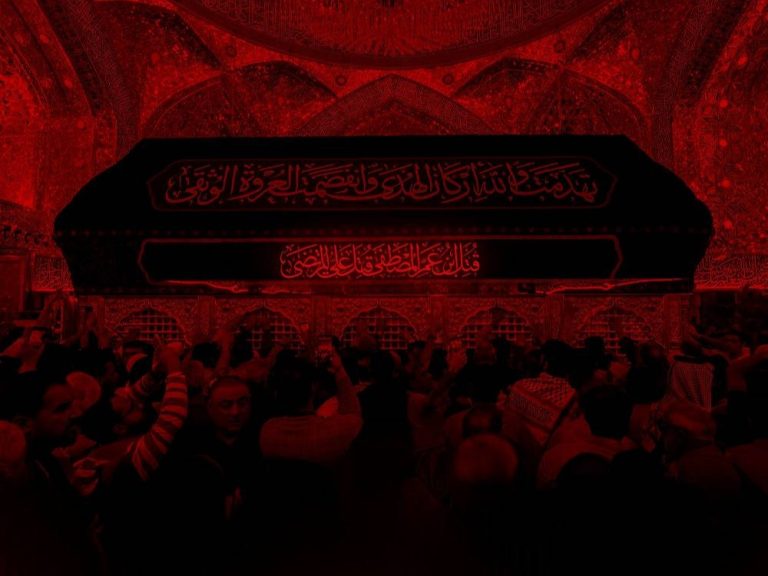

Imam Ali, peace be upon him, instructed his family that his noble grave should remain hidden and concealed, lest his enemies, driven by rancor and malice, attempt to exhume it.
Imam Ali, peace be upon him, thus commanded his household that after his passing and burial, the location of his blessed grave should not be disclosed. This concealment was due to the plots and enmity of his adversaries, who otherwise would have desecrated it.
Imam Jafar al-Sadiq, peace be upon him, when asked by his companion Safwan al-Jammal why the grave of the Commander of the Faithful had been kept hidden, replied,
“For protection against the hostility of the Umayyads and the Khawarij and their deep-rooted malice.”
Shaikh Jafar Al-Mahbuba, quoting from the book “Muntakhab al-Tawarikh,” relates that al-Hajjaj ibn Yusuf al-Thaqafi excavated three thousand graves in Najaf, hoping to uncover the resting place of Imam Ali, peace be upon him.
“Ibn Tawus explains the concealment of the grave as follows: “The Imam (peace be upon him) commanded that his burial be kept secret, so that the enmity and schemes of the Umayyads, the Khawarij, and their followers would not lead to its desecration. The “Banu Hashim” were fully aware of the rancor these factions bore towards the Imam (peace be upon him), for he had confronted them during his lifetime. How then could he not secure himself against their malice after his martyrdom? Indeed, in the concealment of that grave were countless benefits.”
The exact location of the noble grave thus remained unknown in Najaf city, known only to the Imam’s sons (peace be upon them) and some Shiite followers, in accordance with his testament. It stayed hidden until the downfall of the Umayyad dynasty in 132 AH / 749 CE and the establishment of the Abbasid state.
When the obstacles had been removed, Imam Jafar al-Sadiq, peace be upon him, revealed the location of the sacred grave, instructed his followers to visit it, and ordered that a shrine be built over it. This occurred when the Imam came to Iraq at the invitation of the first Abbasid Caliph, Abu al-Abbas al-Saffah, with whom he met in al-Hira.
Shaikh al-Mufid states:
“The noble grave remained concealed until the time of Imam Jafar al-Sadiq (peace be upon him) during the Abbasid rule, when he unveiled it.”
He (peace be upon him) adds,
“When I was in al-Hira with Abu al-Abbas, I went by night toward Najaf to the grave of the Commander of the Faithful (peace be upon him) at Ghar al-Numan. There I performed the night prayer and returned before dawn.”
Imam al-Sadiq’s visits to the grave of his grandfather, the Master of the Successors, continued during the reign of the Abbasid Caliph Jafar al-Mansur. On one such occasion, the Imam (peace be upon him) entrusted Safwan al-Jammal with funds to renovate the shrine. Safwan asked permission to inform fellow believers in Kufa about the grave’s location, and the Imam (peace be upon him) granted it. Safwan then restored the site.
Unfortunately, some later historians, ancient and modern alike, misrepresented the narratives concerning the grave of Imam Ali, peace be upon him, neglecting careful scrutiny. Some erroneously claimed that Harun al-Rashid was the first to disclose the grave in 170 AH / 786 CE or 175 AH / 791 CE, linking it to a hunting incident near Najaf, while disregarding the clear evidence that Imam al-Sadiq, peace be upon him, had already revealed and sanctified the site in 132 AH, building a shrine and enjoining visitation. How could this sacred unveiling be attributed instead to an Abbasid ruler notorious for his hostility to the Ahl al-Bayt, who persecuted the Shia and imprisoned Imam Musa al-Kazim, peace be upon him, until he was poisoned?
Shaikh al-Mufid, in al-Irshad, recounts the famous narrative:
“Muhammad ibn Zakariya narrated from Abdullah ibn Muhammad, from Ibn Aisha, from Abdullah ibn Hazim: Once I accompanied al-Rashid on a hunting trip outside Kufa toward al-Ghariyyayn and al-Thawiyya. We spotted a gazelle and unleashed hounds and falcons after it. The animal ran until it reached a hill, where suddenly the falcons retreated and the hounds drew back. This was repeated three times. Al-Rashid, astonished, ordered that whoever was found nearby be brought. An old man from the Banu Asad was presented. Al-Rashid demanded to know the secret of that hill. The man sought amnesty, which the caliph pledged. Then he said, “My forefathers have handed down that this is the grave of Ali ibn Abi Talib, peace be upon him, which God has made a sanctuary where any who seek refuge are granted safety.”
The claim that Harun built a structure over the grave is highly questionable. Ibn Tawus transmits a report attributed to Ibn Tahhal, stating, “Harun ordered a small dome of white brick to be built over the grave. When the tomb was later uncovered, it was found enclosed by clay and mortar. Harun then ordered a clay dome with a green plaster coating, remains of which are still preserved.”
In the margins of Farhat al-Ghari by Shaikh Muhammad Mahdi Najaf, it is noted that in one manuscript the term “Hibra” is used.
Dr. Salah al-Fartusi, in his study The Shrine and Tomb of Imam Ali, questions the authenticity of the Harun narrative. He argues, “Ibn Tahhal’s report is without chain or credible source. The structure later known with a white dome is in fact the building of Adud al-Dawla, constructed between the third and sixth centuries. No reliable evidence attributes any significant edifice to Harun.”
Al-Damiri, in Hayat al-Hayawan al-Kubra, quoting Ibn Khallikan, asserts that Harun merely placed stones around the grave, with no mention of a dome. He writes, “Al-Rashid ordered the grave to be encircled with stone. This may have formed the first foundation, upon which subsequent dynasties—including the Samanids, Hamdanids, Buyids, and others—built further structures.”
Moreover, the claim that Harun constructed a dome is undermined by historical fact: in his era, domes over graves were not customary. It is well-known that the first dome in Iraq was built over the grave of al-Muntasir billah ibn al-Mutawakkil, who died in 248 AH / 862 CE in Samarra. Dr. Suad Mahir notes, “The mother of al-Muntasir, of Greek origin, insisted that a shrine be built over his grave away from the palace. This dome was known as Qubbat al-Sulaybiyya.”