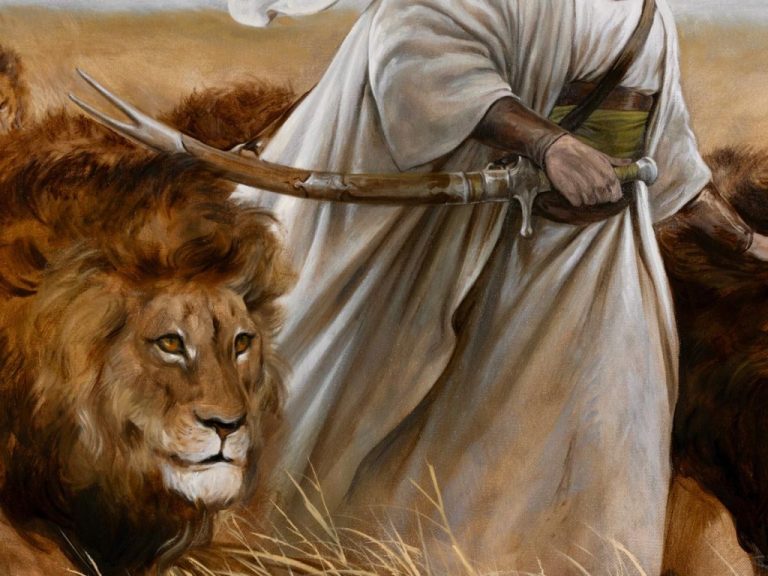

The worship of Imam Ali (peace be upon him), like every other aspect of his noble character, was unique to him. His spiritual state that He (peace be upon him) sees no one but Allah— absolute turning toward God and detachment from everything else — became one of his most renowned qualities. After the Holy Prophet (peace be upon him and his family), no man was ever known who embodied as many virtues and noble morals as the Commander of the Faithful, peace be upon him. His merits surpassed the first and left the last unable to attain them. His perfections are too many to be numbered, and his virtues beyond measure.
The ethics of Imam Ali (peace be upon him) were a radiant reflection of the Prophet’s own noble example. He was raised in the Prophet’s household, nurtured at his table, and trained in the highest manners of divine conduct. The Messenger of God (peace be upon him and his family) instructed him throughout his youth in the most exalted ways of worship and virtue, and those qualities only grew stronger and more resplendent with time.
His Devotion in Prayer and Supplication
ʿUrwah ibn Zubayr narrates from Abu al-Dardaʾ:
“I once saw Ali ibn Abi Talib (peace be upon him) in a grove of palm trees, having distanced himself from his companions. Suddenly, I heard a sorrowful, trembling voice supplicating to God:
‘My God, how many sins have You seen in me yet did not punish me for them!
How many wrongs have I committed which You, through Your mercy, concealed!
O my God, if my life has been spent in disobedience to You, and my sins have weighed heavily upon my record, I still hope for nothing but Your forgiveness, and I desire nothing but Your pleasure.’
The sound of his lamentation drew me closer. I watched as he prayed deep into the night, bowing, weeping, and imploring his Lord. I heard him say:
‘O God, when I reflect upon Your mercy, my sins seem small;
yet when I remember Your justice, my trials seem immense.
Woe to me if I am called to account for a sin I have forgotten,
while You have recorded it, and the command comes: “Seize him!”
Alas for that day when no kin can aid, and no tribe can save!’
Then he cried out:
‘Ah! for the fire that burns the heart and liver!
Ah! for the flames prepared for my destruction!
Ah! for the cries and struggles amidst the blaze!’
He wept until he fell unconscious, motionless as a piece of dry wood. I thought he had passed away. I hurried to his house and informed Lady Fatima al-Zahra (peace be upon her). She said calmly, ‘By God, this is the state that overtakes him in awe of his Lord.’ She brought water, sprinkled it upon his face, and he awoke.
When he saw me in tears, he said, ‘O Abu al-Dardaʾ, why do you weep?’
I replied, ‘For what you bring upon yourself in worship.’
He said, ‘O Abu al-Dardaʾ, how will it be when I stand before my Lord, when the sinners are held to account, when loved ones turn away and none can conceal anything from the Almighty?’
Abu al-Dardaʾ concluded: ‘By God, I never saw any companion of the Prophet in a state like his.’”
The Gratitude of Imam Ali (Peace Be Upon Him)
The spirit of Imam Ali (peace be upon him) was wholly illuminated by the presence of God. His worship was not born of fear of punishment nor of longing for paradise; it was born of pure love and recognition of God’s worthiness of worship.
He expressed the nature of this relationship in his famous words:
“My God, I did not worship You out of fear of Your punishment, nor out of desire for Your reward — but because I found You worthy of worship.”
Such worship transcends mere faith; it is the highest form of certainty and the purest expression of gratitude. Imam Ali (peace be upon him) also said:
“Some worship God out of desire — that is the worship of merchants.
Some worship Him out of fear — that is the worship of slaves.
But some worship Him out of gratitude — and that is the worship of the free.”
This was the worship of Imam Ali (peace be upon him) — worship born of love, gratitude, and recognition of the Divine Majesty. Truly, as the Prophet (peace be upon him and his family) said:
“If all the reeds were pens, and all the seas were ink,
and the jinn were accountants and mankind were scribes,
they could never enumerate the virtues of Ali ibn Abi Talib.”