
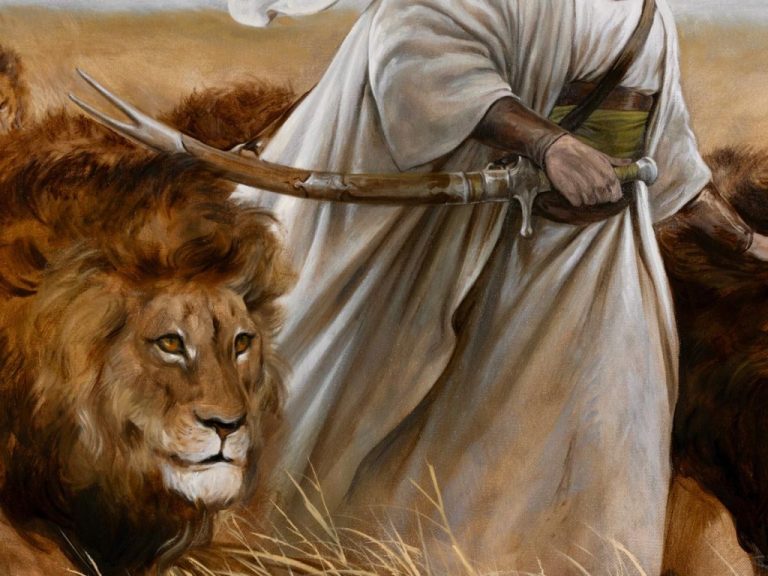
While individual reports vary in wording and transmission, together they form a coherent portrait of a man whose courage shaped pivotal moments in the Prophet Muhammad (peace be upon him and his family) era and beyond.
A Singular Courage, Visible and Decisive
No two men equaled Imam Ali (peace be upon him) in courage. His conduct in battle and his resolute posture in moments of crisis provide enduring testimony to that fact. He was not merely a warrior in the physical sense; he was also an instructor of martial skills, a leader who embodied calm resolve amid chaos.
One of the clearest demonstrations of his dauntless spirit took place during the Prophet’s migration from Makkah to Madinah. As the community sharpened weapons and plotted, Imam Ali (peace be upon him) slept in the Prophet Muhammad’s bed to protect him. When assailants—encouraged by Abu Jahl—pelted the house with heavy stones, Imam Ali (peace be upon him) startled them by rising and demanding, “Who are you?” The assailants immediately recognized him and recounted their fury at losing their intended victim. Abu Jahl, pointing at Imam Ali (peace be upon him), taunted the mob: if Muhammad (peace be upon him and his family) had been left behind he would now be dead; but he blamed Muhammad’s survival on some unknown divine protection. Imam Ali (peace be upon him) answered with composure and fierce dignity, rejecting Abu Jahl’s taunt and affirming that his faculties and strength were gifts from God. He declared that, had the Prophet (peace be upon him and his family) not commanded restraint until the migration was complete, he would have avenged the insult and demonstrated his own capability.
Confrontation and the Appearance of Might
The traditions portray scenes of overwhelming spiritual and physical presence. On one account, when Abu Bakhtari ibn Hisham raised his sword against Imam Ali (peace be upon him), terrifying phenomena seemed to assail the attacker: the mountains appeared to collapse, the ground to split, waves to surge, and the sky to press down. The would-be assailant’s sword fell from his hand and he fainted. Abu Jahl later described a whirling vortex about Imam Ali (peace be upon him) that disoriented those who approached. Such narrative elements emphasize the awe and fear Imam Ali (peace be upon him) inspired in his contemporaries—both through his martial prowess and through a presence that witnesses perceived as superlatively formidable.
Valor at Uhud and Other Fields
In another narration, Shaqiq ibn Salamah recounts:
“I was walking beside ʿUmar ibn al-Khattab when I heard him whisper to himself. I asked, ‘What troubles you, ʿUmar?’ He replied, ‘Woe to you! Do you not see that roaring lion, that warrior born of battle? The one who, with two swords and a banner in hand, charges fiercely against the corrupt and the rebellious?’”Shaqiq ibn Sulaym recounted observing Imam Ali (peace be upon him) amid the dust and turmoil of fighting, likening him to a roaring lion. In one instance during the Battle of Uhud, vast enemy formations pressed upon the Muslim ranks. Imam Ali (peace be upon him), standing like a lion in the maelstrom, scooped handfuls of dust and cast them into the faces of the attackers, then charged with a broad sword whose every strike seemed to exact death itself. Observers recalled his eyes shining like twin lamps and the blood of enemies seeming to glisten in their depths. The shock he inflicted was so great that fear lingered long in witnesses’ hearts.
A Claim of Divine Endowment
In a letter to Sahl ibn Hunayf, Imam Ali (peace be upon him) framed his feats not as mere physical triumphs but as actions enabled by a transcendent power. He wrote that he did not dislodge the gate of Khaiber by ordinary muscle or appetite; rather, he (peace be upon him) moved it by a celestial, spiritual might deriving from the radiant power of God. He (peace be upon him) described himself as a ray of light associated with the Prophet Muhammad (peace be upon him and his family) and declared that, even if the entire Arab world united against him, he would stand unshaken.
Conclusion
Accounts of Imam Ali’s courage combine concrete battlefield exploits with an awareness of a metaphysical dimension that many early witnesses perceived in him. Whether described as natural prowess, spiritual endowment, or both, his courage shaped critical events of the formative Islamic period. For visitors of the Imam Ali Holy Shrine and readers worldwide, these narratives convey a consistent message: Imam Ali (peace be upon him) embodied courage that was as moral as it was martial, as illumining as it was forceful. His example remains a perennial guide to steadfastness, principle, and sacrifice.


