Jafar ibn Abi Talib, known as Jafar al-Tayyar, gave his life at the Battle of Mutah so that Islam would not be left without support against the storms of ignorance. His martyrdom, as a mighty arm of prophethood and a comrade-in-arms of wilayah, left a great void in the army of Islam. It struck a wound in the hearts of the Seal of the Prophets and Amir al-Muminin (peace be upon him).
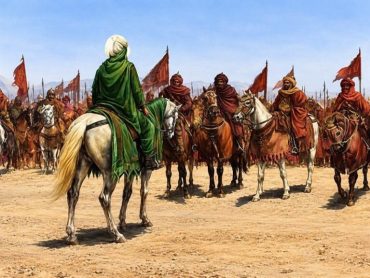
In the month of Jumada al-Awwal in the 8th year AH, the Prophet (peace be upon him and his family) sent an army of three thousand, under the command of Jafar ibn Abi Talib (peace be upon him), to the battlefield. In this great campaign, Jafar ibn Abi Talib (peace be upon him), the brother and valiant arm of Amir al-Muminin (peace be upon him), wrote an immortal epic through his self-sacrifice.
Resembling the Prophet
Jafar ibn Abi Talib (peace be upon him) was, in physical form and character, the person most like the Messenger of Allah (peace be upon him and his family). Jafar was ten years older than Amir al-Muminin (peace be upon him), Aqil was ten years older than Jafar, and Talib was ten years older than Aqil. [1]
The Standing of Jafar al-Tayyar
By the testimony of the Messenger of Allah (peace be upon him and his family), Jafar ibn Abi Talib (peace be upon him) was the person most like him and one of the masters of Paradise. In the words of Amir al-Muminin (peace be upon him), he also holds an unparalleled place in the House of Prophethood.
Amir al-Muminin (peace be upon him) said:
“Allah created seven of us, the Ahl al-Bayt, who have no equal across the entire earth: the Messenger of Allah (peace be upon him and his family), the master of the first and the last and the Seal of the Prophets; his successor, who is the best of successors; his two grandsons, al-Hasan and al-Hussain (peace be upon them both), who are the best of grandsons; Hamzah (peace be upon him), master of the martyrs, who is his uncle; Jafar (peace be upon him), who flies with the angels; and the Qaim (may Allah hasten his noble reappearance).” [2]
The moral virtues and personal character of Jafar ibn Abi Talib (peace be upon him) reflected the lofty conduct of the Messenger of Allah (peace be upon him and his family). Amir al-Muminin (peace be upon him) relates that the Messenger of Allah (peace be upon him and his family) said to Jafar ibn Abi Talib (peace be upon him):
“O Jafar, in physical form and character, you are the person most like me.” [3]
In the words of the Prophet (peace be upon him and his family), the House of Abd al-Muttalib holds a special place in Paradise, which points to the loftiness of their ranks. The Messenger of Allah (peace be upon him and his family) said in this regard:
“We, the House of Abd al-Muttalib, are the masters of the people of Paradise: the Messenger of Allah (peace be upon him and his family), Hamzah (peace be upon him), master of the martyrs, Jafar (peace be upon him), the possessor of two wings, Amir al-Muminin (peace be upon him), Fatimah (peace be upon her), al-Hasan (peace be upon him), al-Hussain (peace be upon him), and al-Mahdi (may Allah hasten his noble reappearance).” [4]
A Gift from the Seal of the Prophets
In welcoming Jafar ibn Abi Talib (peace be upon him), the Messenger of Allah (peace be upon him and his family) showed his boundless affection for this fighter on the path of truth.
Jafar was among the first emigrants to migrate to Abyssinia. He and his companions returned from Abyssinia in the 7th year AH. The Prophet (peace be upon him and his family) set aside a house for him beside the mosque. [5]
Imam al-Sadiq (peace be upon him) said:
“When Jafar ibn Abi Talib (peace be upon him) returned from Abyssinia, the Prophet (peace be upon him and his family) had just conquered Khaybar. When Jafar (peace be upon him) entered his presence, the Prophet (peace be upon him and his family) rose in his honor, went to welcome him, and kissed him between the eyes. Then he said: ‘I do not know which of the two makes me happier: the conquest of Khaybar or the coming of Jafar (peace be upon him).’
Then he said: ‘O Jafar, shall I not grant you a gift and let you benefit from it?’
Jafar (peace be upon him) replied: ‘Yes, O Messenger of Allah (peace be upon him and his family).’
The Prophet (peace be upon him and his family) said: ‘Perform four rakahs of prayer every day; and if you are unable to do so, once a week; and if you cannot, once a month; and if you cannot do even that, once a year; and if that too is beyond your ability, perform it once in your lifetime. For if you perform this prayer, Allah will forgive your sins, even if they are as many as the grains of sand in the desert or the foam of the sea.’
Then it was said: ‘O Messenger of Allah (peace be upon him and his family)! Will whoever performs this prayer have the same reward that Jafar has?’ The Prophet (peace be upon him and his family) said: ‘Yes.’” [6]
Commander of the Epic of Mutah
Jafar ibn Abi Talib (peace be upon him), who by the testimony of the Messenger of Allah (peace be upon him and his family) is among the masters of Paradise, turned the expedition of Mutah in Jumada al-Awwal of the 8th year AH into an eternal symbol of steadfastness on the path of truth. It also manifested his exalted standing with Amir al-Muminin (peace be upon him).
The expedition of Mutah took place in the month of Jumada al-Awwal in the 8th year AH. The story began when the Messenger of Allah (peace be upon him and his family) sent a letter, through Harith ibn Umayr al-Azdi of the Banu Lahab clan, to the king of Busra. When Harith reached Mutah, Shurahbil ibn Amr al-Ghassani confronted him and killed him. Harith was the only envoy in the history of the Messenger of Allah’s mission to be killed in this manner. This incident weighed heavily on the Prophet’s heart (peace be upon him and his family), and he therefore issued a general call to arms. The Muslims prepared quickly, and an army of three thousand encamped at al-Jurf. [7]
Aban ibn Uthman, a companion of Imam al-Sadiq and Imam al-Kadhim (peace be upon them both), narrates from Imam al-Sadiq (peace be upon him):
“The Prophet (peace be upon him and his family) dispatched a great army and entrusted its command to Jafar ibn Abi Talib (peace be upon him), the brother of Amir al-Muminin (peace be upon him).” [8]
The Fighter of the Two Wings
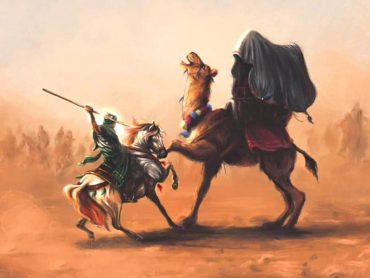
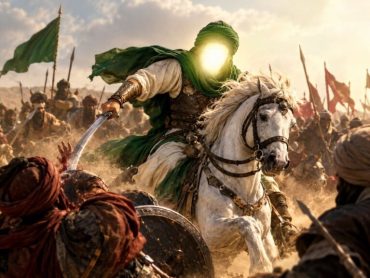
On the battlefield, Jafar ibn Abi Talib (peace be upon him) held the banner with indescribable courage. First his right hand was severed, but he took the banner in his left. When his left hand was severed, this valiant commander did not fall. He clasped the banner in his two arms and held it aloft until the moment of his martyrdom. He was thirty-three years old in this battle, and in recognition of this great sacrifice, Allah granted him two wings in Paradise, with which he may fly wherever he wishes. [9]
The Prophet (peace be upon him and his family) said:
“In place of his two hands, Allah gave him two wings, with which he flies in Paradise.”
For this reason he is called “Jafar Dhu al-Janahayn,” or “the Possessor of Two Wings.” [10]
The Unseen Account of the Seal of the Prophets
In Medina, the Prophet (peace be upon him and his family) watched the Battle of Mutah unfold moment by moment through divine grace. In this narration, Jabir ibn Abdullah al-Ansari relays his precise account of that event.
Jabir ibn Abdullah al-Ansari, a companion of the Prophet (peace be upon him and his family) and a transmitter of hadith, says:
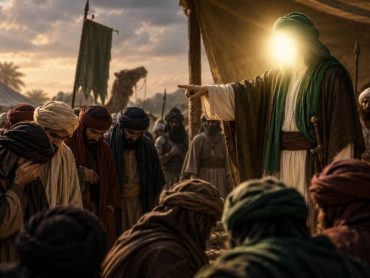
“On the day the Battle of Mutah took place, the Prophet (peace be upon him and his family) led us in the dawn prayer (in Medina), then ascended the pulpit and said: ‘Your brothers have met the polytheists in battle.’ Then the Prophet (peace be upon him and his family) reported the course of the fighting to us moment by moment, until he said: ‘Zayd has been killed and the banner has fallen to the ground; then Jafar ibn Abi Talib took up the banner and charged forward.’ Then he said: ‘Now his hand has been severed, and he took the banner with his other hand; then his other hand was also severed, and he clasped the banner to his chest; now Jafar has been martyred and the banner has fallen to the ground; after him, Abdullah ibn Rawahah took the banner in his hand.’ The Prophet (peace be upon him and his family) even counted the number of slain polytheists and named each of the Muslim martyrs one by one. After finishing his report, the Prophet (peace be upon him and his family) descended from the pulpit, went to Jafar’s house, and took his son Abdullah ibn Jafar in his arms.” [11]
The Loss of Loyal Companions
The martyrdom of two great commanders of Islam, Hamzah (peace be upon him) and Jafar ibn Abi Talib (peace be upon him), was a great wound upon the body of the Ummah, and especially upon Amir al-Muminin (peace be upon him). The loss of these two loyal companions paved the way for his isolation and for the shifting of the caliphate’s course. As the Ahl al-Bayt have explicitly stated, their presence was an unbreakable barrier against the usurpation of the right of wilayah.
During his time as ruler, Amir al-Muminin (peace be upon him) said from the pulpit:
“Beware, by Allah, if Hamzah and Jafar (peace be upon them both) had been alive and present, those two (the first and the second) would not have reached the caliphate, and if Hamzah and Jafar (peace be upon them both) had been witnesses and observers, those two would not have escaped safely.” [12]
Sudayr, one of the Shia narrators and a companion of Imam al-Baqir and Imam al-Sadiq (peace be upon them both), relates:
“We were in the presence of Imam al-Baqir (peace be upon him) when the discussion turned to the events after the Messenger of Allah (peace be upon him and his family) and the manner of Amir al-Muminin’s isolation. At that moment someone asked: ‘Where was the might of Bani Hashim, and where did that great multitude who were among them go?’”
Imam al-Baqir (peace be upon him) said:
“Who was left of Bani Hashim? In truth, only Jafar (peace be upon him) and Hamzah (peace be upon him) had passed away. In those circumstances, only two men remained beside Amir al-Muminin (peace be upon him), who were weak and humbled and had not long since embraced Islam: namely Abbas and Aqil, and both of them were among those freed [after the conquest of Mecca].” [13]
References
[1] Bihar al-Anwar, vol. 22, p. 275
[2] Bihar al-Anwar, vol. 22, p. 275
[3] Bihar al-Anwar, vol. 22, p. 276
[4] Amali al-Saduq, vol. 1, p. 475
[5] Bihar al-Anwar, vol. 22, p. 275
[6] Mustadrak al-Wasail, vol. 6, p. 227
[7] Al-Tabaqat al-Kubra, vol. 2, p. 97; Al-Maghazi by al-Waqidi, vol. 2, p. 755
[8] Alam al-Wara bi-Alam al-Huda, vol. 1, p. 212
[9] Al-Sirah al-Nabawiyyah, vol. 2, p. 378
[10] Bihar al-Anwar, vol. 22, p. 275
[11] Al-Kharaij wa al-Jaraih, vol. 1, p. 166
[12] Kitab Sulaym ibn Qays, vol. 1, p. 16
[13] Bihar al-Anwar, vol. 28, p. 251