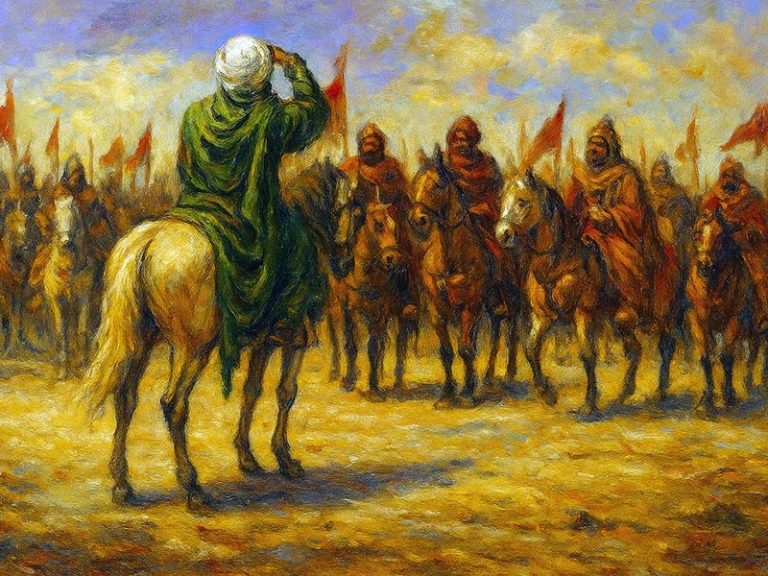
The Commander of the Faithful’s worship was never confined to ritual acts alone; it extended into every sphere of communal life. His example reveals that true piety is not isolation from society, but rather, active service within it.
Balance and Moderation: The Foundation of True Devotion
Imam Ali (peace be upon him) consistently emphasized moderation as a defining principle of faith. Any practice, however noble in essence, when stripped of balance, risks leading to deviation rather than perfection. This truth is especially relevant in seasons of heightened spirituality such as Ramadan month. Excessive focus on ritual to the neglect of ethical or social obligations contradicts the very purpose of worship.
The Imam (peace be upon him) praised those who upheld the divine balance between personal devotion and practical wisdom. He said of those who broke their fasts during travel and shortened their prayers as prescribed by law:
“The best among you are those who, when they travel, perform their prayers in shortened form and break their fasts.”
His words reflect a vision of faith that values understanding, not mere formality—a faith grounded in mercy, not austerity.
Compassion, Kinship, and Social Presence
For Imam Ali (peace be upon him), Ramadan was a time not only for introspection, but for greater connection with others. He gave particular attention to maintaining family ties and visiting his relatives and companions throughout the blessed month.
According to Shaikh al-Mufid, it was the Imam’s custom to visit his children every night during the month of Ramadan, sharing in their prayers and uplifting their spirits with his presence.
The Imam (peace be upon him) also regarded attending communal gatherings and responding to invitations for iftar as acts of high virtue. He would recall the example of the Messenger of God (peace be upon him and his family), who prioritized joining others at the table of breaking fast and accepting their invitations, even above leading prayer. This reflects the deep social harmony and humility that characterized both the Prophet (peace be upon him and his family) and his successor (peace be upon him).
Propagation and Public Duty Amid Worship
The spiritual intensity of Ramadan never diminished Imam Ali’s (peace be upon him) dedication to the broader responsibilities of leadership and religious outreach. His sense of mission remained constant, merging devotion with duty.
One striking example is his journey to Yemen in the tenth year after Hijrah — a journey that occurred during the month of Ramadan. Appointed by the Prophet Muhammad (peace be upon him and his family), Imam Ali (peace be upon him) led a contingent of three hundred men on a dual mission: propagation of Islam and ensuring the safety of those sent to preach, as previous delegations had faced attacks from hostile tribes.
Yemen at that time was home to established Jewish and Christian communities and had long been a center of religious exchange. Imam Ali’s arrival, marked by his wisdom, justice, and eloquence, resulted in a remarkable event: the collective conversion of the Hamdan tribe in a single day.
When news of this reached the Prophet (peace be upon him and his family) , he prostrated in gratitude and wrote a letter blessing the people of Hamdan, sending them greetings of peace three times. This profound success stood in contrast to the earlier mission of Khalid ibn al-Walid, who had not achieved similar results in Yemen. The Imam’s Example: Worship Through Service
Imam Ali’s conduct during Ramadan reminds the faithful that spirituality and social engagement are inseparable. The essence of fasting is not withdrawal from human concerns, but the refinement of one’s capacity to serve others with sincerity and justice.
Through his actions, the Commander of the Faithful (peace be upon him) demonstrated that the true fasting person is not merely one who refrains from food and drink, but one who nourishes society with wisdom, compassion, and steadfast responsibility.
In Imam Ali’s life, Ramadan was not a month of isolation—it was a season of renewal in faith, community, and moral leadership. His example continues to illuminate the path of those who seek to unite devotion with duty, prayer with service, and worship with justice.