From the very beginning of his rule, the Imam (peace be upon him) proclaimed:
“No Arab shall have superiority over a non-Arab, nor a Qurayshi over a non-Qurayshi, except by virtue of righteousness.”
This declaration, revolutionary in spirit and rooted in divine equity, unsettled the privileged elite—among them Talha and al-Zubayr—whose influence waned under the Imam’s just governance. Their resentment festered into conspiracy, and soon the flame of sedition was lit—the Battle of Jamal had begun.
The Spark of Rebellion
When the Imam refused to grant political advantage or material preference to the Qurayshi nobles, Talha and al-Zubayr turned in anger and deceit toward the Umayyads, conspiring to raise arms under the pretense of avenging the death of Uthman ibn Affan. They gathered forces and marched toward Basra, igniting one of the most turbulent civil wars in early Islamic history.
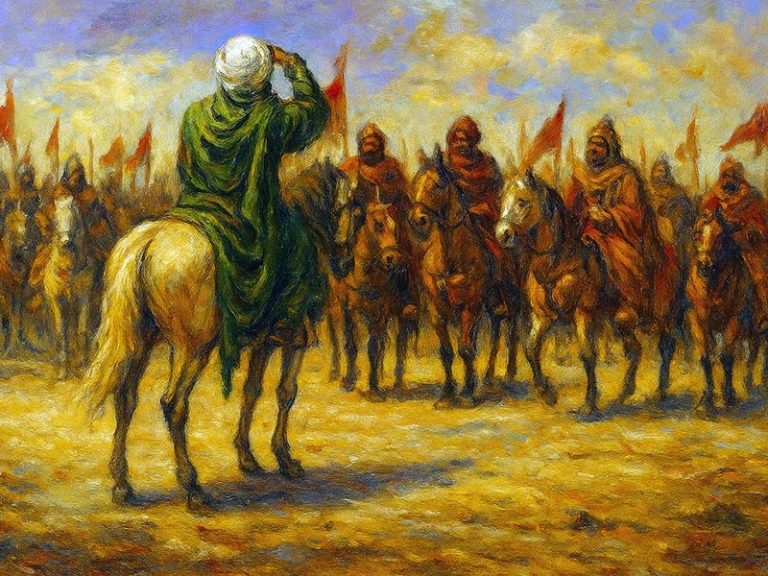
The battlefield was set near the palace of ‘Ubaydullah ibn Ziyad, just outside Basra. The army of Imam Ali (peace be upon him) numbered around 20,000, while the opposing forces gathered 30,000 men.
The Imam’s Ethical Code of Warfare
Before the battle commenced, Imam Ali (peace be upon him) delivered to his companions a timeless instruction that has since stood as a pillar of Islamic military ethics:
“Do not be the first to fight. When you engage them, do not harm the wounded, nor pursue those who flee. Do not strip the slain, nor violate the sanctity of any home. Do not harm women, even if they insult your leaders or speak ill of the righteous among you.”
His guidance reflected the very spirit of the Prophet’s mercy—justice tempered with compassion, even in the crucible of war.
The First Martyr and the Onset of Battle
At dawn, the Imam (peace be upon him) sent Muslim al-Juhani, carrying a copy of the Holy Quran, to invite the opposing camp to divine arbitration. Yet they answered the call of God’s Book with arrows—and the Quran-bearer fell as the first martyr of the day.
Only then did the Imam (peace be upon him) declare:
“O Lord, bear witness.”
He donned the armor and sword of the Messenger of Allah (peace be upon him and his family), raised the Prophet’s black banner known as al-Iqab, and handed it to his valiant son Muhammad ibn al-Hanafiyyah. The battle erupted with an intensity unseen before in Basra’s history.
A Final Appeal to Talha and al-Zubayr
Before combat fully ensued, Imam Ali (peace be upon him) approached Talha and al-Zubayr. The horses of the three men stood so close that their necks touched. The Imam (peace be upon him) said to them:
“You have readied your arms and steeds — would that you had readied a plea before your Lord! Remember God, and be not like the woman who unravels the yarn she herself has spun. Did I not stand beside you as your brother in faith, and you considered my blood inviolable? What has made it lawful for you now?”
Talha replied bitterly, “You incited the people against Uthman.”
The Imam (peace be upon him) answered:
“Their faith demanded justice. And you, O Talha, now seek vengeance for Uthman’s blood? May God curse those who shed it! Tell me — why do you bring the wife of the Prophet (peace be upon him and his family) into battle, while your own wife remains behind the veil?”
Turning to al-Zubayr, he reminded him of the Prophet’s words:
“Do you remember the day we passed by the tribe of Banu Ghanm, and you accused me of pride? The Messenger of Allah said: ‘He does not boast — yet you shall fight against him unjustly.’”
Al-Zubayr trembled and said, “By God, I remember! Had I not forgotten, I would never have marched against you. By God, I will not fight you.”
The Fall of the Camel and the End of the Battle
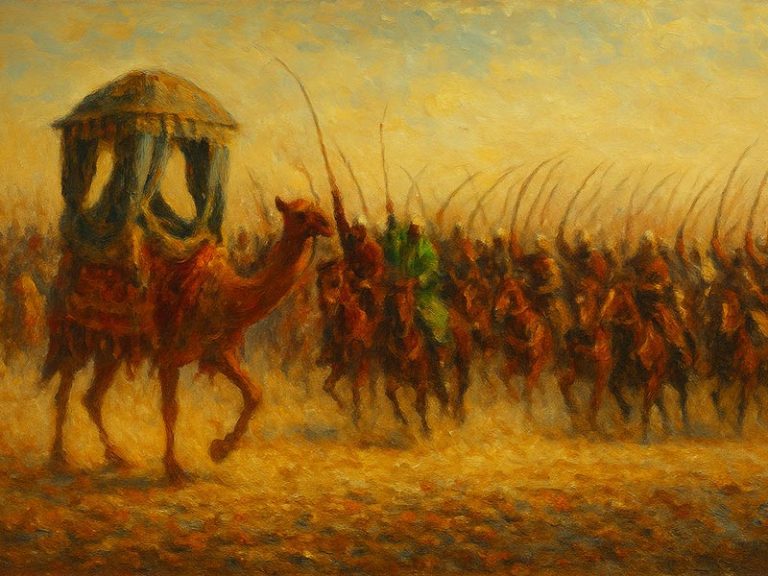
The clash grew fierce and merciless. Amid the chaos, Marwan ibn al-Hakam, though allied with Talha, shot him with an arrow, ending his life in betrayal. Blood flooded the field until the Imam (peace be upon him), perceiving that the battle’s center was the camel of Aisha, cried out:
“Strike down the camel, for so long as it stands, the sword shall not rest!”
When the camel’s leg was severed and it collapsed with a thunderous cry, the battlefield fell into silence—and the army of Jamal was defeated.
Imam Ali’s Dignified Conduct Toward Aisha
When calm returned, Imam Ali (peace be upon him) ordered that Aisha’s litter be carried out from amidst the slain. He instructed her brother, Muhammad ibn Abi Bakr, to ensure her safety, asking:
“See that she is unharmed.”
That night, Aisha was escorted with honor to the home of Safiyyah bint al-Harith in Basra. Later, the Imam (peace be upon him) entered the city, restored order, and accepted the allegiance of its tribes—even from the wounded and those who had fled the battle.
Finally, in a gesture of noble magnanimity, the Imam (peace be upon him) arranged for Aisha’s safe return to Madinah, accompanied by forty women of Basra and her brother Muhammad ibn Abi Bakr, providing her with mounts, provisions, and full respect.