
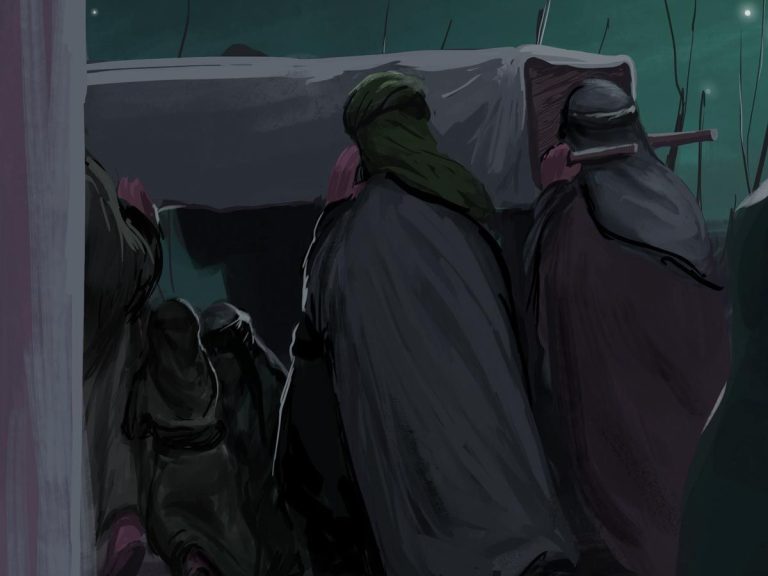
The “True Martyr” in the Imam’s Teaching
Commentators note that Imam Ali’s teaching means a believer who dies with true knowledge of God, the Prophet, and the Ahl al-Bayt receives the reward of martyrdom through sincere intention and loyalty. One who would have fought for the Imam, had circumstances allowed, is granted the same spiritual reward.
Hadiths Referring to the Martyrdom of Lady Fatimah (peace be upon her)
1. The First of the Ahl al-Bayt to Join the Prophet
The Prophet Muhammad (peace be upon him and his family) said that Fatimah would be the first of his family to join him after death, appearing sorrowful and deprived of her rights, killed unjustly. In another narration, he stated she would suffer grave wrongs before being reunited with him.
2. The Loss of Her Fetus (al-Muhsin)
Imam Muhammad al-Baqir (peace be upon him) relates that, after the Prophet’s death, the attack on Lady Fatimah’s (peace be upon her) house caused the violent miscarriage of her unborn son, al-Muhsin. The injury and resultant illness are cited as causes leading to her martyrdom.
3. The Prophet’s Warnings and Curses
Imam Jafar al-Sadiq (peace be upon him) relates reports in which the Prophet (peace be upon him and his family) curses anyone who wrongs Fatimah, takes her rights, strikes her, or causes her death. Other narrations warn of the mistreatment she would face and the violent miscarriage that would follow.
4. Her Status as a Martyr
Imam Musa al-Kadhim (peace be upon him) and other Imams affirm that Fatimah (peace be upon her) was a truthful woman and a martyr. Major Shia scholars regard these reports as clear evidence of her martyrdom.
5. The Family of the Imams Share in Martyrdom
Imams Jafar al-Sadiq and Imam Ali al-Ridha (peace be upon them) are quoted as saying that none among the Ahl al-Bayt will die except as a martyr, whether by sword or by poison—a principle cited by Shia authorities to place Lady Fatimah’s (peace be upon her) death within that context.
6. Written Accounts and Prophetic Foreknowledge
A report related by Ibn Abbas recounts that Imam Ali (peace be upon him) possessed writings from the Prophet (peace be upon him and his family) detailing events from the Prophet’s death up to the martyrdom of Imam Hussain (peace be upon him), including the suffering and death of Lady Fatimah (peace be upon her). This account is presented in classical Shia collections.
7. The Role of Qunfudh and the Fatal Blow
Several narrations attribute Fatimah’s violent miscarriage and illness to a strike by Qunfudh, reportedly on the orders or approval of certain political figures. The blow broke a rib, caused the loss of the fetus, and led to her fatal decline.
8. The Universal Pattern of Martyrdom among the Imams
Authors such as Ibn Shahrashub and Allama Majlisi collect numerous traditions asserting that the Imams were all martyred. Shia exegetes cite Imam Jafar al-Sadiq’s words—“By God, none of us dies except as a slain martyr”—as a foundational claim supporting this view.
9. Public Outcry and the Attempted Assault on Imam Ali (peace be upon him)
Early accounts describe that when a plot to kill Imam Ali (peace be upon him) by other leading figures was averted, women of Banu Hashim protested, condemning the perpetrators and declaring that they had already slain the Prophet’s daughter and now sought to kill his cousin and successor. Their outcry reflects the depth of outrage among the Prophet’s family.
Concluding Note
Shia narrations and scholarship describe Lady Fatimah al-Zahra (peace be upon her) as having endured severe injustice after the Prophet’s death and, according to these traditions, being martyred as a result. These reports have shaped Shia devotional, historical, and theological thought and remain central to commemorations and scholarly discussions.