
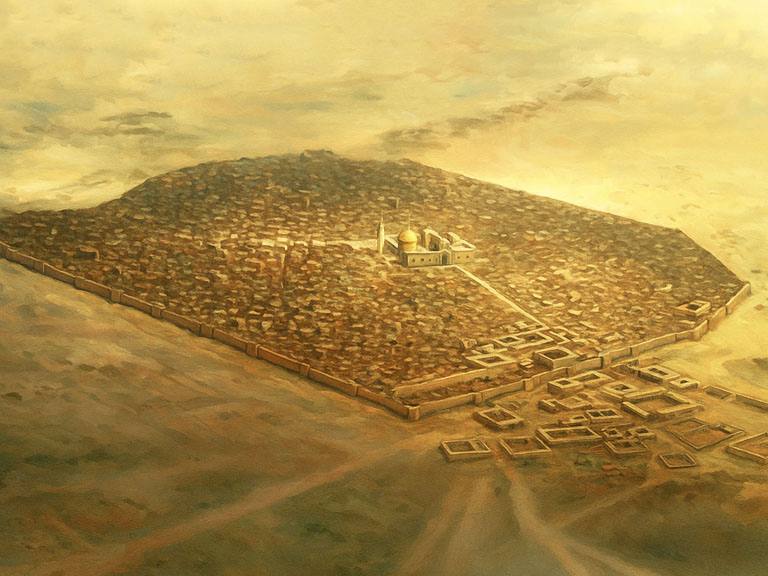
The Geographical Location of Najaf
The holy city of Najaf lies in the southwestern part of Iraq, west of the Euphrates River, approximately 160 kilometers from Baghdad. It is situated on an expansive plain overlooking a low-lying area known as Bahr al-Najaf to the west and bounded by the vast Wadi al-Salam Cemetery to the north.
The elevated plateau of Najaf, often called Rubuat al-Najaf, forms part of the triangular highland extending between Najaf and Karbala. Its highest point rises about 176 meters above sea level, while its western edges range between 100 and 120 meters in elevation. Though largely flat, the terrain bears the marks of natural erosion, forming ridges and valleys that descend toward Bahr al-Najaf.
To the west of the city lies a prominent rocky escarpment known as Tar al-Najaf, which continues northward toward Karbala as Tar al-Sayed, revealing the geological strata of the plateau along its path.
The Climate of Najaf
Najaf has a desert climate, characterized by scorching summers, cool winters, minimal rainfall, and occasional sandstorms from the western desert. The city enjoys some of the highest levels of sunlight in Iraq, especially during summer.
Traditional Najafi architecture reflects adaptation to these climatic challenges; narrow alleys reduce exposure to sunlight, while homes built from brick, plaster, and wood provide natural insulation. Basements and subterranean rooms (sardabs) were traditionally used to escape the summer heat, and underground wells supplied water due to the absence of surface streams.
In modern times, summer temperatures often exceed 50°C, and climate change has intensified these extremes. Diminished rainfall, desertification, and reduced river flow have further degraded the region’s natural vegetation. Urban congestion, air pollution, and the absence of sustainable energy have worsened air quality and contributed to rising temperatures and frequent dust storms.
The Historical Emergence and Growth of Najaf
Following the martyrdom of Imam Ali (peace be upon him) in 40 AH, his sacred body was buried—according to his will—on the Rubuat al-Najaf plateau. The location of the grave remained concealed for some time until it was divinely revealed during the era of Imam Jafar al-Sadiq (peace be upon him) after the fall of the Umayyad dynasty in 132 AH.
The first formal shrine over the noble grave was constructed in 283 AH by Sayed Muhammad ibn Zayd al-Hasani, marking the inception of urban life in Najaf. Subsequently, groups of Alawites, scholars, and noble families settled in the area, and the city flourished with the construction of homes, schools, and marketplaces around the holy mausoleum.
During the Buyid dynasty, particularly under Adud al-Dawla (371 AH), significant efforts were made to expand and beautify the shrine, leading to a period of prosperity and population growth. Najaf’s urban development continued notably under the Jalayirid rulers, transforming it into a major cultural and spiritual center.
The Historical Connection Between Najaf, Hira, and Kufa
Together with Hira and Kufa, Najaf formed a civilizational triangle that played a vital role in Iraq’s political, cultural, and religious history—both before and after Islam.
According to historians, the earliest foundations of Hira trace back to Nebuchadnezzar II (604–562 BCE), who established settlements for Arab traders near present-day Najaf.
Hira gained fame under the Lakhmid kings (268–633 CE), whose Christian rule saw the construction of numerous monasteries, some of which remain as archaeological traces.
Kufa, founded in 17 AH (638 CE), soon became a major administrative capital, and in 36 AH (657 CE), Imam Ali (peace be upon him) designated it as the capital of the Islamic Caliphate. Owing to their proximity and shared history, Najaf was often referred to as “Najaf al-Hira” or “Najaf al-Kufa.”
Najaf in the Words of Historians and Travelers
The historian al-Baladhuri recounts that when Muslim forces found the conditions in al-Madain unfavorable, Caliph Umar ordered the selection of a better site. Sad ibn Abi Waqqas and his companions chose the fertile lands near present-day Kufa—then known as Khadd al-Adhra, famed for its lush red anemones (shaqqaiq al-numan) and wild daisies (uqhuwan).
The scholar Abu Mansur al-Thalibi notes that King Numan ibn al-Mundhir, captivated by the beauty of those flowers, forbade anyone from plucking them, hence their name Shaqqaiq al-Numan (the Anemones of Numan).
Other narrations, such as that of Abd al-Masih al-Ghassani, describe how the sea once extended to the vicinity of Najaf, where ships from India and China would dock. Over time, the waters receded, and the once lush, verdant lands gave way to arid plains—a testament to the divine law governing the transformation of nations and lands.
The open plains surrounding Najaf and Kufa were once rich in desert vegetation and served as grazing lands for Arab tribes. Because of its pure air and open landscape, Najaf was also regarded as a refuge for healing and convalescence during outbreaks of disease.
Historians such as al-Tabari explain that the Palace of Khawarnaq near Hira was commissioned by the Sasanian king Yazdegerd as a healthy retreat for his son Bahram Gur, underscoring the favorable climate of the region.
Over the centuries, the cemeteries of al-Thawiyya and later Wadi al-Salam became resting places for companions and followers of the Prophet (peace be upon him and his progeny), including Hubab ibn al-Aratt and Kumayl ibn Ziyad, whose shrine remains a site of visitation in the district of Hanana.
The Observations of Travelers
The Andalusian traveler Ibn Jubayr, who visited in 579 AH (1183 CE), described Najaf as a vast, elevated land near Kufa, bordering the desert. He noted the presence of a splendid shrine dedicated to Imam Ali (peace be upon him) to the west of the city, although he was unable to visit it due to time constraints.
A century later, Ibn Battuta (727 AH / 1326 CE) portrayed Najaf as a thriving, beautiful, and well-organized city, with clean markets and flourishing life—one of the finest cities in all of Iraq.
As time passed, residential quarters gradually expanded around the holy shrine, and migration to Najaf increased both for its spiritual sanctity and its renowned seminary. Thus, Najaf emerged as one of the foremost centers of learning and pilgrimage in the Islamic world, radiating faith, scholarship, and heritage.


