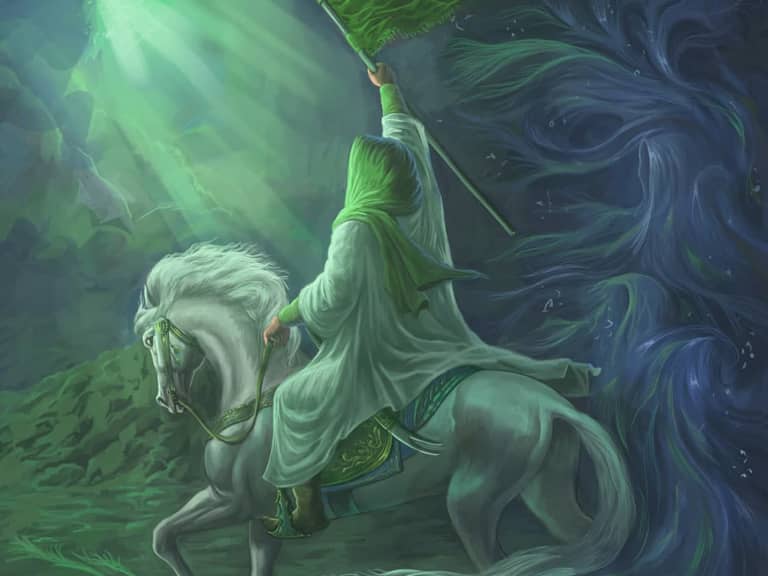
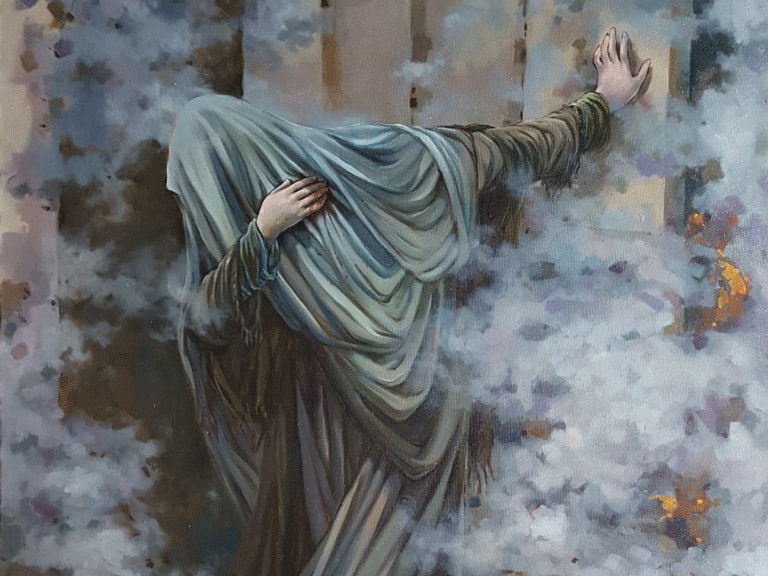
This pure and innocent soul was martyred during the tragic assault upon the blessed house of Lady Fatimah (peace be upon her). Agents of the ruling power sought to force Imam Ali (peace be upon him) to pledge allegiance. In that moment of aggression, the unborn Muhsin (peace be upon him) was struck and miscarried. He became the first martyr in the cause of divine guardianship (Wilayah).
The Sacred Name “Muhsin”—A Reflection of Divine Grace
The Messenger of God (peace be upon him and his family) said to the Commander of the Faithful (peace be upon him):
“When the Almighty created Adam, breathed into him of His spirit, commanded the angels to prostrate before him, and placed him in Paradise with his spouse Eve, Adam lifted his gaze toward the Throne. There he beheld five radiant names inscribed upon it. He asked:
‘O Lord, who are these?’
God, the Exalted, replied:
‘They are those whose intercession I shall accept on behalf of My creation.’
Adam then said, ‘O Lord, by the honor You have bestowed upon them, tell me their names.’
The Almighty said, “The first is My name, ‘Mahmud,’ and he is Muhammad. The second is “Ali.” The third is “Fatir,” and she is Fatimah. The fourth is “Muhsin,” and he is al-Hasan. The fifth is “Dhul-Ihsan,” and he is al-Hussain. These five ever glorify and praise Me.’”
This narration reflects the exalted purity of their names—each a mirror of divine attributes and an emblem of celestial perfection.
The First to Be Judged on the Day of Resurrection
Imam Jafar al-Sadiq (peace be upon him) said:
“The first soul to be judged on the Day of Resurrection will be Muhsin ibn Ali (peace be upon him). After the verdict against his oppressor, Qunfudh will be brought forth, and both shall be punished with lashes of fire—lashes so fierce that if one were to strike the seas, they would boil from east to west, and if they were to strike the mountains, they would melt away.”
This narration encapsulates the magnitude of the injustice. It also highlights the divine retribution that awaits those who violated the sanctity of the Prophet’s Household.
His Burial Within the House
Following the martyrdom of the unborn Muhsin (peace be upon him), the Commander of the Faithful (peace be upon him) said to Lady Fiddah (may God be pleased with her):
“Bury Muhsin in the inner recess of the house and conceal his resting place, for he shall soon be reunited with his grandfather, the Messenger of God (peace be upon him and his family), and will present his complaint before him.”
Thus, the blessed child was laid to rest in silence, hidden from the eyes of the world, yet forever remembered in the hearts of the faithful.
Testimonies of Scholars Concerning the Martyrdom of Muhsin (peace be upon him)
Throughout the centuries, numerous Sunni and Shia scholars alike have acknowledged that Muhsin (peace be upon him) was miscarried as a result of the assault on Lady Fatimah’s home. Among them are:
- Ibn Qutaybah (d. 276 AH), who wrote in al-Maarif: “Muhsin was miscarried due to the blow of Qunfudh al-Adawi.” Later copies of the text were altered to obscure this truth.
- Kanjy al-Shafi in Kifayat al-Talib affirms that Lady Fatimah (peace be upon her) miscarried the child whom the Prophet (peace be upon him and his family) had named Muhsin.
- Ali ibn Muhammad al-Umari, the genealogist, stated that historians omitted mention of Muhsin because “he came into this world lifeless.”
- Muhammad ibn Talhah al-Shafi (d. 652 AH) records that many counted the miscarried Muhsin among the sons of Imam Ali alongside al-Hasan and al-Hussain.
- Al-Dhahabi (d. 748 AH) explicitly wrote, “Umar struck the chest of Fatimah with his foot, causing her to miscarry Muhsin.”
- Ibn Hajar al-Asqalani (d. 852 AH) and others repeated the same acknowledgment.
Such attestations, despite later attempts at omission or distortion, stand as witnesses to this grievous injustice.
The Symbol of Innocence and the Legacy of Resistance
The martyrdom of Muhsin (peace be upon him) is not merely a historical account. It is a spiritual testament—a reminder of the suffering endured by the Prophet’s Household (peace be upon them) and the purity of their devotion to God’s command. His silent sacrifice stands as the first blood shed in defense of the truth of Imamate and divine guardianship. It marks the beginning of a struggle that would continue through Karbala and beyond.
Though some sought to erase his memory, Muhsin (peace be upon him) remains eternally enshrined in the hearts of believers. He is a radiant symbol of innocence, faith, and steadfastness against oppression. His name, derived from the attribute of divine goodness, continues to embody mercy, purity, and unwavering loyalty to the divine covenant.