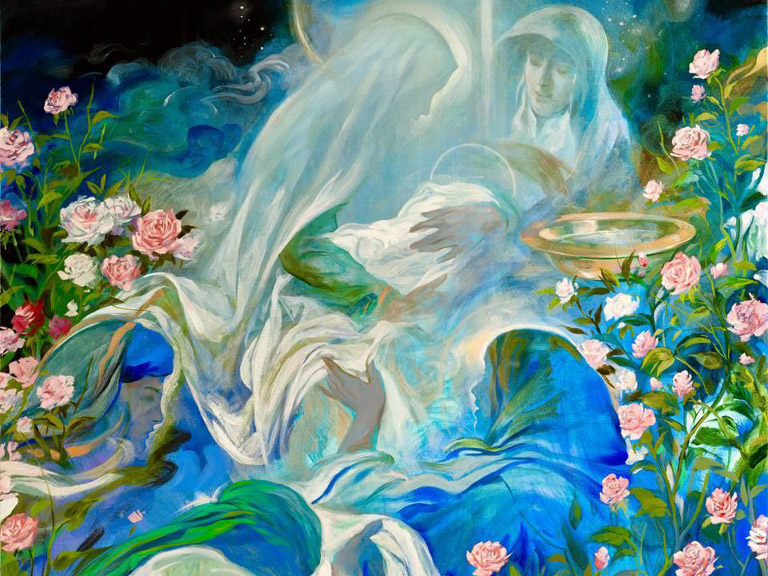
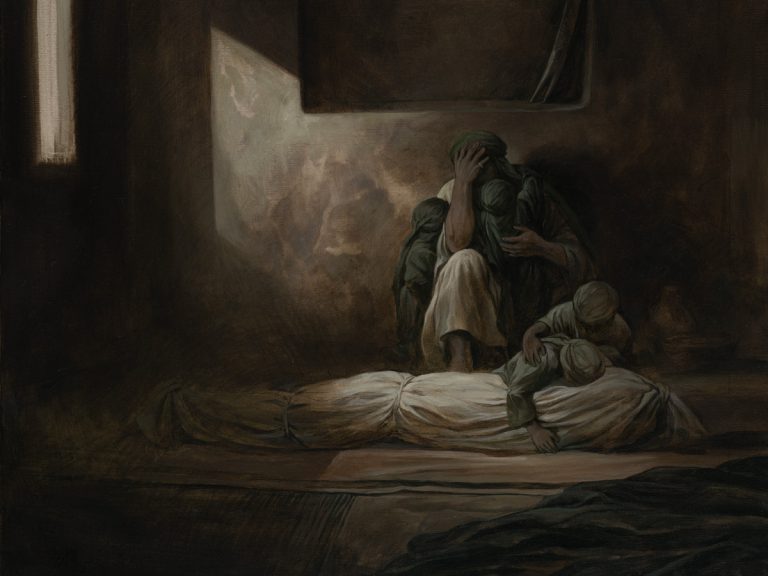
This act reflects the exalted station of Lady al-Zahra (peace be upon her) in the eyes of the Ahl al-Bayt and the role of Amir al-Muminin (peace be upon him) as her guardian and divinely appointed successor. It also highlights the sanctity of the Ahl al-Bayt (peace be upon them) and the obligation to preserve their dignity even after martyrdom.
A narration concerning the final moments of her noble life
In her final hours, Lady Fatimah (peace be upon her) washed her own pure and immaculate body, put on new clothing, and said,
“When it is time for my washing, let no one remove any garment from my body, and let no one expose my shroud.”
Shaikh al-Tusi narrates, with his chain of transmission from Salma, the wife of Abu Rafi:
“On the day Lady Fatimah (peace be upon her) attained martyrdom, she said to me, ‘Bring me water that I may wash.’ When I brought the water, she performed a thorough washing. Then she said, ‘Bring me my new garments.’
I brought them to her; she put them on, entered her room, and said, ‘Spread my bed in the middle of the room.’ I did so. Lady Fatimah (peace be upon her) then lay facing the qiblah, placed her blessed hand beneath her cheek, and said, ‘I shall depart from this world now. Let no one remove my clothing, for I have purified my body. She then uttered these words and passed into martyrdom.
When Amir al-Muminin (peace be upon him) arrived, I informed him of what had occurred. He said, ‘Do not undo anything.’ He then took her blessed body and performed the washing.”
Who washed her?
Al-Mufaddal reports:
“I said to Imam Jafar al-Sadiq (peace be upon him), ‘May I be your ransom? Who washed Fatimah (peace be upon her)?’
He replied, Amir al-Muminin (peace be upon him).’
This weighed heavily upon me, so the Imam said, ‘It seems what I told you has distressed you?’
I said, ‘Yes, it has; may I be your ransom?’
The Imam (peace be upon him) said, ‘Do not be distressed. Fatimah (peace be upon her) was al-Siddiqa, the infallible. None may wash an infallible except another infallible. Do you not know that none washed Lady Maryam (peace be upon her) except Prophet Isa (peace be upon him)?’”
Allamah al-Majlisi comments:
“Al-Siddiqa means the infallible, and an infallible—whether male or female—may be washed only by an infallible.”
Miraculous traversal of distance for the washing of an infallible
Allamah Muhammad Taqi al-Majlisi further states:
“There are numerous traditions confirming that only an infallible washes an infallible. When Imam Musa al-Kadhim (peace be upon him) was martyred in Baghdad, Imam Ali al-Ridha (peace be upon him) came from Madinah by miraculous traversing of the earth (tiyy al-ardh) to wash him.
Likewise, Imam Muhammad al-Taqi (peace be upon him) came from Madinah to Khurasan by tiyy al-ardh (Miraculous traversal) to wash Imam al-Rida (peace be upon him).”
The washing of the truthful martyr as narrated by Amir al-Muminin (peace be upon him)
Amir al-Muminin (peace be upon him) said:
“The Lady Fatimah al-Zahra (peace be upon her) instructed me: ‘Wash me, and do not remove my clothing, for I am pure and immaculate. One from among my household, the nearest of them to me—he who partook of my sustenance—must pray over me. Bury me at night, for this is what my beloved, Prophet Muhammad (peace be upon him and his family), informed me would occur.’”
He continued:
“By God, I fulfilled her command. I washed her while she remained in her garment, and I did not expose her. By God, she was pure and purified. Then I applied to her the remainder of the fragrant burial preparation used for the Messenger of God (peace be upon him and his family), shrouded her, and wrapped her in the burial cloths.”
Asma bint Umays said:
“Lady Fatimah (peace be upon her) instructed me that none should wash her except me and Amir al-Muminin (peace be upon him). Thus, I assisted him in washing her.”
Her written will
After the martyrdom of the Pure Truthful One, when Amir al-Muminin (peace be upon him) came to her side, he lifted the veil from her noble face and found near her blessed head a written document that read:
“In the Name of God, the Most Merciful, the Most Compassionate.
This is what Fatimah, daughter of the Messenger of God, bequeaths. She testifies to the Oneness of God and the Prophethood of the Master of the Prophets. She testifies that Paradise is true, Hell is true, and the Resurrection is true without doubt, and that God shall resurrect those in their graves.
O Ali! I am Fatimah, daughter of Muhammad. God joined me to you in marriage so that I may be your wife in this world and the hereafter, and you are more entitled to me than all others.
Prepare my burial at night, wash me, apply the burial perfume, shroud me, pray over me at night, and bury me at night. Inform no one. I entrust you to God and convey my greetings to my children until the Day of Resurrection.”
The tribulations of the Pure Truthful One
Amir al-Muminin (peace be upon him) said to Ammar regarding the hardships of his oppressed wife:
“When I placed that oppressed woman with a broken rib upon the washing board, I found that one of the bones of her side had been broken; the nail of the door had pierced her chest, wounding it, and her blessed side was blackened from the lashes. Fatimah concealed these injuries from me so that my grief would not intensify.”
The bruised arm
A narration from Sulaim (related by Aban) states:
“I entered the mosque and found a gathering consisting solely of Banu Hashim—among them Salman, Abu Dharr, Miqdad, Muhammad ibn Abi Bakr, Umar ibn Abi Salama, and Qays ibn Sad ibn Ubada.
Al-Abbas said to Amir al-Muminin (peace be upon him), ‘What prevented Umar from demanding compensation from Qunfudh, as he did from his other agents?’
Amir al-Muminin looked at those around him, and his blessed eyes filled with tears. He said:
Umar wanted to reward Qunfudh for the strike he delivered with his whip against Fatimah—the very blow that led to her passing—while the mark of it remained on her arm like a bracelet.’”
A scholar in the presence of the Lady
The dream of the great jurist Allamah Sayed Murtadha Firuzabadi, a leading scholar of the seminaries of Najaf and Qom, concerning Lady Fatimah (peace be upon her):
“While in Najaf, I once saw in a dream that a gathering was being held in my home. Lady Fatimah (peace be upon her) was present, veiled with her chador. Believers were lined up, coming one by one to offer their respects before departing.
When all had left, she lifted her veil. I understood that she did so because I was her mahram. In the dream I said, ‘Her face resembles the face of the Messenger of God (peace be upon him and his family).’
I approached and said, ‘Mother, for nearly fourteen centuries preachers have said that your husband, Ali, was taken to the mosque bareheaded, without his cloak, with a rope around his neck. Is this true?’
She said, ‘After the Messenger of God, they humiliated Ali.’
I spoke Persian, and she responded in Arabic.
I said, ‘Mother, for nearly fourteen centuries historians and preachers have said that that wretched man struck your arm with his whip, leaving it blackened—wa fi ududiha ka-d-dumlaj. Is this true?’
She said, ‘Yes.’
Then she extended her right arm from her sleeve, and I saw that her arm was still darkened and bruised.”