
Claims raised by some opponents in certain texts hold no substantial credibility, as they often stem from ignorance, prejudice, or hostility toward Amir al-Muminin (peace be upon him).
Nonetheless, the doubts raised by some historians and opposing scholars are addressed here for clarity and to illuminate the truth.
Doubts Raised by Certain Historians
Al-Khatib al-Baghdadi reports:
“Some claimed that the grave in Kufa does not belong to Amir al-Muminin (peace be upon him) but to a man named Mughirah ibn Shubah. He stated that Abu Jafar al-Hadrami said, “If the Shia knew, they would have stoned this grave, for it belongs to Mughirah ibn Shubah.”
Ibn Taymiyyah asserted:
“Amir al-Muminin (peace be upon him) was buried in the palace of governance in Kufa, and the Najaf shrine belongs to Mughirah ibn Shubah. For over 300 years, no one visited the grave of Amir al-Muminin in Najaf.”
Ibn Kathir stated:
“After the martyrdom of Amir al-Muminin (peace be upon him), his son al-Hasan (peace be upon him) led the funeral prayer over him and, to prevent attacks by the Kharijites, buried him in the palace of governance in Kufa. Those claiming his grave is in Tahaf or Najaf speak without knowledge, and it likely pertains to the grave of Mughirah ibn Shubah, not Amir al-Muminin.”
Sibt ibn Jawzi reported:
“Abu Nuaym al-Isfahani claimed that the grave visited in Najaf belongs to Mughirah ibn Shubah, and that pilgrims would have stoned it if they had known.”
Responses to the Raised Doubts
1. The Claim Regarding Conflicting Reports
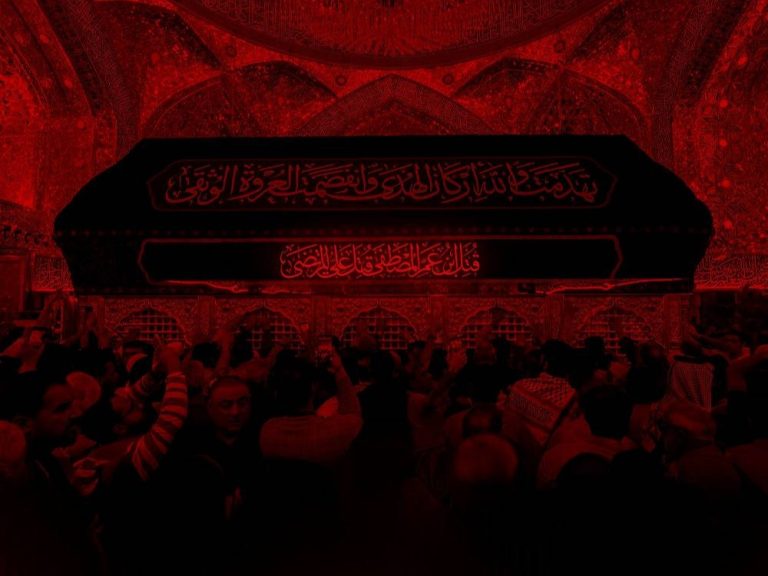
The opponents’ claims concerning the burial place of Amir al-Muminin (peace be upon him) are explained by the deliberate concealment of the grave by the Ahl al-Bayt and the Shia, following the wishes of the Commander of the Faithful, to protect it from enemies.
He was buried at night, and the location was kept hidden from the Kharijites and Umayyad adversaries to prevent desecration or harm to the sacred body.
As Sayed Ali ibn Tawus stated:
“The grave of Amir al-Muminin (peace be upon him) was hidden by his children and followers from his enemies. Since his adversaries did not know the location, this secrecy was entirely appropriate, for it was executed by the Shia and his successors. How, then, could outsiders have known of it?”
2. The Claim Regarding His Residence in Kufa
Upon entering Kufa, Amir al-Muminin (peace be upon him) resided in the house of Jadah ibn Hubayrah al-Makhzumi, son of his sister, Umm Hani, located near the Great Mosque of Kufa in its southwestern corner. He avoided residing in the palace of governance in Kufa, which he referred to as the “Palace of Illusion and Vanity,” and also avoided the palace of Amr ibn Harith to the east.
Reports from Nasr ibn Muzahim al-Manqari, from Abd al-Rahman ibn Ubayd ibn Abi Kunud, and from others note that when asked if he would reside in the Kufa palaces, he replied,
“No, I do not sit in the palace; I reside in the Rahbah.”
As al-Manqari quotes from Asbagh ibn Nabatah:
“When Amir al-Muminin entered Kufa, he was asked if he would reside in one of the two palaces of governance. He replied, “The palace of vanity and illusion will not contain me; I will dwell in the house of Jadah ibn Hubayrah al-Makhzumi.”
Thus, Amir al-Muminin (peace be upon him) consistently avoided living in the palace of governance, and burying him there would have exposed the grave to enemies.
3. The Claim Regarding Mughirah ibn Shubah’s Grave
Some critics claim that the Najaf shrine belongs to Mughirah ibn Shubah. This assertion is unfounded, as historical sources indicate that Mughirah ibn Thaqafi was buried in the Thaqif cemetery in Thuwaiyah, Kufa—not in Ghari (Najaf). The geographical locations of Thuwaiyah and Najaf are distinct and cannot be conflated.
It appears that al-Khatib al-Baghdadi confused Thuwaiyah with Ghari, as he elsewhere clearly states that Mughirah was buried in Thuwaiyah. Abu Nuaym al-Isfahani’s statement is also mistaken, since Mughirah ibn Shubah’s grave was in Thuwaiyah, Kufa, and some sources even indicate he passed away in Syria.