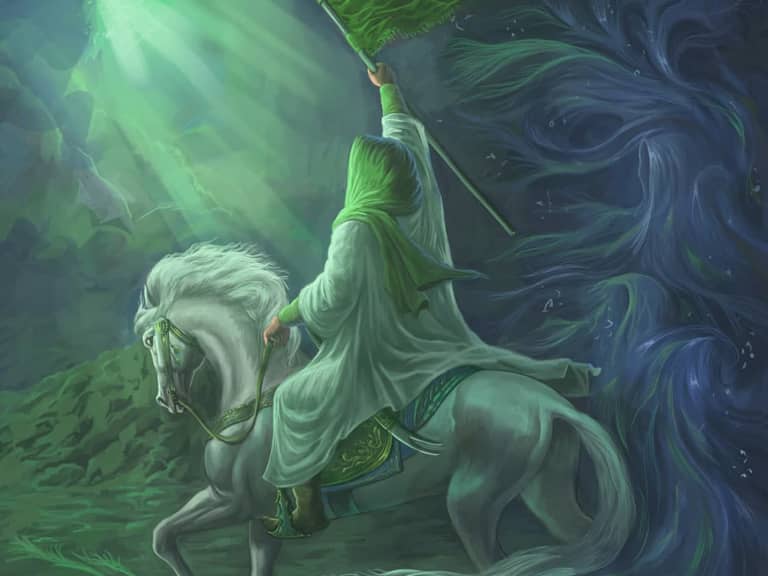

At the beginning of the sixteenth day of the blessed month of Rajab, after three days, Lady Fatimah bint Asad (peace be upon her) emerged from within the Kaaba carrying her illustrious newborn, Amir al-Muminin (peace be upon him). Much can be said about her personality and status, which will be addressed in greater detail on another occasion. Here, however, it is appropriate to highlight some of the distinctive virtues of this righteous and exceptional woman. What follows is a brief overview of the most prominent merits of Fatimah bint Asad (peace be upon her), the noble mother of Amir al-Muminin (peace be upon him).
The Maternal Status of Fatimah bint Asad in the Life of the Seal of the Prophets
The Messenger of God, Prophet Muhammad (peace be upon him and his family), lost his father, mother, and grandfather during his early childhood. From the age of eight, he came under the guardianship of Abu Talib (peace be upon him). As the wife of Abu Talib, Fatimah bint Asad shared fully in the care and upbringing of the Prophet (peace be upon him and his family). Her compassion toward him was so profound that upon her passing, the Prophet declared: “Today, my mother has passed away.”
He shrouded her in his own garment, descended into her grave, and lay in her burial niche. When it was said to him, “O Messenger of God, you show great sorrow for Fatimah,” he replied:
“She was truly my mother. She would leave her own children hungry while she fed me, leave them unkempt while she cleaned and cared for me. Truly, she was my mother.”
God’s Invitation to Fatimah bint Asad (peace be upon her)
God, exalted be He, invited Fatimah bint Asad (peace be upon her) into the Kaaba; she did not enter of her own accord. Had she entered by herself, she would have done so through its door, as was customary. Instead, in honor of the newborn she carried, the wall of the Kaaba itself was cleft open. Through this opening, Fatimah bint Asad entered the Sacred House so that the one destined to be the child raised within the House of God might come into the world there.
The Kaaba as the Place of Birth
The secret behind Fatimah bint Asad’s being granted this unparalleled honor lies in her spiritual purity and unwavering monotheism. At a time when the people of the Arabian Peninsula had largely deviated from the pure Abrahamic faith and were immersed in polytheism and idol worship, she retained a deeply God-conscious and reverent spirit. When the pains of childbirth overtook her beside the Kaaba, she turned to God in supplication and devotion. In response, the Yemeni Corner opened to her, and the Kaaba—though the most sacred of places of worship—became the birthplace of this exalted woman’s child.
By contrast, Lady Maryam (peace be upon her), despite her Quranically affirmed purity and the fact that her son was one of the great prophets endowed with firm resolve, was commanded to leave the sanctuary at the time of childbirth and withdraw to a distant place, for that was a house of worship, not a place of birth.
A Heavenly Sustenance for Fatimah bint Asad (peace be upon her)
This noble lady was not only a monotheist, but a woman of profound spiritual insight. Through her devotion at the Kaaba, not only was its wall opened for her entry and childbirth within the Sacred House, but she also remained inside the Kaaba for four days, sustained by heavenly provisions. Upon her departure, she declared:
“God, the Most Glorious, has chosen me and granted me excellence over all women before me, for I gave birth within the Sacred House of God and was nourished for three days by the fruits of Paradise.”
The Acceptance of Islam by Fatimah bint Asad (peace be upon her)
It is sufficient honor for Fatimah bint Asad (peace be upon her) that she stands among the distinguished women of early Islam. After Lady Khadijah al-Kubra (peace be upon her), she was the first woman to embrace Islam and the second woman to pledge allegiance to the Messenger of God (peace be upon him and his family).
A Historical Account of the Birth of the Child of the Kaaba
Shaikh Bandani Nishaburi, in an interview with the English Media Outlet of the Imam Ali Holy Shrine, provided a historically grounded and descriptive account of the events surrounding the birth of Amir al-Muminin (peace be upon him), based on reliable sources. His remarks aim to offer a clearer visual and conceptual understanding of this sacred moment. A summarized account is presented below:
The entry and exit of Fatimah bint Asad (peace be upon her) occurred through the wall behind the door of the Kaaba.
The opening in the wall did not involve collapse, damage, or the displacement of stones; rather, it appeared miraculously, as though the Kaaba itself had gently opened its breast.
The opening was luminous, with radiant light emanating from within the Sacred House.
The stones of the Kaaba, particularly in its lower section, were dark in color and lighter above, consistent with stones quarried from Mount Abu Qubays near Makkah.
At that time, no curtain like the modern covering adorned the Kaaba, though decorative fabrics bearing poetic verses in praise of tribal leaders are reported to have been hung above it.
The Kaaba stood only slightly elevated from the ground, making entry feasible for a pregnant woman without difficulty. Fatimah bint Asad entered through the opening without bending or exertion.
While Lady Maryam (peace be upon her) was instructed to leave the sanctuary for childbirth, historical reports indicate that on the night of the thirteenth of Rajab, Fatimah bint Asad felt labor pains and softly invoked a sacred name, after which she was calmed. When Abu Talib (peace be upon him) intended to summon assistance, a voice was heard saying, “Be patient.” It was as though no impure hand was to touch the future Guardian of God at his birth. The following morning, a call came: “Leave this house and come to My House.”
The Messenger of God (peace be upon him and his family) and Abu Talib (peace be upon him) accompanied her to the Sacred Mosque. Upon reaching the Kaaba, she raised her gaze toward the heavens—an expression of her monotheistic belief in God’s transcendence—and prayed for ease in her delivery after affirming her faith in God, His messengers, and His revealed books.
Historical descriptions portray her as of moderate stature, neither tall nor short, and physically delicate.
Her modesty, dignity, and chastity were manifest even during the pre-Islamic era. It is said that her covering appeared dark upon entry and white upon her exit.
On the night of Amir al-Muminin’s birth, the earth was illuminated. Abu Talib emerged proclaiming: “O people, the Guardian of God and the Master of the Successors has been born in the Kaaba.”
Fatimah bint Asad remained inside the Kaaba for three days. Despite entering publicly, those present were unable to open the Kaaba’s door during this period, which caused widespread amazement.
At dawn on the fourth day, after sunrise, the Kaaba opened again at the same spot, and Fatimah bint Asad emerged before a great crowd, holding her child in her arms.
According to reports from the Ahl al-Bayt (peace be upon them), they would grow in a single day what others grow in a week, suggesting that Amir al-Muminin (peace be upon him) appeared as a child of several weeks upon his exit.
It is certain that the newborn was wrapped in white heavenly silk.
Reports indicate that infants are most at ease when their head rests near their mother’s heart, suggesting that Amir al-Muminin’s blessed head was inclined toward his mother’s heart as she emerged.
At that moment, a voice proclaimed:
“O Fatimah, name him Ali, for I am al-Ali al-Ala (the Most High). I have created him from My power and derived his name from My own. I have nurtured him with My care and entrusted him with the mission of proclaiming the message. He was born in My House, shall be the first to call the adhan upon it, shall shatter idols, glorify Me, and proclaim My greatness. He is the Imam after My beloved, My chosen one, and My Messenger Muhammad (peace be upon him and his family). Blessed are those who love and support him, and woe to those who oppose him and harbor enmity toward him.”
Abu Talib (peace be upon him) later hosted a grand feast and declared:
“Come for the banquet of Ali ibn Abi Talib (peace be upon him), but first circumambulate the Kaaba seven times and then greet my son Ali.” This occurred before the Prophet (peace be upon him and his family) had publicly declared his mission.
Fatimah bint Asad presented the child to the Messenger of God (peace be upon him and his family), who recited the adhan in his right ear and the iqamah in his left, and said:
“This is a newborn born upon the natural disposition (fitrah).”
This singular event remains a radiant testimony to the unparalleled honor bestowed upon Fatimah bint Asad (peace be upon her) and to the unique sanctity of the birth of Amir al-Muminin Ali ibn Abi Talib (peace be upon him).