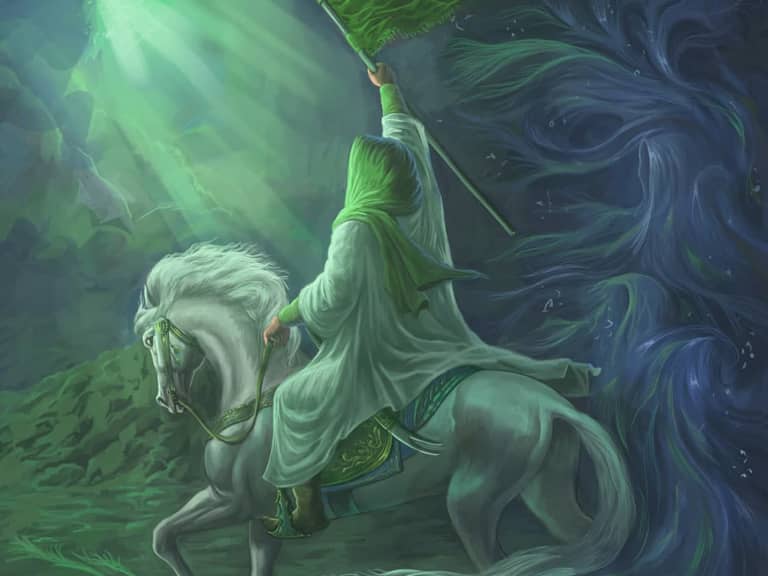

Throughout the caliphate of the Commander of the Faithful, Imam Ali (peace be upon him)—which lasted four years and nine months—Imam al-Hussain (peace be upon him), alongside his esteemed brother Imam al-Hasan (peace be upon him), actively fulfilled his responsibilities in the major political and social developments of the era. Among the most prominent examples of this role was their presence in significant historical events such as the Battles of Jamal, Siffin, and Nahrawan.
The Sermon of Imam al-Hussain (peace be upon him) at the Beginning of the Caliphate of Amir al-Muminin (peace be upon him)
The earliest instance recorded by historians regarding the presence of Imam al-Hussain (peace be upon him) during the caliphate of Amir al-Muminin (peace be upon him) is his sermon delivered at the time when the people pledged allegiance to Imam Ali (peace be upon him) as caliph.
It has been narrated that when Amir al-Muminin (peace be upon him), assumed the caliphate, he entered the mosque, ascended the pulpit, and sat upon it with dignity. He then called upon his sons, al-Hasan (peace be upon him) and al-Hussain (peace be upon him), to ascend the pulpit and address the people.
After Imam al-Hasan (peace be upon him) delivered a brief sermon, Imam al-Hussain (peace be upon him) ascended the pulpit. After praising and glorifying God and invoking blessings upon the Prophet Muhammad (peace be upon him and his family), he said:
“O people! I heard my grandfather, the Messenger of God (peace be upon him and his family), say: ‘The Commander of the Faithful, Ali (peace be upon him), is the city of guidance; whoever enters it shall be saved, and whoever remains outside it shall perish.’”
He then descended from the pulpit, whereupon his father warmly received him. Amir al-Muminin (peace be upon him) approached him, embraced him closely, and kissed him.
Presence in the Battle of Jamal
During the Battle of Jamal, Imam al-Hussain (peace be upon him), alongside his brothers Imam al-Hasan (peace be upon him) and Muhammad ibn al-Hanafiyyah, and accompanied by a number of the Muhajirun and the Ansar, marched with the army of Amir al-Muminin (peace be upon him), toward Basra.
In this battle, Imam al-Hasan and Imam al-Hussain (peace be upon them) advanced courageously, seeking to carry the standard; however, out of concern for the lives of the sons of the Messenger of God (peace be upon him and his family), Amir al-Muminin (peace be upon him) restrained them and entrusted the banner to Muhammad ibn al-Hanafiyyah.
He then said to them:
“Indeed, I entrusted the banner to your brother Muhammad ibn al-Hanafiyyah and restrained you from this task because of the exalted rank you hold in the sight of the Messenger of God (peace be upon him and his family).”
After arranging his army in ranks, the Commander of the Faithful (peace be upon him) appointed Imam al-Hasan (peace be upon him) as the commander of the right wing and Imam al-Hussain (peace be upon him) as the commander of the left wing of his forces.
Presence in the Battle of Siffin
It has been narrated that prior to the army’s departure toward Siffin, Imam al-Hussain (peace be upon him), following the addresses of Amir al-Muminin (peace be upon him) and Imam al-Hasan (peace be upon him), rose to deliver a powerful sermon, urging and mobilizing the people of Kufa to fight against the Syrian forces.
In this sermon, after praising and glorifying God as befitting, he said:
“O people of Kufa! You are supporters of the noble and a people whose inner and outer selves are one. Strive to revive what is your true garment (your unity), make the difficult path easy for yourselves, and transform the causes of your division into means of cohesion. Be aware that war is a swift evil, with a bitter taste and harsh draughts. Whoever prepares himself for it, readies his equipment, and does not falter or fear when wounds befall him at its onset, shall prevail. But whoever hastens into it before its proper time, without insight and preparation, will bring loss upon his people and destruction upon himself. We ask God to strengthen you through His assistance upon unity and solidarity.”
The army then advanced toward Syria, until the two forces met in a region known as Siffin. After completing his final arguments against the Syrian army, Amir al-Muminin (peace be upon him) arranged his forces and appointed Imam al-Hasan (peace be upon him) and Imam al-Hussain (peace be upon him) to positions on the right flank of his army.
Amir al-Muminin (peace be upon him) instructed his companions to safeguard the descendants of the Messenger of God (peace be upon him and his family). He himself also restrained Imam al-Hasan and Imam al-Hussain (peace be upon them) from extensive participation in direct combat in order to preserve their lives.
On one of the days of the Battle of Siffin, when he saw his son Imam al-Hasan (peace be upon him) advancing toward the battlefield, the Commander of the Faithful (peace be upon him) said:
“Hold this young man back for me, lest he deprive me of my strength. I am reluctant for these two—al-Hasan and al-Hussain (peace be upon them)—to meet death, for fear that the progeny of the Messenger of God (peace be upon him and his family) might be cut off.”
After the conclusion of the battle and the episode of arbitration, Imam al-Hussain (peace be upon him) was appointed by his father as one of the witnesses overseeing the proper conduct of the negotiations.
Presence in the Battle of Nahrawan
During the Battle of Nahrawan, Imam al-Hussain (peace be upon him), together with his brothers Imam al-Hasan (peace be upon him), Muhammad ibn al-Hanafiyyah, and Abdullah ibn Abbas, took part in the campaign.
Following this, Amir al-Muminin (peace be upon him) began preparations to return to Siffin and engage in renewed combat against Muawiyah, organizing a large army. In view of the innate merit and martial spirit he recognized in Imam al-Hussain (peace be upon him), he appointed him as the commander of ten thousand warriors from Iraq.
Nawf al-Bikali reports:
“Amir al-Muminin (peace be upon him), assigned ten thousand troops to Imam al-Hussain (peace be upon him), ten thousand to Qays, ten thousand to Abu Ayyub al-Ansari, and distributed other contingents among additional commanders. However, before even a week had passed, the accursed Ibn Muljam struck the Commander of the Faithful (peace be upon him), and upon receiving the news, the army returned to Kufa.”