
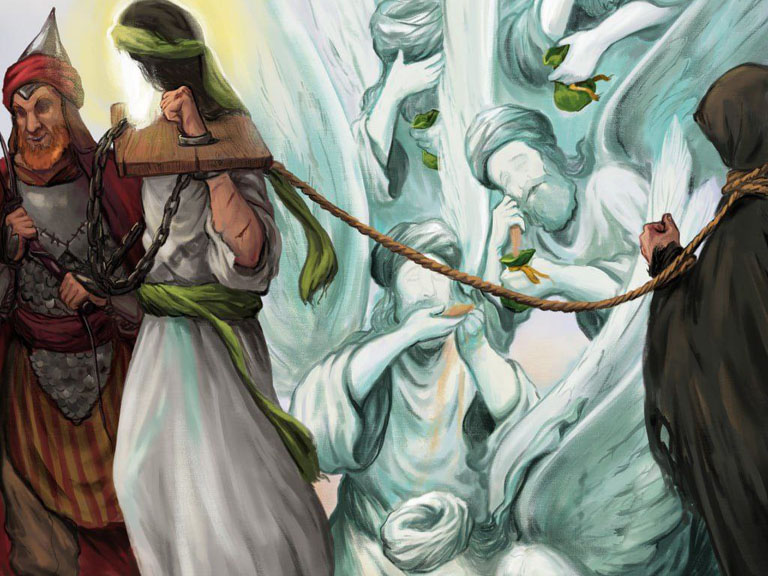
Imam al-Sajjad (peace be upon him), with unmatched courage, exposed historical truths by introducing the exalted character of the Commander of the Faithful (peace be upon him) and the Ahl al-Bayt. Drawing on Quranic verses and divine virtues, he proclaimed the glory and truthfulness of his noble father, Amir al-Muminin (peace be upon him), as the pillar of the tent of Islam. In the end, by explaining the lofty station of the House of Prophethood, the Imam established the truth of Amir al-Muminin (peace be upon him) the Household of Muhammad against the deviant Umayyad current.
The Sorrowful Account of the Captives’ Arrival
The 29th of Muharram marks the anniversary of the arrival of the caravan of captives. The author of Manaqib narrates from Sahl ibn Sa’d, one of those who witnessed the scenes and moments of the arrival of the captive Ahl al-Bayt and the heads of the martyrs in Damascus, that he encountered Damascus filled with an atmosphere of joy and music, while the people cruelly announced the arrival of the blessed head of Imam al-Hussain (peace be upon him) as a gift from Iraq. Upon seeing the spearman carrying the sacred head, and meeting Sakinah (peace be upon her), who asked that the head be moved further ahead of the Prophet’s shrine, he attempted, by paying the spearman money, to bring the sacred head to Yazid. At Yazid’s court, after the spearman was killed, the head of Imam Hussain (peace be upon him) was placed upon a golden tray — an event so immense that eminent scholars among the Tabi’in, such as Sayyid ibn Tawus, concealed themselves out of the intensity of the calamity, considering this killing tantamount to the killing of the Messenger of God (peace be upon him and his family) and the destruction of the very meaning of takbir and tahlil.
Quranic Argumentation in the Debates of Damascus
After the caravan of the Karbala captives entered the mosque, an old man criticized them with insulting and malicious words, but Imam al-Sajjad (peace be upon him), citing Quranic verses revealed concerning the Commander of the Faithful (peace be upon him) and the Ahl al-Bayt, proved to him his true identity and divine station.
The old man said: “Praise be to God who killed and destroyed you, relieved the cities of the hands of your men, and gave Yazid dominance over you.”
Ali ibn al-Hussain (peace be upon them both) said: “Old man, have you read the Quran?” He replied: “Yes.”
The Imam, referring to verses from Surahs al-Shura and al-Anfal, explained to him the station of the Prophet’s household (peace be upon him and his family), and then cited the Verse of Purification as an example for him.
Imam al-Sajjad (peace be upon him) said:
“Have you read this verse, which says: God intends only to remove all impurity from you, O People of the House, and to purify you with a thorough purification” (Al-Ahzab, 33).
The old man said: “Yes, I have read this verse.”
Imam al-Sajjad (peace be upon him) said:
“Old man, we are the very Ahl al-Bayt to whom God has dedicated this Verse of Purification.”
These Quranic arguments caused the old man to feel remorse and weep before the truth; he disavowed enmity toward the Household of Muhammad (peace be upon him and his family) and sought forgiveness from the Imam through repentance. However, when Yazid learned of this change of heart, he ordered the old man to be killed. [1]
The Failure of Distortion
Yazid summoned a preacher to distort the truth and speak ill of Amir al-Muminin (peace be upon him) and Imam al-Husain (peace be upon him) in his assembly, in an attempt to establish the legitimacy of the Umayyads.
Ibn Shahrashub, the Shia jurist, exegete, and traditionist, writes:
“The accursed Yazid summoned a pulpit and a preacher to distort the deeds and the opposition of Imam al-Hussain and the Commander of the Faithful Ali (peace be upon them both) to Umayyad rule.”
After Imam al-Sajjad (peace be upon him) protested and rebuked Yazid, accusing him of buying the people’s approval at the cost of God’s wrath, and after the people insisted despite Yazid’s initial refusal, the Imam ascended the pulpit. Through a moving and eloquent speech, by explaining six moral qualities and seven lofty distinctions belonging to himself and the Prophet’s household (peace be upon him and his family), he revealed to all the authentic identity and unrivaled spiritual station of the Prophet’s progeny, drawing on divine lineage, miracles, and close connection to revelation and the heavens — and through this, reclaimed the truth against the distortions of Yazid’s regime.
A Sermon in Praise of AMIR AL-MUMININ
In this sermon, Ali ibn al-Hussain (peace be upon him) enumerated approximately seventy virtues of the Commander of the Faithful (peace be upon him). A portion of Imam al-Sajjad’s (peace be upon him) sermon reads as follows:
“I am the son of Muhammad al-Mustafa; I am the son of Ali al-Murtada; I am the son of the one who struck the noses of the people until they said ‘There is no god but God.’ I am the son of the one who fought before the Messenger of God with two swords and struck with two spears, who migrated twice and gave the pledge of allegiance twice, who fought at Badr and Hunayn, and who did not disbelieve in God for even the blink of an eye. I am the son of the most righteous of believers, the heir of the prophets, the uprooter of heretics, the leader of Muslims, the light of the strivers, the ornament of worshippers, the crown of those who weep, the most forbearing of the forbearing, and the most excellent of those who rise from the House of Yasin, and the Messenger of the Lord of the Worlds. I am the son of the one who was supported by Gabriel and aided by Michael. I am the son of the one who defended the sanctuary of the Muslims and fought the Mariqin, the Nakithin, and the Qasitin, and struggled against his Nasibi enemies, and who was the most honored of Quraysh to have ever walked the earth — the first son of the first among the believers to answer the call of God and His Messenger, the first to embrace Islam, the breaker of transgressors, the destroyer of polytheists, an arrow from among God’s arrows against the hypocrites, the tongue of wisdom of the worshippers, the helper of God’s religion, the guardian of God’s command, the garden of God’s wisdom, and the seat of His knowledge. He was gentle, generous, dignified, modest, pure, belonging to the land of Batha, well-pleasing, resolute, of high aspiration, forbearing, fasting, refined, one who rises to duty, a breaker of backs, and a divider of factions.
He was the most God-fearing and steadfast of all people, the most resolute and strong-hearted; a mighty lion who, when spears clashed in battle and hardships drew near, would grind his enemies like a millstone and scatter them as the wind scatters dry things — the lion of the thicket of Hijaz and the mighty leader of Iraq; of Mecca, of Medina, associated with the Mosque of Khayf, connected to al-Aqabah, a veteran of Badr, Uhud, and Shajarah, a migrant, who was the master of the Arabs and its lion in war; heir to the two stations and father of the two grandsons of the Ummah, Hasan and Hussain — all of this describes my grandfather, Ali ibn Abi Talib (peace be upon him).”
He then said: “I am the son of Fatimah al-Zahra; I am the son of the best of women” — continuing to introduce himself until the people’s voices rose in weeping and lamentation. [2]
The Name Ali Among the Children of Imam al-Hussain
In the continuation of Yazid’s conversation with Imam al-Sajjad (peace be upon him) regarding the reason for naming his sons, an answer was given that points to the bond between Imam al-Hussain (peace be upon him) and his father.
Yazid ibn Mu’awiyah — may God curse him — said to Ali ibn al-Hussain (peace be upon him): “I am amazed! Out of so many names, your father named his sons only Ali?”
Imam al-Sajjad (peace be upon him) said: “Because my father Hussain (peace be upon him) loved his father so greatly, he kept repeating his name.” [3]
References:
[1] Bihar al-Anwar, vol. 45, p. 127; Al-Luhuf ala Qatla al-Tufuf, p. 156
[2] Bihar al-Anwar, vol. 45, p. 137; Amali al-Saduq, p. 167
[3] Bihar al-Anwar, vol. 45, p. 175
