The pure soul of the Prophet of Islam (peace be upon him and his family) ascended to his Lord on the 28th of Safar, in the embrace of Amir al-Muminin (peace be upon him). Following his martyrdom, while the leaders of the Muhajirun and Ansar were disputing over his succession at the Saqifah of Bani Sa’idah, Amir al-Muminin (peace be upon him) undertook the ritual washing and shrouding of the body of the Seal of the Prophets (peace be upon him and his family).
The Final Testament to Amir al-Muminin
On the last night of the Messenger of God’s life (peace be upon him and his family), he asked Amir al-Muminin (peace be upon him) to bring paper, and dictated to him this testament, in which he named those who would succeed him.
Amir al-Muminin Ali (peace be upon him) relates that on the night of the Prophet’s martyrdom (peace be upon him and his family), he said to me: “O Abu al-Hasan! Bring pen and paper.” The Messenger of God (peace be upon him and his family) then dictated the text of his testament, and I wrote it down. When he reached this passage, he said:
“O Ali! After me will come twelve Imams, and you are the first of them. God has called you by these names in the heavens: Ali al-Murtada, Amir al-Muminin, al-Siddiq al-Akbar, al-Faruq al-A’zam, al-Ma’mun, and al-Mahdi; and none but you is worthy of these names.
O Ali! You are my successor after me over my household, both living and departed, and over my wives. Whichever of my wives you keep will meet me on the Day of Judgment, and whichever you divorce, I am free of her; neither will she see me nor will I see her in the plains of Resurrection. You are also my caliph and successor over my nation.
When your time of death approaches, entrust the caliphate to my son Hasan, who is virtuous and a reconciler. After him, let it pass to my son Hussain, that pure martyr who will be slain; and when Hussain’s time of death comes, let it pass to his son Ali, Sayyid al-Abidin, possessor of the calluses of prostration. He shall then entrust it to his son Muhammad, al-Baqir of knowledge, who shall entrust it to his son Ja’far al-Sadiq. After him, to his son Musa ibn Jafar al-Kazim, then to his son Ali al-Rida, then to his son Muhammad al-Taqi, and after him to his son Ali al-Naqi. He, in turn, shall entrust it to his son Hasan al-Askari, and finally, he shall entrust the caliphate to his son Muhammad, who is the treasure of the family of Muhammad (peace be upon him and his family). These are the twelve Imams who are my successors.”[1]
Foretelling the Martyrdom of the Prophet’s Household
In the final days of his life, the Noble Prophet (peace be upon him and his family) foretold the certain fate of martyrdom awaiting himself and his pure Household.
The Messenger of God (peace be upon him and his family) said: “There is not one of us but shall be poisoned or slain.”[2]
Amir al-Muminin Ali ibn Abi Talib (peace be upon him), weeping, rose and said: “O Messenger of God! May my father and mother be sacrificed for you! Will you too be slain?” The Prophet (peace be upon him and his family) replied:
“Yes! I shall be poisoned and martyred. You shall be slain by the sword, and your beard shall be dyed with the blood of your head. My son Hasan shall attain martyrdom through poison, and my son Hussain shall be killed by the sword, slain by the son of an oppressor born of oppressors, the son of an impure one born of the impure, the son of a hypocrite born of hypocrites.”[3]
The Final Meeting
In the final hours of the Prophet’s life (peace be upon him and his family), Amir al-Muminin (peace be upon him) was the only one granted the honor of private conversation with him.
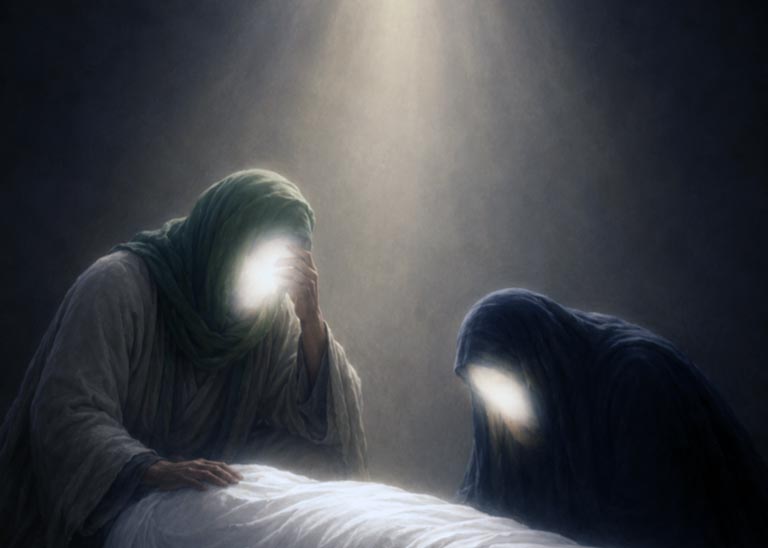
Umm Salamah relates: “By the God to whom Umm Salamah swears, the last person to meet and be with the Messenger of God (peace be upon him and his family) was Amir al-Muminin (peace be upon him). On the morning of the day he passed away, the Messenger of God had sent Ali to attend to a matter. He kept asking, ‘Has Ali come?’ and repeated this three times. At last, Ali ibn Abi Talib (peace be upon him) arrived just before sunrise. When we realized that the Messenger of God (peace be upon him and his family) wished to speak with him privately, we left the room. Amir al-Muminin (peace be upon him) leaned over the Prophet’s bedside (peace be upon him and his family), and he was the last to be alone with the Messenger of God; the Prophet then spoke to him gently and whispered with him.”[4]
The Agonizing Moments of Martyrdom
Amir al-Muminin Ali (peace be upon him), in Sermon 197 of Nahj al-Balagha, describes the final moments of the blessed life of the Messenger of God (peace be upon him and his family) thus:
“The Messenger of God (peace be upon him and his family) passed away with his head upon my chest; his breath passed through my hand, and I wiped it upon my face. I undertook his ritual washing, while the angels assisted me. The doors and walls and courtyard of the house resounded with lamentation. Groups of angels descended to the earth and groups ascended to the heavens, and my ears never ceased hearing their soft prayers over him, until we laid him in his grave. Who is more worthy than I to attend to him in his life and in his death?”
The Burial of the Seal of the Prophets
The martyrdom of the Prophet (peace be upon him and his family) marked the beginning of profound mourning for his companions, veiled in grief and sorrow. Amid this, Amir al-Muminin (peace be upon him), with wisdom and the assistance of those close to him, made the preparations for the farewell and burial of the last Messenger of God.
The Prophet (peace be upon him and his family) passed away in the embrace of Amir al-Muminin (peace be upon him), who, with the help of al-Fadl ibn al-Abbas, Usamah ibn Zayd, and others, washed and shrouded him over his garment. At the suggestion of Amir al-Muminin, people entered the Prophet’s house in groups and prayed over him without any single person leading the prayer, a practice that continued into the following day.[5][6]
According to some accounts, several sites were proposed for the Prophet’s burial (peace be upon him and his family), but all accepted the insistence of Amir al-Muminin (peace be upon him) that God takes the souls of prophets in the purest of places, and the Prophet’s body (peace be upon him and his family) was buried at the very site of his passing. Abu Ubaydah al-Jarrah and Zayd ibn Sahl prepared the grave, and Amir al-Muminin (peace be upon him), with the help of al-Fadl ibn al-Abbas and Usamah ibn Zayd, buried the Prophet’s body (peace be upon him and his family).[7]
The Affair of the Saqifah and the Divine Trial
After the martyrdom of the Prophet (peace be upon him and his family), while Amir al-Muminin (peace be upon him) was occupied with his burial, some of the companions gathered at the Saqifah to deliberate over the caliphate and succession.
When the matter of the usurped caliphate of Abu Bakr was settled and the people had pledged allegiance to him, a man came to Amir al-Muminin (peace be upon him) while he, spade in hand, was casting earth upon the grave of the Prophet (peace be upon him and his family). The man said: “The people have pledged allegiance to Abu Bakr; the Ansar have been humbled and disgraced, and the Tulaqa (those freed by the Prophet at the conquest of Mecca) rushed to pledge allegiance to Abu Bakr, lest this position should come to you!”
Upon hearing this, Amir al-Muminin (peace be upon him) drove the handle of the spade into the ground, then recited verses 1 through 4 of Surat al-Ankabut:
“In the name of God, the Most Gracious, the Most Merciful. Alif. Lam. Mim. Do the people suppose that they will be left to say, ‘We believe,’ and will not be tried? We indeed tried those who came before them, so that God may surely know those who are truthful, and He may surely know the liars. Or do those who commit evil deeds suppose that they will escape Us? Evil is their judgment.”[8]
References
[1] Al-Ghaybah* of al-Tusi, vol. 1, p. 150.
[2] Kifayat al-Athar, vol. 1, p. 226; Bihar al-Anwar, vol. 27, p. 216; Bihar al-Anwar, vol. 43, p. 363; Ithbat al-Hidayah, vol. 1, p. 344.
[3] Kitab Sulaym, vol. 2, p. 834.
[4] Bihar al-Anwar, vol. 22, p. 472.
[5] Shaikh al-Mufid, Al-Irshad, 1413 AH, vol. 1, p. 188.
[6] al-Ya’qubi, Tarikh al-Ya’qubi, Dar Sadir, vol. 2, p. 114.
[7] al-Irbili, Kashf al-Ghummah, 1381 AH, vol. 1, p. 19.
[8] Bihar al-Anwar, vol. 24, p. 230.