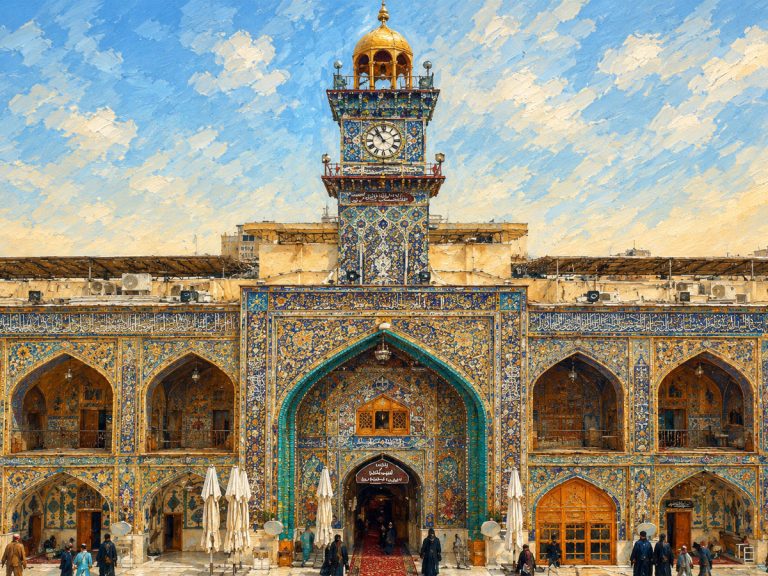
Bab Muslim ibn Aqil (peace be upon him): A Gate Toward the Stranger of Kufa
This gate is located on the eastern side of the courtyard wall, to the right of Bab al-Sa’ah and adjacent to the al-Khadra Mosque. It was opened in the year 1252 AH, corresponding to 1836 CE, by Mulla Yusuf, the custodian (sadin) of the Haydariyah Sanctuary, during the reign of the Ottoman Sultan Mahmud II (d. 1255 AH).
Former Name
This gate once opened onto the tailors’ quarter, and for this reason was known as Bab al-Abayajiyah or Bab Ahl al-Akal (“the Gate of the Cloak Sellers” or “the Gate of the Burden Bearers”).
The late Shaikh Jafar Mahbouba relates that the old Dar al-Diyafah (guesthouse), after falling into ruin during the Safavid era, was purchased by Mulla Yusuf from Shaikh Muhammad Hasan Sahib al-Jawahir. He rebuilt it as a tailors’ market, and it was at this same time, in the month of Rajab 1252 AH, that he opened this gate to provide access to the Qaysariyah.
It is worth noting that a large portion of this market was demolished in the year 1368 AH, corresponding to 1949 CE, during the Kingdom of Iraq, by order of the mutasarrif (governor) of Karbala, Abd al-Rasul al-Khalisi, during the construction of the ring road surrounding the courtyard. In the early 1980s, the remainder of this market, along with all the buildings attached to the wall of the sacred Alawi courtyard, was also removed.
Reconstruction and Renaming
In the year 1371 AH, corresponding to 1951 CE, this gate was rebuilt once again. The work took place during the tenure of the Qa’im-Maqam of Najaf, Master Diya Shukarah, and its outer façade was adorned with Karbalai tiles. At this same time, it was officially given the name Bab Muslim ibn Aqil (peace be upon him). It appears that the reason for this naming was that the gate faces toward the shrine of Muslim ibn Aqil, the Stranger of Kufa.
Bab al-Faraj
Bab al-Faraj is the most recently opened gate in the sacred courtyard. It is located on the western wall of the courtyard and once opened onto the al-Amarah quarter (known today as the courtyard of Lady Fatimah). The order to construct and open this gate was issued by the Ottoman Sultan Abdulaziz in the year 1279 AH, corresponding to 1862 CE.
The late Sayyid al-Baraqi writes on this matter: “In the year 1279 AH, a gate was opened on the western side of the sacred courtyard, and it was named Bab al-Faraj, and a market subsequently arose on that side.”
The starting year of the works to open this gate (1279 AH) is recorded and preserved in historical writings by Shaikh Abbas ibn Shaikh Hasan Al Kashif al-Ghita.
The Reason for Bab al-Faraj’s Alternate Name: Bab al-Salatin
After nearly nine years of continuous work — a considerable span of time — Bab al-Faraj was finally opened in the month of Rajab 1287 AH, corresponding to 1870 CE. To commemorate this event, a tughra (Iranian and Islamic calligraphic inscription) bearing the name of the Ottoman Sultan Abdulaziz was installed at the entrance of the gateway, reading: “Abdulaziz Khan ibn Mahmud al-Muzaffar Da’iman,” with the date inscribed below it as “Rajab 8,” referring to the year 1287 AH.
Given the good relations between the Iranian and Ottoman states at the time, and coinciding with the journey of the Iranian Sultan Nasir al-Din Shah Qajar to the holy shrines of Iraq that same year (1287 AH, corresponding to 1870 CE), it was decided that he would enter Najaf through this newly built gate upon his arrival. This gesture was made by the Ottoman Sultan as a mark of honor toward him. For this reason, during that same period, in addition to the name “Bab al-Faraj,” this gate also became known as “Bab al-Salatin” (the Gate of the Sultans).
Bab al-Faraj: A Gate Built in Honor of the Shah of Iran!
Shaikh Muhammad Hussain Harz al-Din states:
“This gate is the fifth gate of the sacred courtyard and, at the same time, the last one to be opened. The reason for its naming is that the Ottoman Sultan Abdulaziz specifically ordered the opening of this gate for Nasir al-Din Shah Qajar, the Sultan of Iran, so that he might enter through it during his pilgrimage to the holy shrines of Iraq (in the year 1287 AH).
Upon Nasir al-Din Shah’s arrival in Najaf, the Ottoman Sultan held magnificent ceremonies in his honor, including the inauguration of this new gate. This gate was, in effect, a chamber within the courtyard wall, featuring, like the other iwans, a raised and projecting iwan structure above the doorway. In addition to the name Bab al-Salatin, this gate is also known as Bab al-Faraj. The market that arose alongside the opening of this gate likewise became known as Suq Bab al-Faraj.”
The Account of Nasir al-Din Shah’s Journey to Najaf
The late Shaikh Jafar Mahbouba relates, citing Muntazam-i Nasiri (vol. 3, p. 315):
“In the year 1287 AH, on the thirteenth day of the month of Ramadan, Sultan Nasir al-Din Shah entered Najaf on pilgrimage, and on the twentieth day of that same month, he set out for Karbala. He bestowed favors upon those residing near the sacred shrine and presented gifts to the Holy Alawi Shrine, among them a diamond piece inscribed with Surat al-Mulk, which was entrusted into the hands of the shrine’s custodian.”
Following this, the gate underwent several rounds of restoration. In the years 1380 AH (corresponding to 1960 CE) and 1382 AH (corresponding to 1962 CE), its tilework was renewed. Likewise, in the year 1391 AH, corresponding to 1971 CE, two lines of poetry composed by Hajj Abd al-Zahra Fakhr al-Din were inscribed on tiles directly above the wooden door.
The Tughra (Seal of the Ottoman Sultans) on Bab al-Faraj
It is worth noting that the tughra (royal seal) belonging to this gate was, at some unknown point, removed from its original place above Bab al-Faraj and installed instead on one of the walls of the Habboubi Iwan. It appears that the reason for this relocation was the restoration of the gate’s tilework, coupled with a lack of awareness of the nature and historical significance of this tughra.
On the first of Jumada al-Ula 1444 AH, corresponding to 2022 CE, this tughra (royal seal) was removed from the wall of the aforementioned iwan, and the Engineering and Construction Affairs Department, through its “Nafa’is” (Treasures) and “Manqushat” (Inscriptions) units at the Holy Alawi Shrine, undertook its restoration. In this process, the background of the piece was coated with a cold turquoise-colored enamel material, and its lines were adorned with gold leaf. This tughra (royal seal) is made of white marble and measures approximately 52 centimeters in length and 67 centimeters in width.
Upon completion of the restoration, this historic piece was returned to its original position, above the entrance of Bab al-Faraj (on the interior side facing the sacred courtyard). Its unveiling took place on the thirteenth of Rajab 1444 AH, corresponding to 2023 CE, coinciding with the blessed anniversary of the birth of Amir al-Muminin Ali (peace be upon him).
Subsequently, on Sunday, 19 Sha’ban 1444 AH, corresponding to March 12, 2023 CE, work began on removing the tiles from the exterior façade of Bab al-Faraj. This operation was carried out by engineers from the Kowsar Institute of Iran. Following the restoration of the walls, the exterior façade was refurbished with Iranian marquetry (moarraq) tilework, while the text of the old inscriptions was preserved exactly as it had originally appeared. This project was fully completed on Wednesday, 20 Jumada al-Thani 1445 AH, corresponding to January 3, 2024 CE, coinciding with the anniversary of the birth of Lady Fatimah (peace be upon her).
Maintenance and Restoration of the Sacred Courtyard’s Doors
By order of the Deputy Custodian of the Holy Alawi Shrine, in the year 1428 AH, corresponding to 2007 CE, the carpentry workshop affiliated with the Shrine’s Engineering and Construction Affairs Department undertook the restoration and repainting of the main doors of the sacred Alawi courtyard. New wooden windows of teak were also crafted and installed for the upper façades of the doors of Shaikh al-Tusi, al-Qiblah, and al-Faraj, which faced outward from the courtyard. This work was carried out after the removal of the old façades, which had sustained considerable damage over the preceding years.
In the year 1430 AH, corresponding to 2009 CE, a new wooden window was installed on the exterior side of Bab al-Sa’ah. Likewise, the old metal façade that had stood above Bab al-Sa’ah on the interior side was removed and replaced with a new façade of carved teak, inlaid with sesame wood and rārinj (Persian ebony-like wood). In addition, a new convex mirror replaced the old concave mirror, allowing visitors to view the complete reflection of the sacred Alawi shrine.
In the year 1431 AH, corresponding to 2010 CE, the Shrine’s carpentry personnel completed the restoration and repainting of the wooden façades of the chambers in which great religious authorities (maraji’) are buried — among them the resting places of Shaikh Murtada al-Ansari and Sayyid Abu al-Hasan al-Isfahani. Likewise, the wooden façades of Bab al-Sa’ah, Bab Muslim ibn Aqil (peace be upon him), and all the doors of the chambers located within the iwans of the sacred Alawi courtyard were also restored and renovated.
Taken from the book “Tarikh al-Marqad al-Alawi al-Mutahhar” .