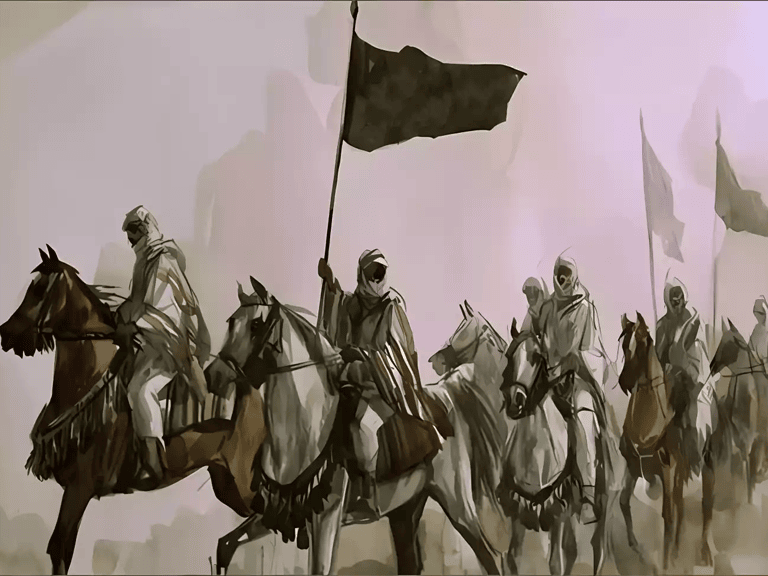
Al-Mukhtar ibn Abi ʿUbayd al-Thaqafi, a member of the noble tribe of Thaqif, was the son of Abu ʿUbayd al-Thaqafi — one of the Companions of the Messenger of Allah (peace be upon him and his family).
Al-Mukhtar belonged to the generation of the Tābiʿīn (those who followed the Companions), and following the tragedy of Karbala, he rose in a historic revolt to avenge the blood of Imam al-Ḥussain (peace be upon him).
During the events leading up to the Karbala tragedy, Mukhtar hosted Muslim ibn Aqīl, the envoy and representative of Imam al-Ḥussain (peace be upon him) in Kufa, and assisted him until the moment of his martyrdom. Afterward, Mukhtar was arrested by the order of Ubaydullah ibn Ziyad and imprisoned — which is why he was absent from Karbala on the Day of Ashura.
The Title Bestowed Upon Al-Mukhtar by Imam Amir al-Muʾminin (Peace Be Upon Him)
Aṣbagh ibn Nubata, one of the devoted companions and distinguished disciples of Imam Ali (peace be upon him), recounts:
“I once saw the Commander of the Faithful (peace be upon him) place the young Mukhtar — still a child — upon his blessed knee. The Imam gently stroked the boy’s head and said with affection, “al-Kayyis” O intelligent one, O intelligent one.
Some narrations record the word with emphasis (intelligent), meaning “exceedingly wise.” Because the Imam uttered it twice, the epithet al-Kayyis (“the wise one”) became associated with Mukhtar.
This, according to major Shia scholars such as ʿAllamah Ibn Namma and Grand Ayatollah Sayed Abu al-Qasim al-Khoei, is the origin of his famous title.
Another interpretation holds that Mukhtar’s close friend and counselor, Kaysan, from whom he received encouragement to rise and guidance in his mission, lent his name to Mukhtar as an honorific.
Kaysan — also known as Abu ʿAmrah — was one of Mukhtar’s most courageous commanders, renowned for his relentless pursuit of the murderers of Imam al-Ḥussain (peace be upon him).
Imam Ali’s (Peace Be Upon Him) Prophecy of Mukhtar’s Revenge
In both Shia and Sunni sources — particularly in the books of Malaḥim wa Fitan (prophecies and tribulations) — narrations exist from the Prophet (peace be upon him and his family) and from Imam Ali (peace be upon him) foretelling future events.
Among these prophecies are the martyrdom of Imam al-Ḥussain (peace be upon him) and the subsequent uprising of al-Mukhtar.
The revered scholar al-Muqaddas al-Ardabili narrates that Imam Ali (peace be upon him) said:
“My son al-Ḥussain shall be slain, and soon thereafter, a young man from the tribe of Thaqif will rise. He will exact vengeance upon the oppressors, slaying three hundred and eighty-three thousands of them.”
While some may find this number remarkable or hyperbolic, historical accounts affirm that Mukhtar’s revolution resulted in the downfall of a vast number of those who had participated in or supported the killing of Imam al-Ḥussain (peace be upon him).
The leading perpetrators — many residing in Iraq — were executed at Mukhtar’s command.
Moreover, in the battles following his victory in Kufa and during the confrontation led by Ibrahim ibn al-Ashtar against Ibn Ziyad and the army of Syria, tens of thousands perished.
Thus, the immense figure mentioned in the narration need not be regarded as implausible.
The Imam’s Testimony and the Divine Vengeance
Allamah al-Majlisi relates a narration in which Imam Amir al-Muʾminin (peace be upon him) said:
“Just as among the Bani-Israel there were those who obeyed and were honored, and others who disobeyed and were punished, so shall it be with the Ummah of Muhammad (peace be upon him and his family).”
When asked who the disobedient would be, the Imam (peace be upon him) replied:
“Those who were enjoined to honor and preserve the rights of the Ahl al-Bayt but betrayed and opposed them; those who denied our rights, disrespected our sanctity, and shed the blood of our sons — the very sons of the Messenger of Allah ((peace be upon him and his family).”
They asked: “O Commander of the Faithful, will this truly come to pass?”
The Imam said: “Indeed, it is certain. My two sons, al-Ḥassan and al-Ḥussain, shall both be slain.”
Then he continued:
“Soon the oppressors shall face one whom God will raise to avenge the blood of the wronged — a man from the tribe of Thaqif, known as Mukhtar ibn Abi Ubayd.”
The eminent scholar al-Mamqani writes:
“This narration is among the strongest proofs of al-Mukhtar’s sincere faith and loyalty to the Imams, for the Commander of the Faithful (peace be upon him) — who was aware of what was yet to come — could not have spoken in error regarding his fate.”