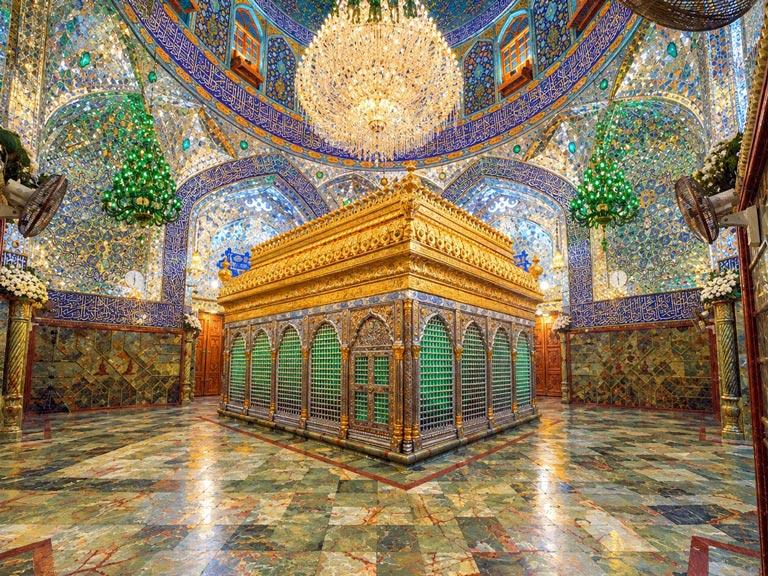
Gilding of the Sacred Zarih
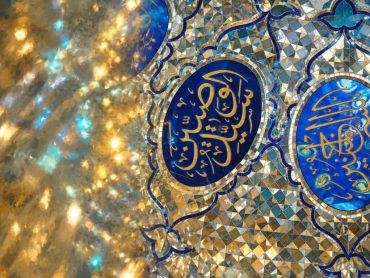
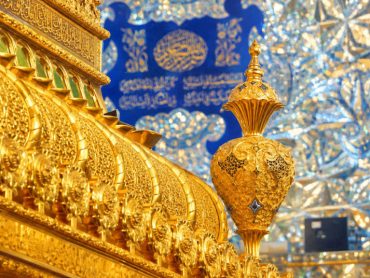
The technical staff of the Bohra community, under the supervision of the Holy Alawi Shrine, restored several parts of the sacred zarih. The first measure was the regilding of the zarih, carried out on 23 Jumada al-Awwal 1426 AH, corresponding to 9 Tir 1384 SH. In this operation, the golden crown of the zarih was regilded by hand-hammering, using 25 kilograms of pure gold. The flowers around the golden crown and the blessed Names of Allah (the Beautiful Names) inscribed upon it were also inlaid with rubies. This work began in the month of Muharram at the Fayd al-Hussaini Institute in Najaf and was completed in Rajab 1427 AH, corresponding to 1385 SH. The project’s completion was officially announced in Sha’ban of that year, coinciding with the birth anniversary of Imam Zayn al-Abidin (peace be upon him).
Reconstruction of the Zarih’s Interior Ceiling
In 1429 AH, corresponding to 1387 SH, the specialized staff of the Holy Alawi Shrine oversaw another project. In it, the central section of the zarih’s interior ceiling was carved and ornamented with Burmese teak and veneered with local bitter-orange wood and Indian sissoo wood. In the past, this section had been decorated with plain plywood boards covered only with oil paint. The new work was carried out voluntarily by the carpenter Hajj Kifah Shimarti in his workshop in Najaf.
Installation of New Silver Pillars
In 1430 AH, corresponding to 1388 SH, with financial contributions from the Bohra community, the installation of four new corner pillars of the sacred zarih was completed. These pillars are made of pure silver and topped with gold-plated crowns. They were of great artistic value, from the delicacy of their craftsmanship to the beauty of their designs and the inscriptions engraved upon them. Among these inscriptions are the blessed phrases “Ya Ali” and “And He is the Most High, the Most Great,” set in rubies.
These pillars were made in Karachi, Pakistan, and approximately 20 kilograms of gold were used to gild them. After the replacement, the old pillars were kept in the storerooms of the Holy Shrine.
In 1431 AH, corresponding to 1389 SH, the golden crowns of the corner pillars were changed once more. They were replaced with crowns of pure gold, adorned with three rows of rubies and inlaid with new designs and diamonds. In this operation, the gold used for the four pillars reached 15,453 grams and the silver 40,000 grams. In this way, the sacred zarih, with its new, radiant pillars, gained redoubled splendor in time for the blessed birth anniversary of Amir al-Muminin Ali ibn Abi Talib (peace be upon him).
Reconstruction and Gilding of the Zarih’s Door
The door of the zarih had suffered serious damage over time. In particular, its supporting timbers had rotted from water poured by some pilgrims, which also disrupted the technical function of opening and closing the door. After consultation between the deputy custodian of the Holy Shrine and the Bohra community, it was decided to rebuild and fully regild it. In this process, the door’s original structure and all its artistic details, including floral motifs, Quranic inscriptions, and noble hadiths, were fully preserved and carefully recreated.
Precise measurements were taken, and the final design was completed in Dhu al-Hijjah 1431 AH, corresponding to 1389 SH. The project was carried out with the financial support of the Sultan of the Bohras, Muhammad Burhan al-Din.
Construction and Installation of the Zarih’s Door
The door was built in the technical workshops of the Bohra community in Karachi. It is 2 meters high and 1.10 meters wide, with a total weight of approximately 450 kilograms. About 43 kilograms of gold and 220 kilograms of silver were used in its construction.
The letters of “Bismillah” above the door’s lintel were inlaid with about 40 carats of natural diamonds. The frames of the twin flowers, within which the phrase “Ya Ali” was engraved, were also decorated with diamonds, and the phrase itself was inlaid with about 1,500 carats of rubies.
After six months of continuous work, the zarih’s door was completed with artistic design and execution. On Monday, 29 Rabi al-Thani 1432 AH, corresponding to 14 Farvardin 1390 SH, it was transported from Pakistan to Najaf on a chartered aircraft. Thirty master craftsmen and technical specialists from the Bohra community accompanied the door on this journey.
From the following day, the removal of the old door and the installation of the new one began, lasting 17 days. Finally, on Thursday, 16 Jumada al-Awwal 1432 AH, corresponding to 31 Farvardin 1390 SH, the new door was unveiled. The old door was kept in the storerooms of the Holy Shrine.
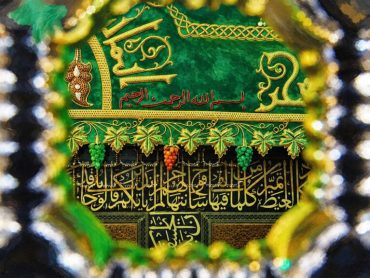
Notably, at this stage, the two side pillars of the door (on the right and left) were replaced with new pillars adorned with golden bands, ornamental crowns, and clusters of grapes in pure gold.
At the beginning of Dhu al-Hijjah 1436 AH, corresponding to 1394 SH, with a group of professors and students of the Najaf seminary in attendance, the project of 20 new pillars for the sacred zarih was inaugurated. Each pillar weighed 30 kilograms of silver and was inlaid and adorned with 20 kilograms of pure gold.
Renewal of the Zarih’s Silver Latticework
On the first of Rabi al-Awwal 1438 AH, corresponding to 1396 SH, work began on renewing the seventeen silver latticed windows of the sacred zarih. In this operation, the original design of the latticework was preserved, while approximately 225 kilograms of silver were added to each window. The phrase “Ya Ali,” previously engraved in silver on both sides of the upper part of each window, was replaced with a circular flower motif of pure 24-karat gold. These letters were inlaid with rubies.
The upper part of the latticework was covered from the inside with engraved Burmese teak, each piece of which was adorned with 30 pentagonal pieces of red Yemeni agate. Further artistic improvements were also made to the 20 middle pillars between the windows.
Another important point is that a lamp holder (mishkat) of pure gold was hung in the middle of the zarih’s ceiling, a gift from the Sultan of the Bohras, Mufaddal Saif al-Din.
In addition, the flooring of the passage between the Khatam Chest and the latticework was renewed with fine Indian marble. This marble had two veins of Indian agate and took on a beautiful appearance with red and green floral patterns.
Finally, after more than a month of continuous work, on Friday, 7 Rabi al-Thani 1438 AH, corresponding to 17 Dey 1395 SH, the sacred zarih was unveiled in its new form in a magnificent ceremony attended by a group of professors of the Najaf seminary.
The Karbalai poet Ali al-Saffar also recorded the year of the renewal of the silver latticework of the zarih of Amir al-Muminin (peace be upon him), 1438 AH, as a chronogram in verse.
Regilding of the Sacred Zarih’s Crown
In keeping with the deputy custodian of the Holy Shrine’s constant attention to preserving the artistic and technical condition of the sacred zarih, and in view of changes that had appeared in the gold plating of the zarih’s crown (which is made of pure silver), the work of opening up and detaching the crown’s pieces began on Monday, 2 Rajab 1445 AH, corresponding to 24 Dey 1402 SH.
These pieces were transferred to the gilding workshop affiliated with the Holy Shrine for comprehensive restoration and regilding, so that skilled and specialized technical staff could rebuild and gild them with care and delicacy.
The Chest of the Noble Tomb (the Khatam Chest)
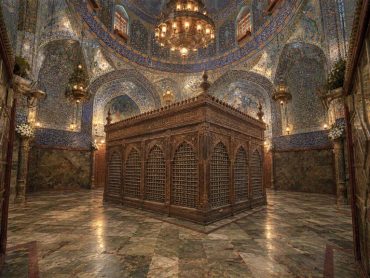
The Khatam Chest is the structure placed over a grave, and it is most often made of wood. The first person to place a chest over the grave of Amir al-Muminin (peace be upon him) was a member of the Abbasid house named Dawud al-Abbasi. This took place in 273 AH, corresponding to 886 CE, as expiation for a sin he had committed. He had sought to exhume the sacred grave in order to reveal its reality and expose its secret, but with the manifestation of an evident miracle of Amir al-Muminin (peace be upon him), he was prevented from this ill intention.
This exhumation incident occurred during the caliphate of al-Mu’tamid al-Abbasi (256–279 AH). It coincided with the collapse of the roof of the shrine of Imam al-Hussain ibn Ali (peace be upon him) on the ninth of Dhu al-Hijjah in 273 AH, corresponding to 887 CE.