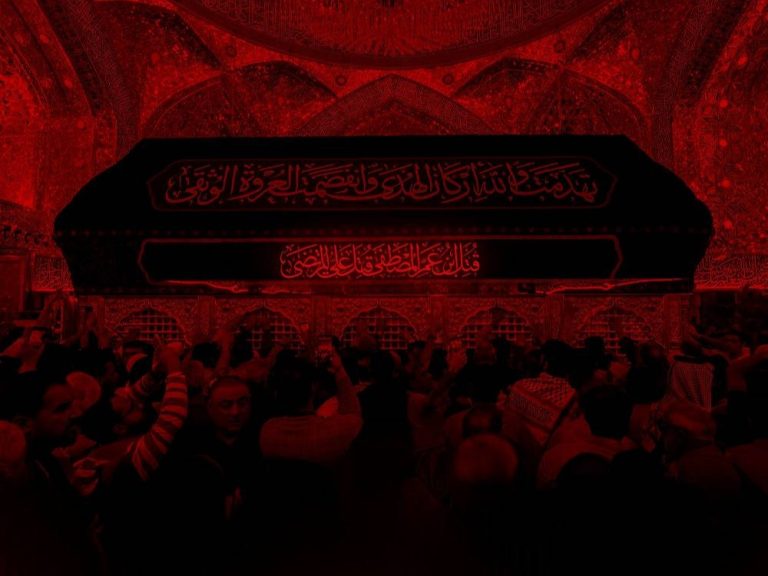

After the end of the Umayyad rule and the removal of imminent threats, Imam Jafar al-Sadiq (peace be upon him) revealed the burial site to his Shia followers and instructed them to visit it. To mark the location, he constructed a small canopy over the grave. Following this revelation, the continuous visitation of the shrine became established as a tradition.
Shaikh al-Mufid narrates:
“The grave remained concealed until the time of Imam al-Sadiq (peace be upon him). Upon his arrival in al-Hirah, he revealed its location, and the Shia began visiting it.”
Imam Jafar al-Sadiq (peace be upon him) revealed the grave in 132 AH, prior to the reign of Harun al-Rashid, encouraging people to perform visitation.
Destruction of the Sacred Shrines by Abbasid Caliphs
The practice of visitation continued until 236 AH, when Caliph al-Mutawakkil ordered the demolition of the canopy over the graves of both Amir al-Muminin (peace be upon him) and Imam al-Hussain (peace be upon him), forbidding Shia from visiting these sacred sites. This action was part of a broader policy aimed at suppressing the Shia and intimidating the Ahl al-Bayt (peace be upon them).
Shaikh al-Masudi reports:
“The family of Abu Talib faced immense hardships during this period, with their lives constantly under threat. Al-Mutawakkil commanded the destruction of Imam al-Hussain’s grave and the obliteration of any signs of it. Visiting the sites was punishable by severe penalties.”
Al-Mutawakkil’s Oppression Against the Ahl al-Bayt
During al-Mutawakkil’s reign, his minister, Abdullah ibn Yahya ibn Khaqan, was a staunch adversary of the Ahl al-Bayt and continually urged the caliph to persecute the Shia and the Prophet’s family (peace be upon him and his family).
Upon learning that Shia continued to visit the sacred shrines, particularly those of Amir al-Muminin (peace be upon him) and the Karbala martyrs, al-Mutawakkil grew furious. He ordered the destruction of the surrounding areas of Imam al-Hussain’s grave, irrigation of the site to destroy it, and even enlisted Jewish agents to prevent Muslim visitation, with violators facing arrest or execution.
His hostility was partly fueled by personal biases and adherence to anti-Shia ideologies. One famous incident involved his concubine, Umm al-Fadl, who traveled to Najaf to visit Imam Ali’s shrine, provoking al-Mutawakkil to prohibit visits to the Ahl al-Bayt’s graves entirely.
Despite public protests in Baghdad—including inscriptions on walls and mosques and critical poems by figures such as Dubal—al-Mutawakkil’s oppressive policies persisted until his death.
State of the Shrines During and After al-Mutawakkil
Shaikh al-Tusi narrates:
“In 247 AH, Abdullah ibn Daniyah al-Turi, while visiting the sacred sites in Iraq, witnessed that the graves of Amir al-Muminin (peace be upon him) and Imam al-Hussain (peace be upon him) were under siege and destruction. The surrounding lands were plowed and flooded, and animals, including oxen, trod over the sacred sites. Despite these efforts, the graves themselves remained intact. Shortly after Abdullah ibn Daniyah returned to Baghdad, news arrived of al-Mutawakkil’s death, marking the end of his tyranny.”
Shaikh al-Masudi adds:
“The destruction and visitation bans caused deep concern among the Shia, many of whom were unable to visit these shrines. This situation continued until Walid ibn al-Muntasir (al-Muntasir) came to power in 247 AH. With his accession, visitation resumed, and the descendants of Imam al-Hasan and Imam al-Hussain (peace be upon them) regained the fiefs of Fadak and other endowments.”
While oppression against the Ahl al-Bayt (peace be upon them) continued under some Abbasid caliphs, al-Muntasir lifted restrictions on Shia visits. His short six-month reign allowed a brief period of religious freedom, although persecution resumed under subsequent rulers.
Incident of Exhumation Attempts
After Imam Jafar al-Sadiq (peace be upon him) revealed the grave, news reached Abbasid Caliph Abu Jafar al-Muhtadi al-Dawaniqi, who traveled with agents to al-Gharri in Najaf to investigate the burial. Ibn Tawus narrates:
“Mansur and his associates dug into the grave using shovels and picks to examine the tombstone. Upon realizing it was indeed the grave of Amir al-Muminin (peace be upon him), they reburied it immediately and confirmed its authenticity.”
In 273 AH, an Abbasid named Dawud attempted another exhumation. Witnessing the miraculous sanctity of the site, he refrained and instead placed a wooden chest over the grave, known as the Dawud Abbasid Chest.
Ibn Tawus, citing Abu al-Hussain Muhammad ibn Tamam al-Kufi, describes:
“A group of Kufan elders, including Abbas ibn Ahmad and Ismail ibn Isa Abbasid, accompanied by strong laborers, attempted to dig up the grave. One laborer was severely injured and died while attempting to break the tombstone. Dawud, Ismail’s uncle, repented and ordered a wooden chest to cover the grave, which remained until Muhammad ibn Zayd al-Dai al-Hasani constructed the first formal shrine in 283 AH, building directly over the chest.”
Shaikh al-Tusi and Ibn Tawus confirm these narrations, clarifying that while some sources erroneously attributed the construction to Hasan ibn Zayd, it was in fact Muhammad ibn Zayd who established the first shrine.
This historical record demonstrates the persistent sanctity, protection, and eventual public recognition of the grave of Amir al-Muminin (peace be upon him), despite continuous threats from successive oppressive regimes. It also highlights the reverence and protective efforts of the Ahl al-Bayt (peace be upon them) in preserving their ancestor’s burial site.