Confining duties and obligations to religious rituals and daily acts of worship, while neglecting social roles and responsibilities, is among the afflictions of certain Islamic societies. This is despite the fact that human society can only traverse the stages of religious and worldly perfection and felicity through responsible conduct and purposeful, meaningful participation.
Moderation and the Middle Path
Any idea or any matter that might under normal circumstances be regarded as a path to felicity and perfection can, if it deviates from the path of moderation and balance, lead to misguidance and error. During religious seasons, this failing not only alienates the faithful but also stands in contradiction to the very philosophy and wisdom underlying acts of worship.
The traveler who breaks his fast and performs the shortened prayer brings honor to his people according to Amir al-Muminin (peace be upon him). [1]
When Ramadan began Amir al-Muminin (peace be upon him) recommended that people should visit their family members who lived nearby their home. According to a report by Shaikh al-Mufid the practice of Amir al-Muminin (peace be upon him) during Ramadan was to visit his children every night of the month.[3]
Visiting others and inquiring after their well-being held such a high place in the priorities of Amir al-Muminin (peace be upon him) that he—citing a recollection from the Messenger of God (peace be upon him and his family)-considered joining the host at an iftar table and accepting an invitation to be more important than even performing prayer.[4]
Commitment to Propagation and Social Responsibility
The social responsibility which Imam Ali (peace be upon him) demonstrated through his work sustained him throughout all Ramadan rituals and customs of the month.
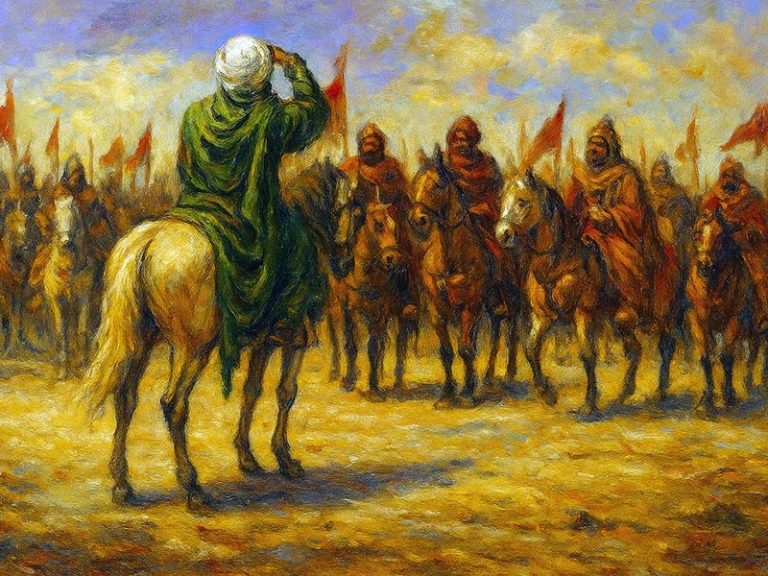
The migration of Amir al-Muminin (peace be upon him) to Yemen in Ramadan of the tenth year after the Hijra stands as one such event. During this journey, he led a missionary group with a military escort. The accompaniment of military forces was necessary because, on similar expeditions, various tribes had killed and plundered numerous groups of missionaries.
The journey to Yemen was significant on multiple levels; Yemen had long been a land where Jewish and Christian missionaries and governors had been active. On this expedition, Amir al-Muminin (peace be upon him) was accompanied by three hundred horsemen.[5]
One of the important outcomes of Amir al-Muminin’s journey to Yemen was the mass conversion of the Hamdan tribe in a single day.[6]
Upon receiving this news, the Messenger of God (peace be upon him and his family) prostrated in gratitude and, in a letter, sent his greetings three times over to the Hamdan tribe and the other newly converted Yemenis.[7] This stood in marked contrast to Khalid ibn al-Walid’s expedition to Yemen that same year, which had failed to achieve any such success.[8]