Amir al-Muminin (peace be upon him) has stated that benefiting from the spiritual blessings and achieving perfection in the worship of the holy month of Ramadan is conditional upon adhering to the principles of hygiene, healthy nutrition, and fulfilling the body’s fundamental requirements.
Cleanliness and Grooming: Tooth Brushing
In another narration, he recommends that those fasting brush their teeth in the morning. In response to the objection that the moisture from the toothbrush might nullify the fast, he cited the permissibility of rinsing the mouth with water, which creates more moisture. [2]
Thus, brushing the teeth, apart from its effective role in health and hygiene, contributes significantly to physical beauty and fresh breath. Attention to this importance is observed in Amir al-Muminin’s recommendation for those fasting to use a toothbrush at the beginning and end of the day. [3]
Health and Well-being: Eating Two Meals
In a hadith, after emphasizing the importance of eating two meals, pre-dawn and Iftar, Amir al-Muminin (peace be upon him) deems it necessary, in terms of explaining the necessity, to eat at least half a date at Iftar and a sip of water at pre-dawn. [4]
In another narration, Amir al-Muminin introduces the realization of the virtues and worship of Ramadan as dependent on maintaining health and meeting the body’s basic needs. He states that benefiting from the blessings of fasting is linked to eating food at dawn, and the ability to perform night vigils is connected to sleeping during the day. [5]
Recommendations to use certain food items such as dates and a type of halwa made from oil and wheat or barley flour [6] and to brush the teeth after eating at the pre-dawn meal and before eating at iftar [7] are among the matters that indicate Amir al-Muminin’s (peace be upon him) emphasis on health and well-being during Ramadan.
Prayer Takes Precedence, Except When Food Is Served
The recommendation of Amir al-Muminin (peace be upon him) to give precedence to prayer at the time of iftar, except when the food is ready and the table is set, is one of the pieces of advice that has a health-related basis. [8] This is because the smell and sight of prepared food not only diminish one’s focus during prayer but may also cause harm to the body due to the secretion of digestive enzymes and saliva.
The Best Time for a Pre-Dawn Meal
In the above-mentioned hadith, Amir al-Muminin (peace be upon him) recommends postponing the pre-dawn meal until the time immediately before the dawn call to prayer and rushing to break the fast immediately after the sunset call to prayer. [9]
Suggested Food Items During Ramadan
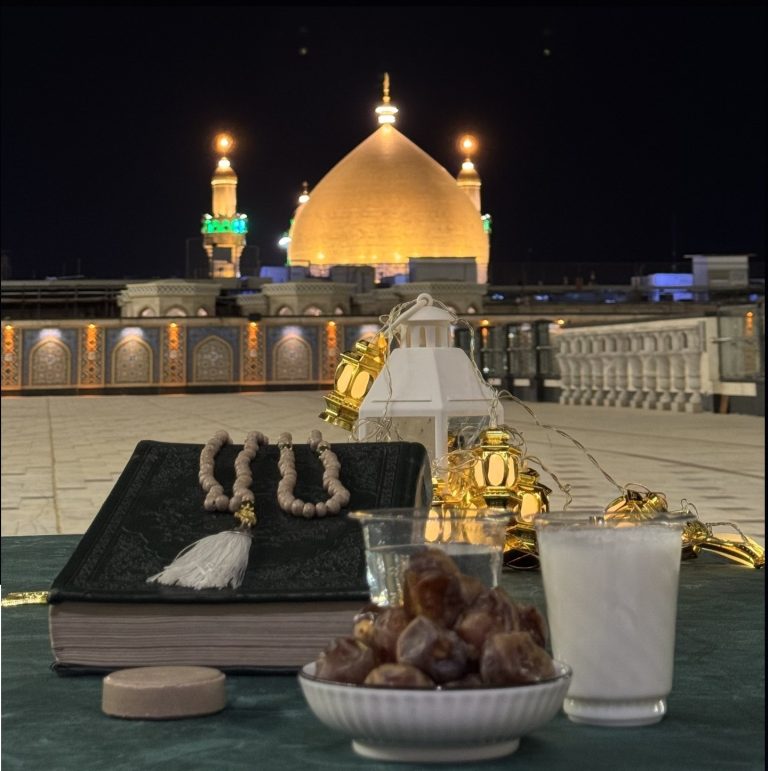
It appears that Amir al-Muminin’s practice of using food items such as dates, barley bread, salt, and milk during the month of Ramadan incorporates health considerations. [10] [11]
Therefore, the type and quality of food items can be considered among the matters to which Amir al-Muminin (peace be upon him) paid attention during Ramadan. Of course, it should not be forgotten that the type, quality, and timing of using certain foods, or other health recommendations, might have been made considering the environmental and regional conditions of the Hijaz or Kufa. Hence, extracting the fixed principles and variable approaches from the biography of the Infallibles (peace be upon them) across different domains and varying temporal and spatial conditions is a subject that requires comprehensive research.