We have heard and read much about Eid al-Ghadir. However, these accounts sometimes lack a logical, simple, and fluent progression, making it hard to remember and review them easily. So when asked to speak more about the event of Ghadir Khumm, we settle for saying that after performing Hajj, the Prophet (peace be upon him and his family) gathered Muslims in the Ghadir area by divine command and appointed Imam Amir al-Muminin (peace be upon him) as his successor and Commander of the Faithful.
As we celebrate one of the greatest and most important Islamic festivals every year on Eid Ghadir, it befits us to know, read, and speak about it in a manner worthy of that occasion. In this report, we take a brief look at the event of Ghadir and provide a concise profile of this great Eid.
What does Ghadir mean?
Ghadir literally means “pool” or “water reservoir”; more precisely, in Arabic, it refers to a depression in the desert where rainwater gathers. Between the two great cities of Mecca and Medina lies an area called “Juhfah,” through which Hajj caravans passed during the Prophet’s time (peace be upon him and his family). Juhfah is one of the five miqats where pilgrims enter ihram for Hajj or Umrah. Even today, it is one of the two miqats where Shia enter ihram. The Ghadir pool is located in the Juhfah region. The reason it is called “Khumm” is that the pool there was shaped like dyers’ vats, and some desert tribes occasionally washed their dyed clothes in it.
What was the background of Ghadir? How many Muslims accompanied the Prophet on Hajj?
It was Dhu al-Qa’dah of 10 AH, and the Prophet (peace be upon him and his family) decided to perform Hajj-what became known as the “Farewell Hajj,” as it was his last. While in Mina during the Tashriq days (three days after Eid al-Adha), he announced this was his final Hajj. On the 24th of Dhu al-Hijjah, he told the people:
“O people! Learn the rites of Hajj from me, for you may not see me again.”
When news of the Prophet’s final Hajj reached other Muslims, they flocked to him in droves. Some narrations estimate his companions on this Hajj at 90,000 to 124,000—a vast number for that era. It is said that Amir al-Muminin (peace be upon him)was in Yemen promoting Islam at the time and rushed to join the Prophet before the Hajj rites began upon hearing the news.
What is the date of Eid Ghadir?
There is little disagreement among Sunni and Shia sources on the date of Ghadir. According to many, it was Sunday, the 18th of Dhu al-Hijjah, 10 AH, when Muslims halted on their return from Hajj in the Ghadir Khum area and listened to the Prophet’s words (peace be upon him and his family). The exact time of the gathering is not precisely known, but Sheikh Tabarsi reports that Gabriel descended on the Prophet when five hours of the day had passed regarding the divine command to announce Ali’s succession (peace be upon him). Fattal Nayshaburi similarly states: “Five hours into the day, Gabriel brought the message of divine decree to the Prophet.” This means around noon, under the scorching sun of Ghadir, the Prophet received and conveyed the divine command: “Those ahead should return to Ghadir, and those behind should join the caravan at Ghadir Khumm.”
How many gathered at Ghadir? Were all Muslims present?
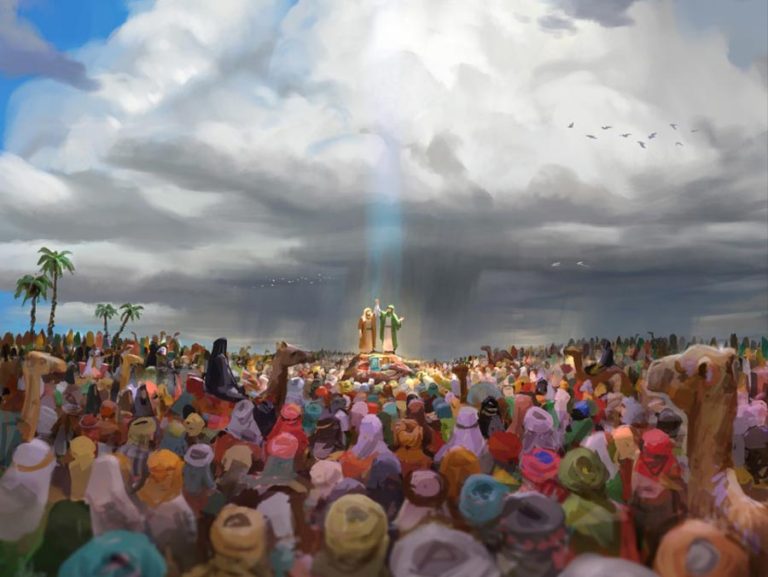
The core attendees at Ghadir were Medina residents and others from surrounding tribes, likely northern Najd tribes. Given Medina’s population, it could send about 5,000 to Mecca; thus, a narration in Tafsir al-Ayyashi from Imam Sadiq (peace be upon him) estimates 10,000 present. Based on “Jami’ al-Akhbar,” around 5,000 from Medina and a similar number from nearby tribes were there.
Thus, it can be confidently concluded that at least 10,000 Muslims who were present at Hajj were also at Ghadir Khumm. What is more important than the number of attendees at the Ghadir event is the presence of prominent figures from Mecca and Medina and the greats of early Islam. Figures who, after the Prophet’s sermon (peace be upon him and his family), congratulated Amir al-Muminin (peace be upon him), but later plotted another scheme and drew up another plan!
Recounting the Event of Ghadir Khumm: Let Those Present Convey to the Absent
Which verse was revealed to the Prophet (peace be upon him and his family) on the Day of Ghadir?
Now that Muslim groups, large and small, from across Islamic lands have journeyed to Mecca, performed Hajj alongside the Prophet (peace be upon him and his family), and are returning from Mecca, before the people of Syria, Egypt, and Iraq disperse from the pilgrims and create distance among Muslims, the Prophet’s command spreads caravan to caravan, ear to ear:
“Those who have gone ahead should return to Ghadir, and those behind should join the caravan at Ghadir Khumm.”
What has happened? A buzz arises. The pilgrims-Muhajirun, Ansar, old and new Muslims-all expectant, with searching ears and eyes, wonder why the Prophet (peace be upon him and his family) has halted them in this scorching heat and ordered the stragglers and frontrunners to join him at Ghadir Khumm. But does the Prophet command, advance, halt, permit, or forbid except by the permission of his Lord?
The divine command has descended:
“O Messenger! Convey what has been revealed to you from your Lord. If you do not, you will not have conveyed His message” (Quran 5:67).
What is that message? What grave and crucial matter has prompted the Prophet (peace be upon him and his family) to order this halt? Which verse has detained nearly thousands of pilgrims and Muslims at Ghadir Khumm?
How old was Amir al-Muminin (peace be upon him) on the Day of Ghadir?
The Day of Ghadir occurred in the 10th year of Hijrah. Determining Imam Amir al-Muminin’s age that day depends on which narration we accept regarding his birth. The most common view among historians is that he was born in the 30th year of the Year of the Elephant, i.e.,10 years before the Prophet’s mission (peace be upon him and his family). Thus, Imam Amir al-Muminin (peace be upon him) was 33 years old on Ghadir Day. Another view holds he was born 12 years before the mission, making him 35 then.
What was the Prophet’s mission on the Day of Ghadir? What happened at Ghadir?
Now that Muslims have gathered at Ghadir Khum, it is time for the Prophet (peace be upon him and his family) to speak and reveal the secret of this historic gathering. Under the unbearable sun but cooled by the pure presence of the Prophet (peace be upon him and his family) and his companions, they sit or stand, eyes fixed on the Seal of Prophets’ lips.
The Prophet (peace be upon him and his family), eager with the mission on his shoulders, awaits the appointed moment. Due to the heat, a shaded pulpit is built for him. Calmly, with heavenly serenity, heartfelt assurance, and fulfillment of divine duty, he ascends and begins the sermon:
اَلْحَمْدُ لِلَّهِ الَّذی عَلا فی تَوَحُّدِهِ وَ دَنا فی تَفَرُّدِهِ وَجَلَّ فی سُلْطانِهِ وَعَظُمَ فی اَرْکانِهِ
” He praises and thanks God.
The Sermon of Ghadir:
وَأُقِرُّلَهُ عَلی نَفْسی بِالْعُبُودِیَّةِ وَ أَشْهَدُ لَهُ بِالرُّبُوبِیَّةِ، وَأُؤَدّی ما أَوْحی بِهِ إِلَی حَذَراً مِنْ أَنْ لا أَفْعَلَ فَتَحِلَّ بی مِنْهُ قارِعَةٌ لایَدْفَعُها عَنّی أَحَدٌ.
After testifying to God’s oneness, affirming servitude to God, and stating his divine mission the first part ends, and the second begins:
“I affirm my servitude to Him and bear witness to His Lordship, and I convey what He has revealed to me, fearing that if I do not, a calamity may befall me that none can avert.” “There is no god but He. For He has informed me that if I do not convey what He has revealed to me regarding Ali, I will not have fulfilled His message. And He, the Blessed and Exalted, has guaranteed me protection from people, and He is Allah, the Sufficient, the Generous.”
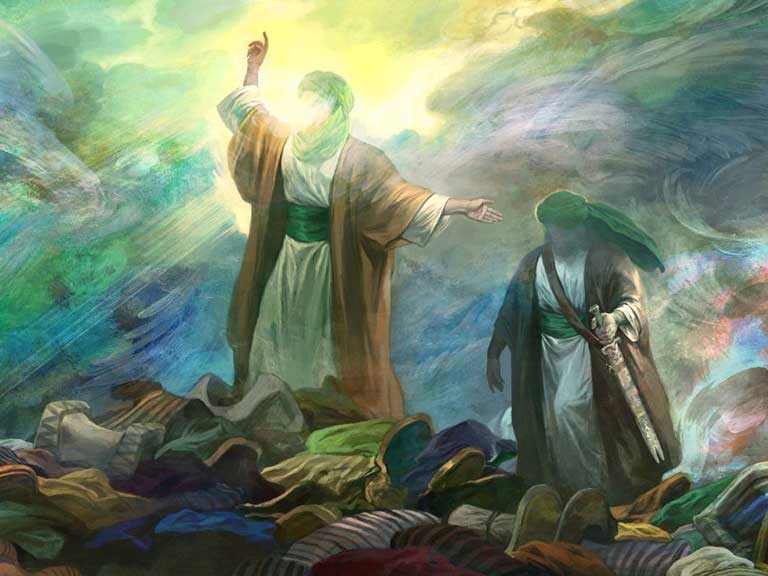
Standing upon the pulpit, the Prophet (peace be upon him and his family) was as if he saw the culmination of a lifetime of Jihad, struggle, propagation, worship, servitude, and his divine mission in fulfilling this final heavenly obligation. He then spoke of Ali ibn Abi Talib (peace be upon him ), conveying the divine command for the succession of the Commander of the Faithful (peace be upon him) to all ears.
One after another, his words and sentences echoed across the desert of Ghadir. The Muslims had rarely-perhaps never-seen the Prophet (peace be upon him and his family) as resolute and serious as they did today while he introduced the Commander of the Faithful, Amir al-Muminin (peace be upon him). The more he spoke, the thirstier the crowd grew for his words, and it seemed the Prophet (peace be upon him and his family) himself was increasingly eager to speak of the virtues of Imam Amir al-Muminin (peace be upon him).
Finally, the sermon reached its climax:
“Whomsoever I am his Mawla (Master/Leader), this Ali is his Mawla…”
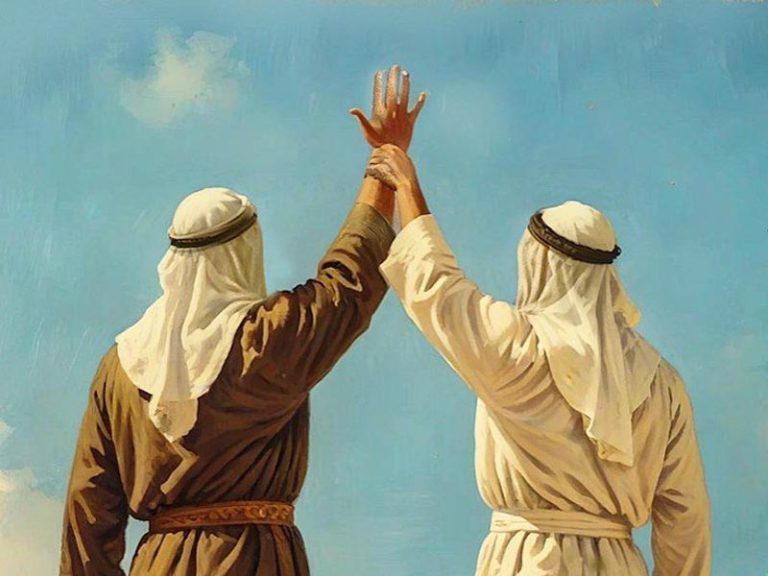
He then summoned Amir al-Muminin (peace be upon him) and took his hand. Addressing the pilgrims, he asked: “O people! Am I not more entitled to authority (Wilayah) over you than your own selves?” The crowd replied: “Yes, O Messenger of Allah!” The Prophet (peace be upon him and his family) stated: “Allah is my Wali, and I am the Wali of the believers, and I am more entitled to authority over you than yourselves.”
Then, the Messenger of Allah (peace be upon him and his family) shouted across the heights of history:
“Whomsoever I am his Mawla, this Ali is his Mawla.”
He repeated this proclamation three times. According to some narrations, he continued:
“O Allah! Love those who love him and accept his guardianship; be an enemy to those who are his enemies; help those who help him, and forsake those who forsake him.”
Finally, he addressed the people:
“Let those present convey this message to those who are absent.”
“Khom-khaneh”; A special publication by the Holy Alawi Shrine for Eid al-Ghadir.