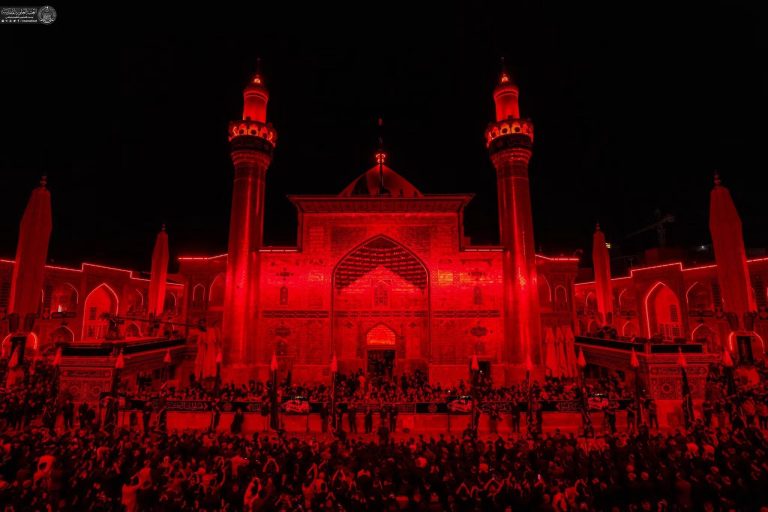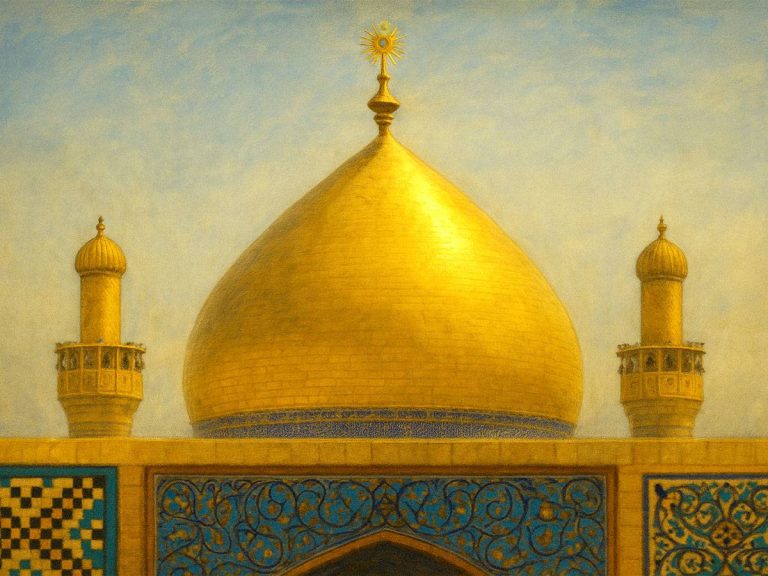
Among the most prominent features of this majestic edifice are the exquisite and captivating tileworks adorning the walls. These tiles are decorated with ingenious geometric patterns and delightful floral motifs, creating a soul-stirring vista through precise order and vibrant, luminous colors. Amidst these decorations, luminous verses of the Holy Quran, noble Hadiths, and sublime poetry in praise of the Ahl al-Bayt (peace be upon them)—particularly extolling Amir al-Muminin (peace be upon him) —are inscribed in artistic calligraphy, filling the shrine with spirituality, majesty, and a profound sense of serenity.
Engineering Proportions in the Shrine’s Architecture
A study conducted by the “Architect of the Shrine” (Mi’mar al-Haram) Engineering Institute reveals that the design of the holy Alawite shrine complex is founded upon a precise system of engineering proportions and standards. The overall layout of the shrine’s plan is primarily based on a square grid, a geometric order that plays a vital role in creating visual balance and spatial tranquility.
Calculated variations in spatial proportions and differences in the height of the surrounding walls evoke diverse spatial perceptions in the pilgrim’s mind. Consequently, the sense of “enclosure and being embraced” varies in intensity and quality across different sections of the shrine. Furthermore, the ratio between the dimensions of the spaces and the height of the surrounding walls creates a pleasing harmony with the human scale, reinforcing the sense of proportion, balance, and peace in the hearts and minds of the pilgrims.
In general, the ratio of the sense of enclosure within the courtyard spaces ranges from approximately 1.6:1 to 1.7:1, which is considered an ideal and desirable proportion in architectural terms. Among these, presence in the Eastern Courtyard conveys a greater sense of grandeur and majesty to the pilgrim compared to other areas, a result of the greater elongation of this space and the extension of the visual line of sight for the observer.
It is noteworthy that Shaikh Bahai utilized the “Golden Ratio” in the architectural design of the holy Alawi shrine—a proportion he had previously employed in the design of Naqsh-e Jahan Square and the Shaikh Lotfollah Mosque in Isfahan, a city in Iran. This approach demonstrates the profound link between mathematical knowledge, artistic flair, and spirituality in Islamic architecture, particularly in the edifice of the Holy Alawi Shrine.
Adapted from the book “Tarikh al-Marqad al-Alawi al-Mutahhar” (History of the Holy Alawi Shrine)