
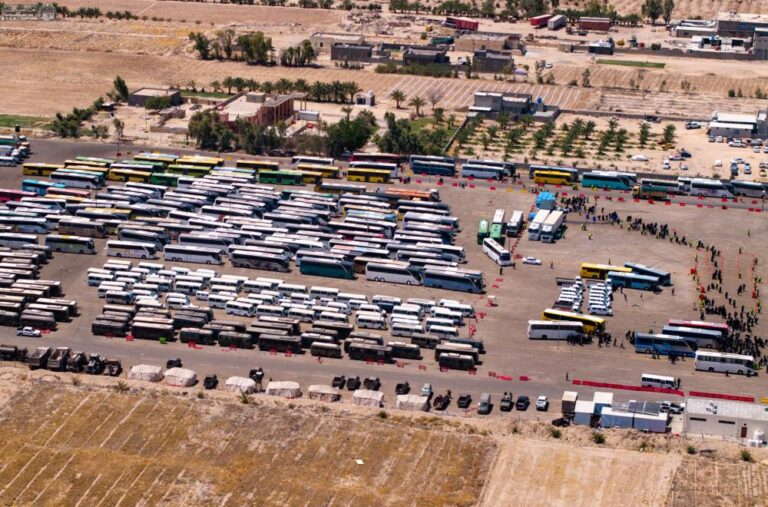
The Holy Alawi Shrine, through the provision of extensive and distinguished services, has hosted millions of al-Hussaini pilgrims during the days of Arbaeen.
Hosting Millions of Pilgrims
According to recorded statistics, from the first day of the month of Safar through the twentieth of that month, 17,463,011 pilgrims were honored to visit the sacred shrine of Amir al-Muminin, Imam Ali (peace be upon him).
Providing Drinking Water
During the days of the Arbaeen pilgrimage, the Holy Alawi Shrine distributed 70 million liters of purified drinking water among pilgrims. In addition, more than 13 million cups of water were made available to pilgrims.
Alawi Hospitality
Through 16 catering centers, the Holy Alawi Shrine’s guesthouse provided a total of 7.5 million meals to Arbaeen pilgrims.
Providing Accommodation for Pilgrims
In its ongoing efforts to serve Arbaeen pilgrims, extensive infrastructure was provided for pilgrim accommodation:
– Opening of 4 large halls in the Courtyard of Lady Fatimah al-Zahra (peace be upon her)
– Equipping of 4 rest stations around the holy shrine and in the Imam al-Rida (peace be upon him) township
– Providing 49,000 square meters of shaded space
Technical and Technological Services
During the days of Arbaeen, more than 5,000 closed-circuit cameras were installed and activated to safeguard pilgrims’ security. Multilingual signage was also installed around the holy shrine. Internet services were provided to 13,500 pilgrims.
Cultural and Religious Services
The Holy Alawi Shrine set up 21 stations along the Arbaeen walking route to respond to religious inquiries, under the supervision of seminary scholars. In addition, 250 Qur’anic stations were active across various Iraqi provinces, with the participation of 1,000 Qur’an instructors.
The Honor of Serving Pilgrims
More than 10,214 volunteer servants were organized according to their expertise and skills across various sections around the holy shrine, serving pilgrims throughout the days of Arbaeen.
Cultural and Artistic Activities
The Mohsen Cultural Center, affiliated with the Holy Alawi Shrine, depicted the epic of Arbaeen for child pilgrims through cultural and artistic programs staged along the walking route. It also held a painting exhibition to introduce and explain the Ashura movement and Hussaini culture.
Guiding Lost Pilgrims
Through the establishment of 5 lost-and-found centers, 21,800 pilgrims were identified and reunited with their families.
Pilgrim Medical Services
During the days of Arbaeen, 5 medical stations were set up to provide healthcare services, with 392 male and female relief workers, in cooperation with the Najaf Health Directorate, participating in the provision of medical and emergency care.
Transportation and Facilitating Pilgrim Movement
The Holy Alawi Shrine deployed 470 public transport vehicles, mobilizing its entire transportation capacity to move and transfer Arbaeen pilgrims.


