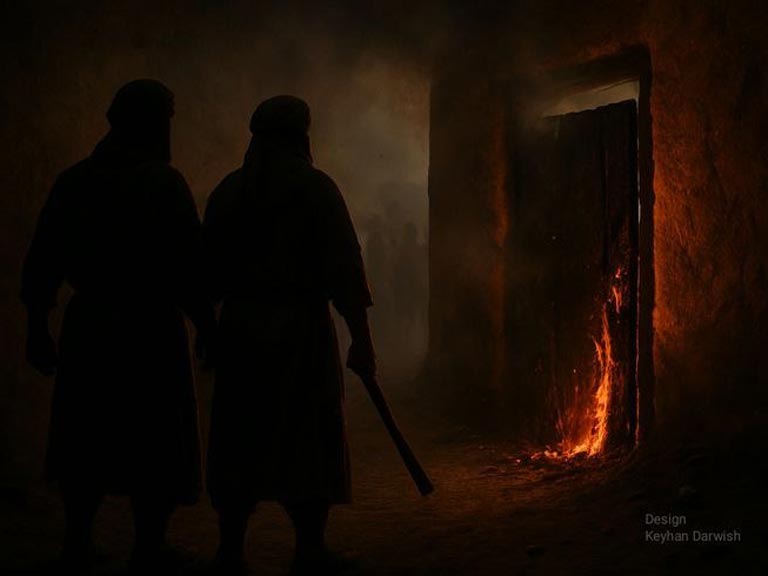
In the latter part of Safar in the 11th year of the Hijra, after the martyrdom of the Messenger of Allah (peace be upon him and his progeny), while Amir al-Muminin Ali (peace be upon him) was present beside his pure body, a group of Muhajirun gathered at a place called Saqifah Bani Sa’idah with the aim of electing Abu Bakr, and a group of Ansar gathered there to support Sa’d ibn Ubadah, each seeking to entrust the caliphate to their preferred candidate.
In this assembly, no representative of the Banu Hashim or the Ahl al-Bayt was present. This pledge of allegiance was contrary to the will of the final Prophet at Ghadir Khumm, and it marked the starting point of the coup and the usurpation of the caliphate from Amir al-Muminin (peace be upon him), as well as the greatest deviation and division that arose among Muslims.
The Meaning of Saqifah
Saqifah means a roofed portico or canopy, and it was located near the Mosque of the Messenger of Allah (peace be upon him and his family), serving as a gathering place for the Ansar in Medina.
The Dispute over the Caliphate
Abd al-Rahman ibn Abi Amrah al-Ansari, one of the companions of the Prophet of Islam, narrated the beginning of the Saqifah affair and the debates between the Ansar and Muhajirun over the caliphate on that day as follows:
“After the martyrdom of the Prophet (peace be upon him and his family), the Ansar gathered in Saqifah Bani Sa’idah and decided to entrust the leadership to Sa’d ibn Ubadah. Sa’d was ill and could not speak loudly, so one of his close associates repeated his words to those present.
After praising and glorifying God, Sa’d addressed the Ansar, saying that they had been forerunners in Islam and possessed qualities that others did not. The Prophet (peace be upon him and his family) had called people to worship God and abandon idolatry for about ten years, and only a few believers had supported him, until finally God, with your help, brought about the victory of His religion. You strove more than others in protecting the final Prophet and the faith, to the point that the Arabs submitted to God’s command by your swords. Now it is your duty to take charge of the leadership of the ummah!
The Ansar confirmed his words and said: ‘Your opinion is correct; the decision is yours because you are esteemed among us.’ Some said: ‘If the Qurayshite Muhajirun do not accept this and say that they are the close relatives of the Prophet of God, and ask why you oppose us, we will propose that one commander be chosen from you and one from us; we will accept nothing less than this.’ Upon hearing this proposal, Sa’d ibn Ubadah said: ‘This proposal is a sign of your weakness.’
Umar went to the house of the Prophet of God to inform Abu Bakr. Amir al-Muminin (peace be upon him) was busy with the burial arrangements of the final Prophet’s body, and Abu Bakr came out. Umar said: ‘Something has happened that you must be informed of.’
When Abu Bakr heard that the Ansar intended to give the caliphate to Sa’d ibn Ubadah, they all went to Saqifah along with Abu Ubaydah. Umar intended to speak, but Abu Bakr said: ‘Let me speak first.’
Abu Bakr began by praising God and said: ‘God sent Muhammad (peace be upon him and his family) as His Messenger to guide the people, so that they would worship Him and abandon their self-made deities.’
Then he recited verse 18 of Surah Yunus: “And they worship besides God that which neither harms them nor benefits them, and they say: ‘These are our intercessors with God.'”
And he recited verse 3 of Surah Az-Zumar: “We worship them only that they may bring us nearer to God in position.”
Then Abu Bakr continued: ‘Abandoning the religion of their forefathers was difficult for the Arabs. For this reason, God chose a group of the early Muhajirun to support the Messenger of God and to endure hardships patiently. Despite the opposition of all, they were not afraid of their small numbers or the opposition of their people, and they became the first servants of God on earth. These individuals are the close ones of the Prophet of God and are worthy of the caliphate. The Ansar, too, stepped forward to support the religion and the Prophet of God, and God chose them. Let us be the amirs (rulers) and you the wazirs (ministers); you will not be denied our counsel, and no affair will be carried out without you.’
Mundhir ibn Hubab stood up and said: ‘O Ansar! Take hold of your own affairs.’ Then he stood and pledged allegiance to Abu Bakr, and with the allegiance of the tribe of Aslam to Abu Bakr, the plan of Sa’d ibn Ubadah was thwarted. Upon seeing this, Umar became assured of victory.
Sa’d ibn Ubadah resisted the pressure to pledge allegiance and declared that he would fight to his last breath and would never pledge allegiance. Bashir ibn Sa’d proposed that they leave him alone, as he posed no threat. Sa’d withdrew from the community until Abu Bakr passed away.” (1)
Forced Allegiance
After the coup of the Saqifah council in usurping the caliphate, some companions refused to pledge allegiance to Abu Bakr. One of these individuals was Bara’ ibn Azib, a famous companion of the final Prophet, who did not accept the bay’ah to Abu Bakr.
Bara’ ibn Azib narrated the method used to secure allegiance for Abu Bakr as follows:
“I always had affection for the Bani Hashim. When the Prophet of Islam (peace be upon him and his family) passed away, I was worried that the Quraysh would seize power from the Bani Hashim. This worry, along with the grief of the Prophet’s death, made me extremely restless, like a she-camel that has lost her young. I constantly went to the house of the Bani Hashim, where they were beside the Prophet’s body. At the same time, I kept an eye on the leaders of the Quraysh and saw that Abu Bakr and Umar were not among the people. Suddenly, I heard that the people had gathered in Saqifah Bani Sa’idah and had pledged allegiance to Abu Bakr. Then Abu Bakr, along with Umar and others, came from Saqifah. They had wrapped their Yemeni garments around themselves and were roaming through the alleys.
Whoever they came across, they would seize by force, bring them forward, pull their hand, and place it upon Abu Bakr’s hand so that he would pledge allegiance to him—whether he was willing or unwilling!” (2)
Saqifah from the Perspective of Ahl al-Sunnah
Al-Bukhari and Muslim, in their Sahih collections—which are considered the most authoritative hadith books according to Ahl al-Sunnah—narrated the Saqifah affair as follows:
“The Ansar gathered in Saqifah Bani Sa’idah to pledge allegiance to Sa’d ibn Ubadah, but they did not inform Abu Bakr, Umar, and the other Muhajirun. When Abu Bakr, Umar, and Abu Ubaydah learned of this gathering, they quickly went there. Abu Bakr addressed the Ansar and said that he would accept either of these two men—Umar or Abu Ubaydah—for leadership. Umar replied, ‘I will not take precedence over you,’ and pledged allegiance to Abu Bakr. Then several of the Ansar also pledged allegiance to him. However, Amir al-Mu’minin (peace be upon him) and the Banu Hashim refrained from pledging allegiance to him for six months.” (3)
Sources
-
Bihar al-Anwar, Volume 28, Page 330
-
Sharh Nahj al-Balagha by Ibn Abi al-Hadid, Volume 1, Page 219 / Nathr al-Durr fi al-Muhadarat, Volume 1, Page 277
-
Kashf al-Muhajjah, Volume 1, Page 132