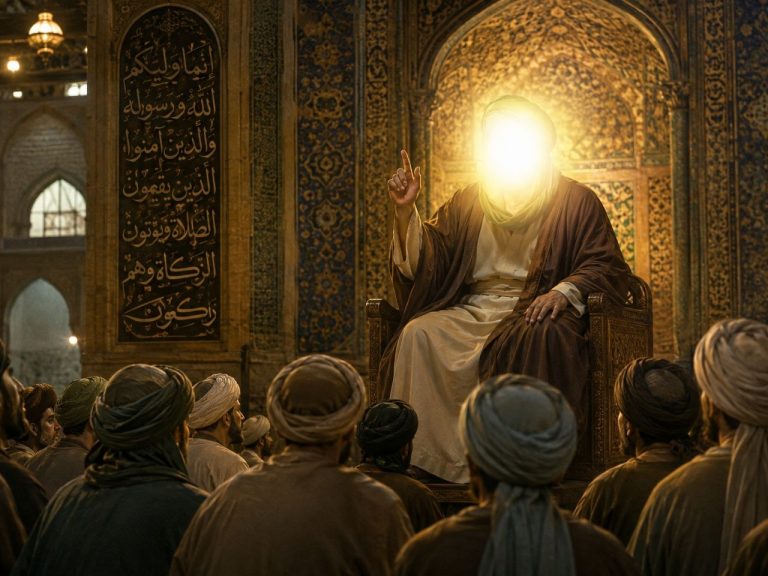
The station of Imamate, with its characteristics of boundless knowledge, superior morality, and fundamental role in preserving religion and connecting the community, holds a station beyond human capacity. The “Hadith of Marw” is a collection of compelling arguments presented by Imam al-Rida (peace be upon him) concerning the conditions and characteristics of Imamate, articulated in the city of Marw in a conversation with Abd al-Aziz ibn Muslim. This tradition, employing Qur’anic proofs and rational arguments, establishes the lofty station of Imamate.
Definition of the Station of Imamate
Imam al-Rida (peace be upon him) explains that the recognition of the Imam is fundamentally beyond the capacity of the people to choose an Imam for themselves, for the Imam must possess characteristics that people do not correctly comprehend.
Abd al-Aziz ibn Muslim, a companion of Imam al-Rida (peace be upon him), narrates that in Marw, we discussed with Imam al-Rida (peace be upon him) the disagreements among people concerning the matter of Imamate. The Imam, with a smile, said: “These people are ignorant and have been deceived by their own opinions and their religion. God did not take the soul of the Prophet (peace be upon him and his family) except after He had perfected the religion for him and sent down the Quran as a book that fully expresses all the needs of humanity, from rulings and limits to the lawful and the unlawful, and He said: ‘We have not neglected anything in the Book.'” (Surah al-An’am, Verse 38)
Imam al-Rida (peace be upon him), referring to the story of Prophet Abraham (peace be upon him), stated that the station of Imamate is reserved for the chosen and pure individuals, transferred after the Prophet (peace be upon him and his family) to Amir al-Muminin (peace be upon him) and then to his infallible descendants.
He then continued: “Do they know the value and station of Imamate among the nation, that their choice and selection in it should be permissible? Indeed, Imamate has a station far higher, a rank more exalted, a degree more elevated, a threshold more sublime, and a depth deeper than that which people could attain with their intellects, or comprehend with their opinions and views, or choose an Imam through their own selection.
Imamate is a station that Prophet Abraham attained after he had achieved the station of prophethood and close friendship (khullah). This Imamate is the third degree and virtue with which God honored him and elevated his name, and He said: ‘Indeed, I am making you an Imam for the people.’ (Surah al-Baqarah, Verse 124) The Friend (Abraham) asked with joy: ‘And from my offspring?’ God Almighty said: ‘My covenant does not reach the wrongdoers.’ This verse invalidated the Imamate of every wrongdoer until the Day of Resurrection and made it exclusive to the pure chosen ones. Then God Almighty honored him and placed Imamate in his chosen offspring, and He said: ‘And We gave him Isaac and Jacob and made each of them righteous. And We made them Imams guiding by Our command, and We revealed to them the doing of good deeds, establishment of prayer, and giving of charity, and they were worshippers of Us.’ (Surah al-Anbiya, Verse 72)
This Imamate remained continuously in his offspring, inherited from one to another; generation after generation, until it reached the Prophet (peace be upon him and his family). God said: ‘Indeed, the most worthy of Abraham among the people are those who followed him, and this Prophet, and those who believe; and God is the Guardian of the believers.’ (Surah Al Imran, Verse 68)”
The Inability of Man to Fully Comprehend the Imam
Imam al-Rida (peace be upon him), citing Quranic verses, emphasized the invalidity of human choices against the divine will, and considered deviation from the path of truth to be a result of turning away from the command of God and His Messenger (peace be upon him and his family).
He said: “They turned away from the choice of God Almighty and His Messenger (peace be upon him and his family) and turned to their own false selection, although the Holy Quran says: ‘And your Lord creates what He wills and chooses; they have no choice. Exalted is God and high above what they associate with Him.’ (Surah al-Qasas, Verse 68) And He also says: ‘It is not for a believing man or woman, when God and His Messenger have decided a matter, to have any choice in their affair.’ (Surah al-Ahzab, Verse 36)
And He says: ‘What is the matter with you? How do you judge? Or do you have a book in which you read that you have whatever you choose in it? Or do you have a solemn covenant with Us extending to the Day of Resurrection, that you shall have whatever you decide? Ask them which of them will guarantee that. Or do they have partners? Then let them bring their partners, if they are truthful.’ (Surah al-Qalam, Verses 36-41)
Concerning those who do not ponder over the verses of God, He says: ‘Do they not reflect upon the Qur’an, or are there locks upon their hearts?’ (Surah Muhammad, Verse 24)
And in describing those who do not accept the truth, He says: ‘They say, “We have heard,” while they do not hear. Indeed, the worst of living creatures in the sight of God are the deaf and dumb who do not reason. If God had known any good in them, He would have made them hear; and if He had made them hear, they would have turned away and refused.’ Or they say, “We have heard and we disobey”… Rather, it is the favor that God grants to whomever He wills, and God is the possessor of great favor.’ (Surah al-Anfal, Verses 20-23)”
Consequences of Wrongly Choosing an Imam
Imam al-Rida (peace be upon him), citing Qur’anic verses, emphasized that human choices far removed from divine standards are not only not a path to salvation, but are also a source of misery and divine wrath.
Imam al-Rida (peace be upon him) said: “Now it must be asked: Is man capable of choosing such an Imam? Has the one whom the people have chosen possessed such attributes and characteristics that they preferred him over others? They, through disrespect to the House of God and ignoring the teachings of the Quran, separated their path from the truth. They forgot that the only path to salvation and healing is in following the Book of God; but they preferred to follow their own carnal desires. The result of this was divine wrath, enmity with God, and eternal misery. God in the Quran describes this situation as follows: ‘Who is more astray than one who follows his own desire without guidance from God? Indeed, God does not guide the wrongdoing people.’ (Surah al-Qasas, Verse 50)
And He says: ‘Great is the enmity in the sight of God and those who believe; thus God seals the hearts of every arrogant tyrant who believes in falsehood.’ (Surah Ghafir, Verse 35) Peace be upon the Prophet of Islam and upon his sacred family.”
Characteristics of the Worthy Imam
Imam al-Rida (peace be upon him), by mentioning eleven fundamental characteristics, explained the essential and necessary attributes of the one who should be the leader of guidance. He then said: “How can they choose an Imam, when the Imam must possess a personality with the following lofty attributes:
-
Knowledge and Learning: He must be knowledgeable and far removed from ignorance and unawareness.
-
Responsibility: He must be a guardian and overseer who does not shirk his responsibility nor show negligence.
-
Infallibility (Ismah): He must be a source of purity, sanctity, light, asceticism, knowledge, and worship.
-
Chosen by God: He must be chosen by the Messenger of God (peace be upon him and his family) for the divine call and appointed by His command.
-
Fatimid Lineage: He must be from the lineage of Lady Fatimah al-Zahra (peace be upon her), that pure and chosen lady.
-
Hashimite Lineage: He must have a pure and untainted lineage, from the best tribe of Quraysh, the highest clan of Banu Hashim, and the progeny of the Great Messenger (peace be upon him and his family), approved by God Almighty.
-
Noble: He must be the noblest of the nobles, from the descendants of Abd Manaf.
-
Forbearing: He must be one who splits open the realities of knowledge and possesses perfect forbearance and clemency.
-
Prudent: He must be filled with the spirituality and reality of Imamate, and knowledgeable in governance and politics.
-
Obedience Compulsory: His obedience must be obligatory, and he must rise up by the command of God.
-
Sincere Adviser: He must be a well-wisher for the servants of God and a guardian of the religion of God Almighty.”
Completion of Religion and the Choice of the Master of the Pious
In the Hadith of Marw, Imam al-Rida (peace be upon him), referring to the Verse of Completion (Ikmal), reminded of the public announcement of the Imamate of the Master of the Pious by the Prophet of Islam (peace be upon him and his family) at the Farewell Pilgrimage (Hajjat al-Wada’). He said: “During the Farewell Pilgrimage, which was the last pilgrimage of the Prophet (peace be upon him and his family), this verse was revealed: ‘Today I have perfected your religion for you, completed My favor upon you, and chosen for you Islam as your religion.’ (Surah al-Ma’idah, Verse 3) So the matter of Imamate is among the perfection of religion and the completion of favor.
The Prophet (peace be upon him and his family) did not depart from this world except after he had explained all the landmarks of religion to the people, illuminated their path, and placed them on the path of truth; and he appointed Amir al-Muminin (peace be upon him) as their leader and guide. He did not omit anything needed by the nation except that he clarified it. Whoever thinks that God has not perfected his religion has rejected the Book of God; and whoever rejects the Book of God is a disbeliever.”
Imam al-Rida (peace be upon him) then proceeded to describe the attributes and characteristics of the Imam, saying: “The Imam is like the sun, the moon, the star, and a lamp in the darkness, guiding the thirsty and the lost; he is both a source of mercy (like a rain-giving cloud) and a source of security and refuge (like a compassionate father and brother) for the people. The Imam is the proof and the true caliph of God, pure from defects, and possessing divine knowledge. He has a station at which intellects are bewildered in comprehension, minds are helpless in recognition, and orators are incapable in description.”
The Invalidity of Human Choice in the Station of Imamate
Comprehending the reality of the station of Imamate is beyond the boundaries of limited intellect and human perception; for this station is divine and unique. In this tradition, Imam al-Rida (peace be upon him) explains: “Understanding the secrets of the Imam and his succession is beyond the capacity of describers and the reach of humanity. He is a unique personality, and the station of Imamate is only found in the family of the Prophet (peace be upon him and his family). Those who, with their deficient intellects, wish to choose a leader other than him are in a great error. These individuals, relying on their own opinions, only reach misguidance, falsehood, and fall into the abyss of bewilderment. They knowingly and deliberately abandoned their Imam and raised the banner of falsehood: ‘Satan made their deeds seem fair to them and turned them from the way, though they had insight.’ (Surah al-Ankabut, Verse 28)”
The Knowledge and Divine Superiority of the Imams
In this discourse, Imam al-Rida (peace be upon him), citing Qur’anic verses, emphasized the inseparable connection between the station of Imamate and divine knowledge, considering the epistemic superiority of the Imams to arise from God’s direct and unparalleled bestowal. He said: “God grants success to the prophets and Imams (peace be upon them) and gives them, from the treasury of His knowledge and wisdom, knowledges that He has not given to others. Therefore, their knowledge is superior to the knowledge of all the people of their time. God Almighty says: ‘Is He who guides to the truth more worthy to be followed, or he who does not guide unless he is guided? What is the matter with you? How do you judge?’ (Surah Yunus, Verse 35) And He also says: ‘Whoever is given wisdom has been given much good; and none will remember except those of understanding.’ (Surah al-Baqarah, Verse 269)
Concerning Talut, He says: ‘Indeed, God has chosen him over you and increased him in knowledge and physical strength. And God gives His sovereignty to whom He wills, and God is All-Encompassing, All-Knowing.’ (Surah al-Baqarah, Verse 247) And concerning His Prophet, He says: ‘And God has sent down to you the Book and wisdom and taught you what you did not know; and the grace of God upon you is great.’ (Surah al-Nisa, Verse 113)
Concerning the family of the Prophet, who are from the family of Abraham (peace be upon them), God says: ‘Or do they envy people for what God has given them of His bounty? We have given the family of Abraham the Book and wisdom, and some of them believed and some disbelieved; and Hell is a sufficient blaze.’ (Surah al-Nisa, Verse 54)”
Divine Inspiration and Confirmation
In this luminous discourse, Imam al-Rida (peace be upon him) unveils the manifestation of divine favor in the being of the Imam and shows how God, by bestowing wisdom and preserving His chosen ones from error, makes them a clear proof for His servants. The Imam continued: “Whenever God chooses a servant to reform the affairs of His servants, He grants him an expansive knowledge and causes springs of wisdom and sagacity to flow in his heart. God teaches him His knowledge through inspiration (ilham), so that he is not helpless in answering any question nor bewildered in recognizing the truth and reality. Such a person is infallible by God and enjoys divine assistance and confirmation; therefore, he is safe from error, slip, and incorrect decision. God has distinguished him with these characteristics so that he may be a clear proof for all the servants who comprehend him. This is the favor of God which He grants to whomever He wills, and God is the possessor of great favor.”
The Legacy of Imamate in the Prophetic Family
In this hadith, characteristics for the Imam are enumerated, among them: scientific and moral superiority, expansive knowledge, courage in implementing divine limits, and uniqueness.
Imam al-Rida (peace be upon him) said: “This station of Imamate was exclusively for him (the Prophet), and by God’s command, he entrusted it to Amir al-Muminin (peace be upon him), just as God Almighty had made it obligatory. Then it was transferred to his chosen descendants—those to whom God gave knowledge and faith, based on the word of God Almighty: ‘Those who were given knowledge and faith will say, “You have remained in the Book of God until the Day of Resurrection; and this is the Day of Resurrection, but you do not know.”‘ (Surah al-Rum, Verse 56) They are the descendants of Amir al-Muminin (peace be upon him) until the Day of Resurrection; for there is no prophet after Muhammad (peace be upon him and his family). How can these ignorant ones create an Imam for themselves, while Imamate is the station of the prophets and the legacy of the successors (awsiya’)? Imamate is the caliphate from God and His Messenger, and the station of Amir al-Muminin (peace be upon him) and the legacy of Hasan and Husayn (peace be upon them).
Indeed, Imamate is the reins of religion, the system of the Muslims, and the honor of the believers. Imamate is the pure foundation of Islam and its blessed branch. Through Imamate, prayer, fasting, charity (zakat), pilgrimage (hajj), and jihad are properly performed, spoils and alms are multiplied, limits and rulings are enforced, and borders and regions are secured. The Imam clarifies the lawful and unlawful of God, establishes His limits, defends His religion, and invites to the path of God with wisdom, good counsel, and clear argument.”
The Hadith of Marw establishes that Imamate is a divine responsibility, not merely a political and elective position. Through this tradition, Imam al-Rida (peace be upon him) emphasizes the close connection between prophethood and Imamate, and points to the importance of the existence of an infallible Imam for the complete preservation of religion and the prevention of human distortions.
This hadith clarifies the difference between the divine path and human choice, and emphasizes that the main criterion for leadership is innate purity and divine knowledge, which is exclusively found in the family of the Prophet (peace be upon him and his family).
Source
Usul al-Kafi, Vol. 1, p. 198