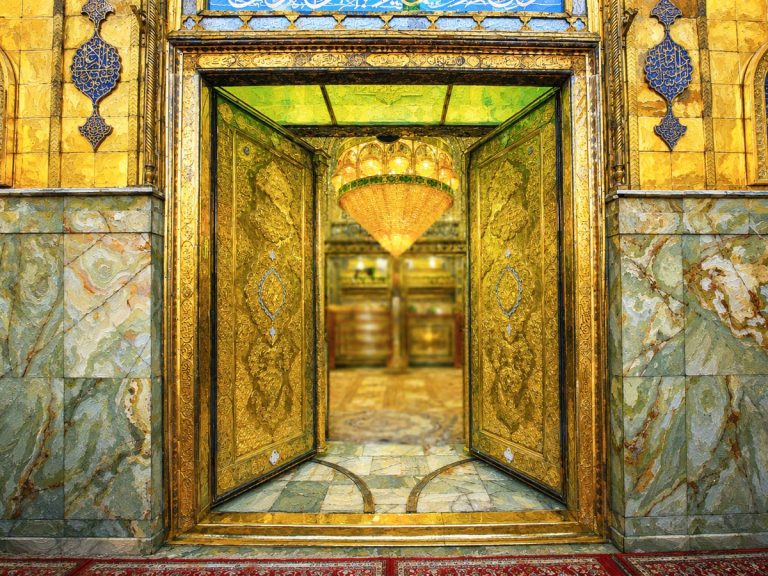
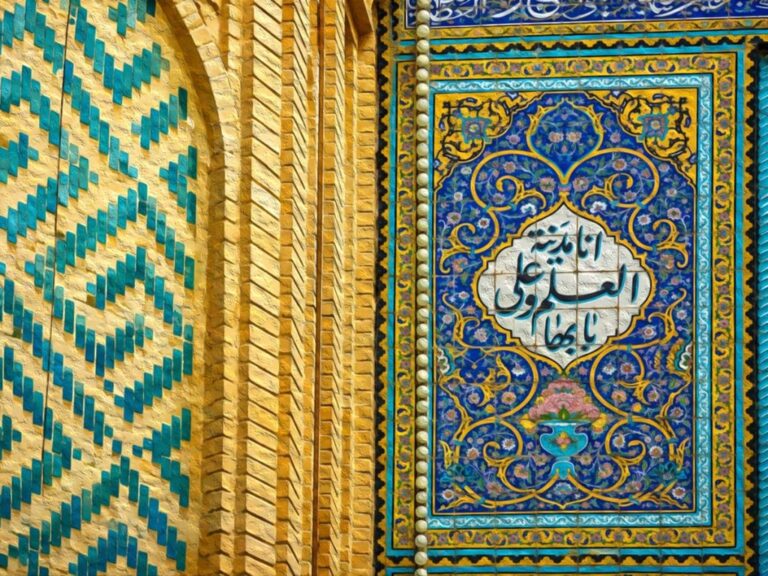
At present, the sacred Alawi shrine has five entrances, but at the time the Safavid-era building was constructed in 1023 AH (1614 CE), it had only three main entrances.
These original doors are the ones known today by the following names: Bab al-Saa (the Gate of the Clock) on the eastern side, Bab al-Tusi on the northern side, and Bab al-Qiblah on the southern side.
Later, with the construction of two additional doors, the number of main doors rose to five. The newly built doors were named Bab Muslim ibn Aqil (peace be upon him) and Bab al-Faraj.
The Sixth Door
To facilitate the entry and exit of pilgrims, particularly during periods of mass pilgrimage, the Custodianship of the Holy Alawi Shrine decided to construct a sixth door. This large door is being built on the northern part of the western wall of the sacred courtyard, facing the courtyard of Lady Fatimah al-Zahra (peace be upon her). In terms of location, size, and shape, it corresponds to Bab al-Faraj on the opposite side.
After the engineering designs were completed, in the month of Ramadan 1445 AH (2024 CE), execution teams from the Kawthar Iran Institute began demolition of the guesthouse building and construction work. Throughout this process, care was taken to ensure that no damage was caused to the original architecture of the iwans of the sacred Alawi courtyard.
Bab al-Saa: The Largest Entrance to the Sacred Courtyard
Bab al-Saa is the great eastern door of the sacred courtyard and serves as its main entrance. This door stands directly opposite the golden iwan of the sacred Alawi shrine. It takes its name — also its most well-known name — from the clock tower situated above it. It is also known as Bab Imam al-Rida (peace be upon him).
During the gilding of the sacred Alawi shrine, ordered by Sultan Nadir Shah Afshar in 1156 AH (1743 CE), magnificent gold ornamentation was installed above Bab al-Saa.
The Gold Ornamentation Above Bab al-Saa
This ornamentation consisted of a wide band of gold plates placed above the entrance, inscribed with the verses of Surat al-Fath: “Indeed, We have granted you a clear victory, that God may forgive you what preceded of your sin and what will follow,” rendered in interlaced thuluth script. At the end of this inscription, the name of the calligrapher, Muhammad Muqim, and the date of composition (1156 AH) are recorded.
An arched band of gold also frames the wooden window above the door, its borders inscribed in nastaliq script with a Persian ode in praise of Amir al-Muminin (peace be upon him); the poet’s identity is unknown. Around this arch appear lantern-shaped motifs bearing the inscription “O Ali, come to my aid.”
At the top center of the arch is a gold plaque bearing the phrase “O Ali, O Opener of Doors.” The crown of the arch is adorned with a beautiful golden circular motif at whose center is inscribed the word “Allah,” radiating fourteen golden rays symbolizing the Fourteen Infallibles (peace be upon them).
Decoration and Restoration of the Bab al-Saa Iwan
Inside the Bab al-Saa iwan is a rectangular calligraphic band inscribed with verses 36 through 38 of Surat al-Nur. At the end of this inscription is recorded the date of its composition, 1198 AH, and the name of the calligrapher, Muhammad Rida.
Over the course of history, the decoration, motifs, and inscriptions on both the exterior facade and interior corridor of this door have undergone numerous restorations and reconstructions, a process that has resulted in the loss of certain important records and dated inscriptions.
For example, tiles were once installed at the base of this inscribed band on either side of the iwan, bearing prophetic traditions and wise sayings of Amir al-Muminin (peace be upon him). At the end of these inscriptions were recorded the name of their maker, Hajj Abd al-Hussain Bahadur Khan, and the date 1234 AH.
These inscriptions no longer exist. In the recent restoration, the following was written in their place:
In the panel beneath the right-hand band: “The Noble Messenger (peace be upon him and his family) said.” In the panel beneath the left-hand band: “Ali is my brother, and of me, and I am of Ali; he is the gate to my knowledge and my successor.”* On the left side, the date 1430 AH (2009 CE) is inscribed.
Additionally, in 1327 AH (1909 CE), the Ottoman Sultan Abdul Hamid II undertook the restoration of the tilework of the Bab al-Saa iwan. The date of this restoration is recorded with the phrase: “The gate of Ali, straight upon its threshold.”
Bab al-Saa in the Contemporary Era
During the Sha’baniyyah Uprising of 1411 AH (1991 CE), when mercenaries of the Ba’athist regime, acting on the orders of the tyrant of the age, the accursed Saddam, launched a savage assault on the sacred Alawi shrine, Bab al-Saa came under attack from various weapons and was severely damaged, with no regard whatsoever for the sanctity of this holy site.
A few months after the situation calmed, hurried repairs were carried out on the tilework and damaged sections. However, for sectarian and racist reasons, all of the original gold ornamentation was stripped away and left in the Shrine’s storerooms. The original Quranic inscription was also removed and replaced with a band of Karbala tile bearing verse 23 of Surat al-Ahzab: *”Among the believers are men true to what they promised God. Among them is he who has fulfilled his vow, and among them is he who awaits, and they have not changed in the least.”* In place of the original radiating gold strands, an octagonal strand bearing the phrase “He is the Most High, the Most Exalted” was installed.
Over time, out of concern for preserving the architectural heritage of the sacred Alawi shrine and by order of the Custodianship of the Holy Alawi Shrine — particularly through the efforts of the Deputy Custodian, Sayyid Eisa Muhammad Salih al-Khirsan — substantial restoration work was undertaken. The inscriptions of Bab al-Saa were restored, and the missing elements, especially the radiating strands, were reconstructed by master craftsmen in the Shrine’s gilding workshop.
The wooden window above the door, which forms the crown of Bab al-Saa, was also repaired and repainted. Finally, a signboard was installed above it identifying the door’s various names.
The Restoration and Gilding of Bab al-Saa
Restoration work began on the first day of Rajab 1444 AH (2023 CE) and was completed in an unprecedented span of just three months.
Technical engineers from the Kawthar Iran Institute took part in the project, gilding the copper plates with pure 24-karat gold. The completed pieces were then returned to their original positions.
It is worth noting that the several kilograms of gold used in the gilding process were donated by Master Haidar Fallah al-Shamma out of love and devotion for his master, Amir al-Muminin (peace be upon him). May God reward him with the finest recompense given to those who do good.
Among the significant events that the history of the Holy Alawi Shrine will proudly record in letters of light was the magnificent ceremony held in the courtyard in front of Bab al-Saa, attended by seminary and cultural figures as well as members of the public.
On Saturday, the eighth of Shawwal 1444 AH, corresponding to April 29, 2023, the veil was lifted from this gilded door. The ceremony coincided with the remembrance of a sorrowful event for the Shia followers of the Ahl al-Bayt — one that had occurred a century earlier: the destruction of the graves of the Infallible Imams (peace be upon them) in al-Baqi, the historic cemetery of Medina. On that day, Bab al-Saa appeared in renewed splendor and beauty.
Among those who commemorated the year of Bab al-Saa’s restoration in verse was the poet of the Abbasi Holy Shrine, Master Ali Saffar, who in his composition referred to this sacred door by its lofty title, “Bab al-Imam al-Rida.”
Bab al-Tusi: The Entrance Near the Shrine of Shaikh al-Tusi
Bab al-Tusi is located on the northern side of the wall of the sacred Alawi courtyard, taking its name from its proximity to the shrine of Shaikh al-Tusi. Notably, the Grand Northern Iwan (the Yazdi Iwan), which connects on its left to the Mosque of Imran ibn Shahin, in fact represents the original Bab al-Tusi in the authentic Safavid-era architectural plan.
The original door in this section was closed at some point in the past, and a new door was built beside it — the present-day Bab al-Tusi. Whoever carried out this change intended for the new door to sit at the center of the iwans along the northern side of the sacred courtyard. The same alteration was made on the southern side of the courtyard with regard to Bab al-Qiblah. These changes, however, caused damage to the original, magnificent architecture of the sacred Alawi shrine.
There is no precise date for this relocation, but research suggests it likely took place after the end of the Afsharid period. Construction of the new doors of the sacred Alawi courtyard is understood to date to the second half of the thirteenth century AH.
The Former Name of Bab al-Tusi
This door was formerly known as Bab al-Ula, after a small quarter of the same name — part of the larger Mashraq quarter — that once extended between the Alawi shrine and the mosque of Shaikh al-Tusi. The opening of this gate was recorded and dated to 1318 AH by the learned scholar Shaikh Abd al-Hussain Huwaizi Ibrahimi.
Work to widen the entrance and rebuild the old alley began in 1369 AH (1949 CE), following the opening of the road surrounding the sacred courtyard. This work was carried out at the expense of the Ministry of Endowments during the monarchy, under the supervision of Master Hajj Saeed the architect.
Construction work was completed in 1372 AH (1953 CE), and the door was formally opened in a ceremony held on May 2, 1953, coinciding with the coronation of Faisal II as King of Iraq.
Two verses composed by the poet and orator Muhammad Ali Yaqoubi were inscribed on the Karbala tiles above the wooden door, at its very top, commemorating the year of the door’s reconstruction.
On the same occasion, another historical poem, dated 1373 AH, by the poet Sayyid Muhammad Hussain al-Hilli, was inscribed on the lower section of the side wall to the left of the door.
One year after the opening ceremony, the tiling and covering of the structure’s surface with Kashani tile was completed. This event was documented in an inscription installed on the outer wall to the right of the door, in the middle band, which reads: “Renewed during the custodianship of the Rawdah Haidariyyah under Sayyid Abbas, 1374 AH.”
On the left side of the same wall is written: “Sayyid Muhammad Hasan and Sayyid Jawad Rafi’i, key-holders, 1954.”
Bab al-Qiblah: The Entrance Facing the Kaaba
This door is located on the southern wall of the sacred courtyard and takes its name from the fact that it faces the venerated Kaaba. What is known today as the Grand Southern Iwan (the Hubboubi Iwan) was, in the original Safavid architectural plan, the site of Bab al-Qiblah itself. In later periods, that original door was closed, and the present door, located at the center of the southern wall, was built.
This gate has undergone several restorations throughout history. Its most significant recent restoration was carried out by Shibli Pasha, the Ottoman governor, in 1291 AH (1874 CE), through the efforts of Sayyid Jawad Rafi’i, custodian of the Rawdah Haidariyyah.
Shaikh Muhammad Hussain Harz al-Din, in his book, cites the manuscript al-Nawadir (44/7) by his grandfather, the eminent scholar Shaikh Muhammad Harz al-Din, who wrote:
“This door was formerly small and built from the trunks of ashrasi palm trees. In 1291 AH, the minister Shibli Pasha built a new door, which remained standing firm until 1340 AH.”
The renowned poet and man of letters Shaikh Ahmad Qaftan also recorded, in his collected poems, the date of this door’s restoration by the Ottoman minister. This date was inscribed in tile script on the exterior facade of the door, on the side facing the sacred courtyard.
The Restoration History of Bab al-Qiblah
Historical inscriptions on the Karbala tiles of the walls of the Bab al-Qiblah iwan indicate that sections of the inscribed bands — containing verses of the Holy Quran and noble traditions — were restored in the years 1333 AH, 1380 AH, and 1382 AH.
Taken from the book “Tarikh al-Marqad al-Alawi al-Mutahhar” .