The Place of Tilework in Safavid Architecture and the Sacred Alawi Courtyard
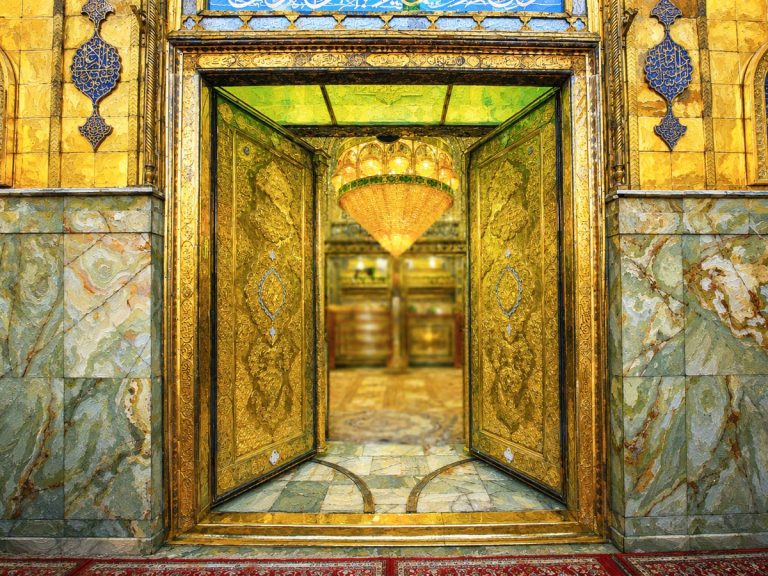
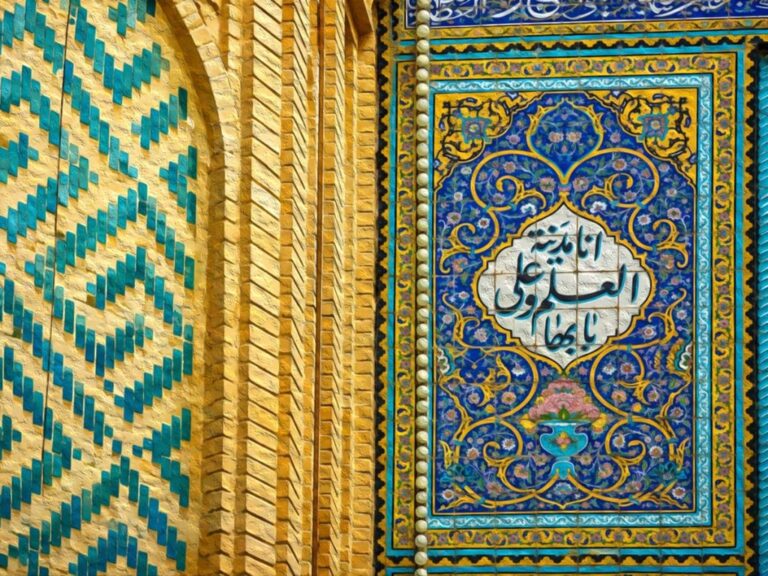
One of the notable features of Safavid architecture, shaped under the influence of the ancient art of Iraq, is the use of glazed brick (qashani tilework) to adorn the walls of religious structures. The walls of the sacred shrine of the Alawi mausoleum are covered with tiles bearing remarkable motifs, presenting a rich combination of geometric and floral forms, along with inscriptions containing verses of the Noble Qur’an, sacred traditions, and the verses of prominent poets.
The tilework of the sacred Alawi courtyard carries great historical and artistic significance, given the value of its antiquity, the diversity of its geometric forms, its decorative elements, its colors, and its methods of production. It is worth noting that most of the tiles used during the Safavid period were, in later eras, replaced for various reasons, such as gilding or reconstruction work. As a result, the walls of the sacred shrine and the smaller iwans of the sacred Alawi courtyard are today largely covered with tiles from the Qajar period.
Extensive Restorations During the Era of Nader Shah and Khatun Gawharshad
Given the damage that had befallen the tiles of the sacred Alawi courtyard’s walls and iwans, the restoration of these sections was carried out in the year 1156 AH, corresponding to 1743 CE, by Khatun Gawharshad, wife of Sultan Nader Shah. Following the completion of the gilding work on the sacred Alawi shrine, the restoration work began in the southern courtyard and concluded in the northern courtyard.
Among the signs of this restoration are the verses of the poet Qawam al-Din Qazvini, inscribed in the al-Mizab and al-Ulama Iwans. These verses were recorded by Kamal al-Din Hussain Golestaneh, whose name appears alongside the dates 1157 AH in the al-Mizab Iwan and 1160 AH in the al-Ulama Iwan — dates that correspond to the period of Nader Shah’s rule.
Restoration of the Sacred Alawi Courtyard’s Tilework by Khatun Gawharshad
Mirza Muhammad Mahdi Astarabadi, in his book Tarikh-e Jahangosha-ye Naderi, reports as follows:
“A sum of one hundred thousand rupees, equivalent to five thousand tomans, was allocated by Her Eminence Gawharshad — mother of the two princes, Nasrullah Mirza and Imam-Quli Mirza — for the restoration of the tilework on the wall of the sacred Alawi courtyard. She also donated a candelabrum adorned with precious jewels, along with an ornate and costly golden incense burner, to the Holy Shrine. Having completed these acts, she traveled to holy Karbala in order to be honored, on the first day of the month of Shawwal, with circling the sacred shrine — the very place that the angels themselves circle.”
Shaikh Muhammad Hussain Harz al-Din likewise writes of this restoration:
“The iwans and walls of the courtyard, during the era of Shah Safi (d. 1052 AH), had been covered with tilework. However, with the passage of nearly a hundred years or more, much of this tilework cracked and fell away. Following the completion of the gilding of the dome — the two minarets and the Great Eastern Iwan — carried out by Nader Shah, his wife allocated a considerable sum for the restoration of the courtyard’s tilework. This project began in the year 1156 AH and concluded in the year 1160 AH.”
Efforts of the Zand Period: From the Restoration of the Dome to the Revival of the Iwans
Forty years later, Sultan Ali Murad Khan Zand sent his representative, Mirza Ahmad al-Nawab, to Najaf, bearing with him substantial funds for the restoration and improvement of the sacred shrine. He also donated a collection of precious lamps to the Holy Shrine.
Shaikh Jafar Mahbouba, citing the book Ahsan al-Siyar by Mirza Ma’sum Isfahani, writes: “In the year 1197 AH, during the reign of Ali Murad Khan Zand — one of the kings of the Zand dynasty — numerous measures were carried out in the sacred Alawi courtyard. Among these measures were the repair of the tall dome, the organization of the courtyard and its associated sections, the restoration of the saqakhaneh (water-distribution structure) located within the sacred Alawi courtyard, and the cleaning of the flowing wells of Najaf. He also donated lamps adorned with precious stones and jewels to the sacred shrine.”
Among the works carried out during this period was the restoration of the tilework and the installation of certain Quranic inscriptions and verses of poetry in the Great Southern Iwan and the inner iwan of Bab al-Sa’ah. This project was carried out under the supervision of Mirza Ahmad al-Nawab and under the management of the architect Muhammad Rabi. The work began in the year 1197 AH, corresponding to 1782 CE, and concluded in the year 1198 AH, corresponding to 1783 CE.
Today, one can observe a band of Quranic verses running around the inner iwan of Bab al-Sa’ah, at the end of which the name of the calligrapher, Muhammad Reza, and the date of execution, 1198 AH, are recorded.
Shaikh Mahbouba also reports that inscribed upon the tilework of the Great Southern Iwan — known today as the Habboubi Iwan — is written: “This structure was built by order of the honored Shah and under the supervision of one of his servants, Ahmad, in the year 1198 AH.”
Restoration of the Sacred Alawi Courtyard’s Tilework During the Ottoman Era
During the Ottoman era, particularly in the month of Jumada al-Thani 1318 AH, corresponding to 1900 CE, some sections of tilework fell from the walls and struck pilgrims. This incident resulted in the deaths of one man and one woman, and left another woman with a broken leg. Following this event, Sultan Abdulhamid II ordered the restoration of the courtyard’s tilework, and the work of removing and rebuilding the tiles began in the month of Sha’ban of that same year. Shaikh Mahbouba writes of this:
“During the reign of Sultan Abdulhamid Khan II, sections of tilework from the iwans fell upon pilgrims, and a number lost their lives. This incident prompted the government to order the removal and reconstruction of the tilework. The restoration work took more than four years to complete, and this effort was carried out through the dedication of Sayyid Jawad Rafi’i, the late khazin (custodian) and grandfather of the present khazin, under the supervision of the renowned architect Master Abu Jawhar. All of the tilework was removed; sound tiles were preserved, and damaged tiles were replaced with matching pieces. This project began in the year 1323 AH.”
The dates recorded upon the tiles of the sacred Alawi courtyard indicate that the work of installing and fixing the tile plaques began in the year 1323 AH, corresponding to 1905 CE. During this period, five lines of poetry by Allamah Shaikh Murtada ibn Abbas Kashif al-Ghita were inscribed upon the right-hand pillar of the upper iwan adjacent to Bab al-Sa’ah, on its right side. This inscription bears the name of the calligrapher Abd al-Ali Ashraf al-Kitab Yazdi, and was completed in that same Hijri year.
The State of the Tilework in the Courtyard and Shrine During the Era of Sultan Abdulhamid II
The completion of the restoration of the tilework on the walls of the sacred Alawi shrine was recorded in the year 1326 AH, corresponding to 1908 CE. During this period, the royal tughras (seals) of the Ottoman Sultan Abdulhamid were installed in repeating, symmetrical fashion at the upper sections on either side adjacent to each of the northern and southern minarets. Inscribed upon this tughra was: “Abdulhamid Khan ibn Abdulmajid al-Muzaffar Da’iman.” To the right of the tughra, the title “Ghazi” had been added, and beneath it, the year 1326 AH was inscribed. This project concluded in the year 1327 AH, corresponding to 1909 CE, at which point the exterior façade of the Bab al-Sa’ah Iwan was also rebuilt with tilework. The poet Sayyid Baqir al-Hindi recorded this event in three lines of verse. It is worth noting that only the date portion — namely, the second half of the final line — was inscribed in tilework on the exterior façade of Bab al-Sa’ah, with the year 1327 AH rendered beneath it.
An important point in this regard is that the financial resources spent on the development and reconstruction of the sacred shrine, by order of this Sultan, were drawn from the revenue generated by the burial of the deceased within the sacred Alawi shrine. The same practice was applied in Karbala. Shaikh Muhammad al-Kufi remarks on this: “The revenue generated from burials within the two shrines of Najaf and the shrine of Imam al-Hussain (peace be upon him), and the areas surrounding them, was allocated for the development and repair of these two noble shrines. His representatives, in accordance with his instructions, marked every section, large or small, that they restored, with the tughra and the date of Abdulhamid’s rule.”
Restoration and Tilework of the Sacred Alawi Courtyard and Its Iwans
Shaikh Muhammad Hussain Harz al-Din writes: “Around the year 1382 AH, the covered passageways (sabats) were covered with qashani tilework, while the ceilings of some of the southern iwans along these passageways remained without tilework until the year 1397 AH.”
In the year 1426 AH, corresponding to 2005 CE, the Deputy Custodian of the Holy Alawi Shrine began the restoration of the two northern and southern entrances and the old curtains of the Golden Iwan. This project included replacing the old tilework on the interior and exterior walls with marquetry (moarraq) tiles featuring the Names of Allah the Exalted, certain sayings of Amir al-Muminin (peace be upon him), and his titles. This work was completed in the year 1429 AH, corresponding to 2008 CE.
Taken from the book “Tarikh al-Marqad al-Alawi al-Mutahhar” (History of the Purified Alawi Shrine)