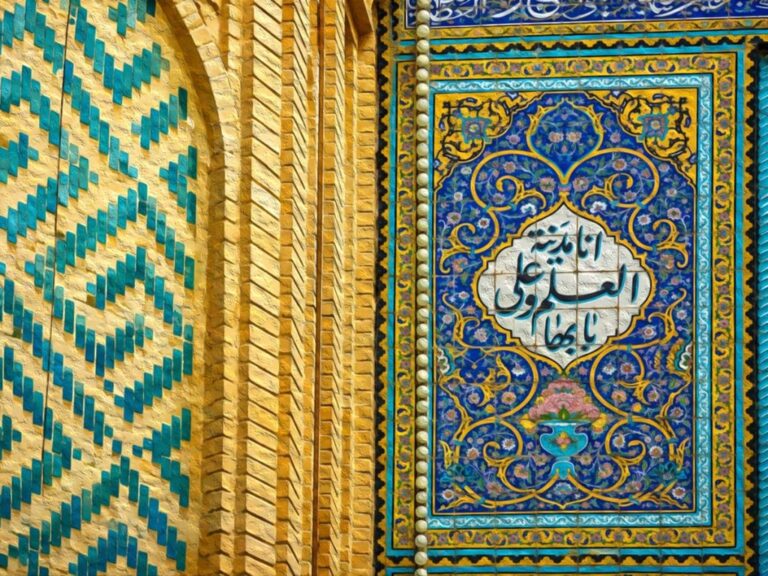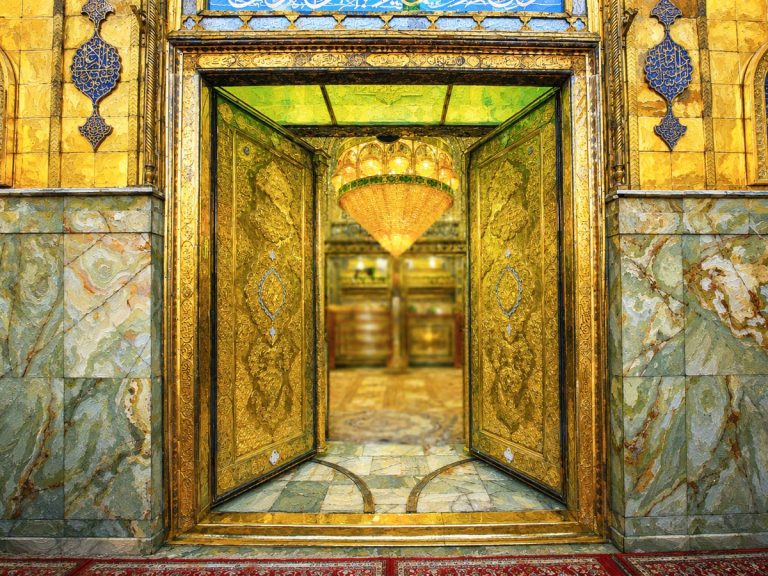
Each of these doors was crafted from fine and valuable materials — precious woods and unique ornamentation — presenting an unrivaled image of the fusion of authentic Islamic art and traditional architecture.
The Doors of the Eastern Portico
A wooden door was installed at the same time as the construction of the present structure of the Holy Alawi Mausoleum, in 1023 AH (1614 CE). This door was the oldest main entrance to the Holy Alawi Shrine from the eastern side of the portico.
The door remained in place for a long time, until around 1219 AH (1804 CE), when it was removed and replaced with a silver door funded by Hajj Muhammad Hussain Allaf al-Isfahani.
This silver door was later replaced, in 1287 AH (1870 CE), during the reign of Nasir al-Din Shah Qajar, with another silver door — this time donated by Mushir al-Saltanah, Sayyid Abul-Hasan Ahmad al-Shirazi.
The Story Behind the Doors of the Tombs of Allamah al-Hilli and Muqaddas Ardabili
These two small doors lead from the courtyard of the Golden Iwan into the eastern portico of the Holy Alawi Shrine. The door to the tomb of Allamah al-Hilli is on the right, beside the northern minaret. The door to the tomb of Muqaddas Ardabili is on the left, beside the southern minaret.
It is worth noting that the last silver door for Allamah al-Hilli’s chamber was installed in 1373 AH, funded by Fathullah Iravani, with its date recorded in verse by Sayyid Muhammad Hussain al-Hilli.
In 1395 AH (1975 CE), Hajj Abdul Rasul Muhammad Ali Ajineh met with Sayyid Muhammad Kalantar at the religious seminary of Najaf and expressed his readiness to fund, from his personal wealth, the construction of two golden doors for the tombs of Allamah al-Hilli and Muqaddas Ardabili, to replace the existing silver doors. Sayyid Kalantar accepted the proposal and took on the responsibility of overseeing its execution.
That summer, he traveled to the city of Isfahan and entrusted the measurements and inscriptions to be engraved on the doors to renowned master craftsmen, including Hajj Muhammad Hussain Parvaresh, a master goldsmith and engraver, and Master Shokrollah Sanie-Zadeh, an expert in enamel work, coloring, and artistic ornamentation.
The Story of Transporting the Doors
After four years of continuous work, the two doors were completed in the most beautiful form. Shaikh Reza, son of Allamah Shaikh Abdul Hussain al-Amini, was tasked with transporting the doors from Isfahan to the Iran-Iraq border. This was carried out with great difficulty, as the roads were unsafe and the general state of the country, in the period following the fall of Mohammad Reza Pahlavi’s government and the establishment of the Islamic Republic of Iran, had not yet fully settled.
Shaikh Sharif, son of Allamah Shaikh Muhammad Hussain Al Kashif al-Ghita, then took charge of bringing the doors from the Mundhiriyah border crossing to Najaf. The doors were finally installed in the month of Dhu al-Qa’dah 1399 AH (1979 CE).
Despite the great significance of this event, no ode or poem recording the date of this occasion has been found. It appears that this was due to poets’ fear of repression under the Baathist regime, as the fear of arrest and interrogation kept them from composing and publishing poetry on the subject.
Memorial Inscription on the Doors of the Tombs of Allamah al-Hilli and Muqaddas Ardabili
At the bottom right of the door to Allamah al-Hilli’s tomb, the following was inscribed:
“In the name of God. Praise be to God, who blessed me and granted me success in crafting these two golden doors for the mausoleum of the Master of Executors, in the most beautiful form of art and beauty. The cost of their construction was paid by Hajj Abdul Rasul Hajj Muhammad Ali Ajineh from his own pure wealth, solely for the pleasure of the Almighty.”
And at the bottom left of the same door, it read:
“As a token of his pure devotion to the Imams of the Ahl al-Bayt (peace be upon them), these two doors were crafted in the city of Isfahan by master craftsmen in the month of Muharram, 1397 AH. And I, hoping for the intercession of my pure fathers and forefathers, am Sayyid Muhammad, son of Sayyid Sultan, son of Sayyid Mustafa al-Musawi Kalantar — may God forgive them.”
This same memorial inscription was also present, word for word, on the door of Muqaddas Ardabili’s tomb, but it was removed after the door’s restoration, due to severe damage caused by the Baathist attack on the Holy Alawi Shrine during the Sha’baniyyah Uprising of 1991.
An ode by the poet Abdul Sahib Imran al-Dujaili was also inscribed on the frames of both doors: the opening lines of the ode were written on the door of Allamah al-Hilli’s tomb, and the remaining verses continued on the door of Muqaddas Ardabili’s tomb.
Restoration and Gilding of the Two Tomb Doors
In 1432 AH (2011 CE), specialized technical teams at the Holy Alawi Shrine began restoration work on the door of Muqaddas Ardabili’s tomb.
In the first stage, the damaged sections of wood were repaired and treated with special chemicals to prevent termite damage. In the second stage, the door was re-gilded, using approximately two kilograms of gold to regild 397 pieces through a hand-hammering technique.
The poetic ode was also rewritten on the door, and in addition, the golden shrine canopy above the tomb’s door was re-gilded. In 1433 AH (2012 CE), restoration work was carried out on the door of Allamah al-Hilli’s tomb. In this restoration, the wood of the door was replaced with a finer type, a new steel frame was built, and the designs, ornamentation, and enamel work were restored. Approximately 2,300 grams of pure gold were used for the gilding.
The Doors of the Western Portico
A close examination of the original architectural plan of the Holy Alawi Shrine reveals that the iwans of the portico on the western side correspond exactly to those of the portico on the eastern side.
Before 1426 AH (2005 CE) — that is, before the removal of the passageways that ran along the western portico of the shrine, which were later incorporated into the western expansion project — this area contained a metal window overlooking the open central space of the passageway from the western portico. In addition, there were four small wooden doors on the side adjoining the portico, leading to the passageway’s chambers.
With the construction and opening of the new Abu Talib Portico in 1432 AH (2011 CE), the need arose to connect it with the western portico in order to ease the flow of pilgrims.
Accordingly, the metal window was removed and replaced with a door designed to match, in form and appearance, the golden entrance door of the eastern portico. This door was about 3 meters wide and 6.75 meters tall. The two wooden doors on its right and left sides remained unchanged.
However, the northern and southern wooden doors were removed, and their openings were widened to create two new entrances, each approximately 3 meters wide. In total, this created five entrances between the two porticoes, easing the flow of pilgrims toward the shrine chamber of Amir al-Muminin (peace be upon him).
Notably, the most important entrance to the western portico today is the central door (Bab Abu Talib). This door was donated by Hajj Muein Jadi and was installed on the eighteenth of Dhu al-Hijjah, 1435 AH (2014 CE), coinciding with the feast of Ghadir Khum.
At the bottom right of this door, the following is inscribed: “This door was made with the blessing of the eminent religious authority, Sayyid Sistani.” And at the bottom left: “Funded by the generous Hajj Muein Shaikh Jaber Jadi al-Najafi, 1435 AH.”
This magnificent door was entirely crafted in Najaf and is renowned for the richness of its ornamentation and beauty, created by the skilled hands of Hajj Majid Abu al-Nawaeer. It was made using Burmese teak wood, with approximately 500 kilograms of copper and 2 kilograms of gold used in its construction, in addition to the blue enamel work applied to it. On either side of the door, and on the arch above it, verses were inscribed by the Hussaini preacher Shaikh Dr. Ahmad al-Wa’ili.
The Doors of the Northern Portico
According to the original Safavid-era architectural design, the wall of the northern portico contains three doors. The most important of these is the Door of the Ulama’s Iwan, which faces directly onto the window of the Holy Alawi shrine chamber. Opposite it, on the north side, lies the great Northern Iwan (Yazdi Iwan), which was originally known in the early architectural layout as Bab al-Tusi.
It should be noted that the Ulama’s Iwan originally functioned as a door in the early architecture of the Holy Alawi Shrine, providing access to the northern portico of the shrine. Above this door, on the outside, Verse 58 of Surah al-Baqarah is inscribed in tilework: “Enter the gate bowing humbly.”At present, this doorway is sealed off with a large metal window.
Beside the Ulama’s Iwan, on the right side, near the Abu Talib Portico, there was once a silver door with a large wooden facade built around it; at its center was a small door leading to the noble courtyard of the shrine. In the central passage of this doorway, Allamah Fadhil al-Sharbiyani was buried in 1322 AH (1904 CE).
Doors Donated by Iranian Cities to the Holy Alawi Shrine
To mark the birth of the Prophet Muhammad (peace be upon him and his family), in 1434 AH (2013 CE), two new doors were installed in place of the previous ones. These doors were crafted in the city of Shiraz, Iran, from Burmese teak — one of the finest woods in the world — and adorned with gold and silver.
The door on the right was donated by Shiraz University of Medical Sciences in Iran. The cost of the door on the left was covered by Chaharmahal and Bakhtiari, one of the provinces of Iran.
On Tuesday, 16 Sha’ban 1445 AH (February 27, 2024), the installation of the golden entrance door of the Ulama’s Iwan was completed. This beautiful door was made at an ornamental design workshop in Isfahan and overlooks the northern portico of the Holy Alawi Shrine. At present, this door does not provide access to the northern courtyard of the noble shrine, as it is blocked by a metal window.
The Doors of the Southern Portico
In the wall of the southern portico, parallel to the northern portico, there are three doors, among them the Door of the Mizab Iwan. This door faces the southern portico of the Holy Alawi Shrine but is currently sealed off with a large metal window.
It should be noted that the Mizab Iwan previously functioned as a door, above which Verse 46 of Surah al-Hijr was inscribed: “Enter it in peace and security.”
This door lies directly opposite the great Southern Iwan (Habboubi Iwan), which was formerly considered the main qiblah-facing door and was built during the Safavid era.
Bab al-Murad: A Door for Sultans
The door to the left of the Mizab Iwan (toward the Abu Talib Portico) is known as Bab Umm al-Banin (peace be upon her). The door to the right, opposite the current qiblah door, is known as Bab al-Murad.
Shaikh Muhammad Hirz al-Din recorded that the Ottoman Sultan Murad, during his visit to Najaf, entered the shrine through this door, which is how it came to bear his name. This door was usually kept closed and was opened only for the entry of sultans. The last person to pass through it was Sultan Nasir al-Din Shah Qajar.
At this entrance, a valuable silver door adorned with gold was installed on Friday, 25 Sha’ban 1341 AH (April 13, 1923). Its cost was covered by Hajiyah Takhah, mother of Shaikh Abdul Wahhab Sakr Al Farrawn, leader of the Al Fatlah tribe, at a cost of 2,200 gold liras. An ode by Allamah Shaikh Abd al-Karim al-Jaza’iri was also inscribed on the door, recording the date of its installation.
In 1434 AH (2013 CE), the two silver doors of the southern portico were also replaced with new doors adorned with gold and silver, matching the design of the doors of the northern portico.
The door of Bab al-Murad was donated by a group of believers from the Gerash region, near the city of Shiraz in Fars Province.
The cost of constructing the door of Bab Umm al-Banin (peace be upon her) was covered by a group of believers from the Bavanat region of the same city.
The installation of the golden entrance door of the Mizab Iwan was completed on Thursday, 22 Jumada al-Awwal 1445 AH (December 7, 2023). This door overlooks the southern portico of the Holy Alawi Shrine and is one of the two doors crafted in Isfahan. Its design, artistry, and ornamentation are entirely identical to the golden entrance door of the Ulama’s Iwan mentioned earlier.
Excerpted from the book Tarikh al-Marqad al-Alawi al-Mutahhar
The previous installment in this series reviewed the history, architecture, and inscriptions of the shrine of Amir al-Muminin (peace be upon him).