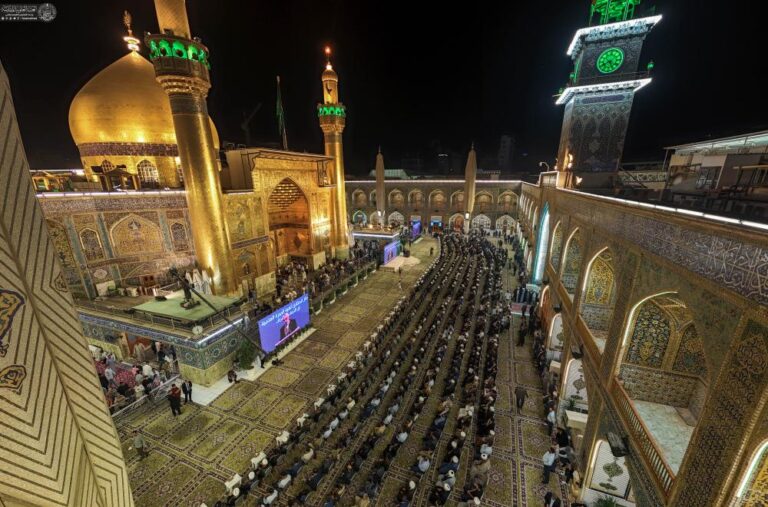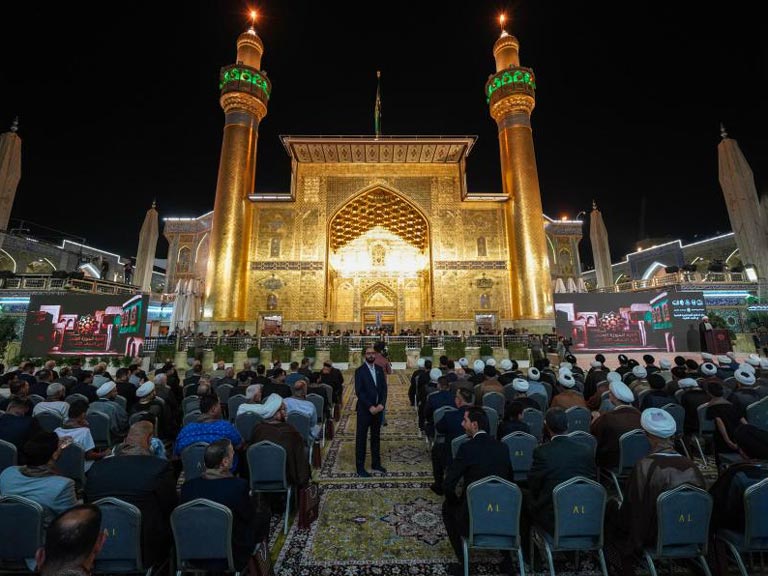
Beside the shrine of Amir al-Muminin (peace be upon him) — the place where the path of knowledge and learning first began — the Holy Alawi Shrine witnessed the grand ceremony announcing the “Millennium of the Hawza” project, attended by a gathering of religious and academic figures and Hawza professors from inside and outside Iraq.
The ceremony revisited the Hawza’s thousand-year path and its achievements across various fields — a seminary that, as one of the oldest religious and scholarly centers, has played a role in shaping Islamic thought, consolidating articles of faith, expanding knowledge, and serving and reforming society, a mission it has carried forward through successive generations of scholars, thinkers, and preachers.
A number of the Hawza’s scholars and professors also shared their views and reflections on this great scholarly event, recalling the seminary’s scholarly, intellectual, and social achievements and emphasizing the significance of its millennium as a continuation of civilizational and intellectual heritage, while also highlighting its role in sustaining the mission of knowledge, education, and guidance.
Najaf: A Center of Knowledge and Learning
Shaikh Karrar al-Khafaji, Head of the Religious Affairs Department of the Holy Alawi Shrine, told the shrine’s news center:
“This festival was held to mark the thousandth anniversary of the Najaf Hawza — a seminary that, over the past thousand years, from the arrival of Shaikh Tusi to the present day, has always been a dynamic scholarly center, and remains rich in scholars, authors, and writers. This diverse scholarly presence, given the breadth of its fields of learning and culture, reflects the importance of spreading Islamic culture — a culture that expresses the broad and blessed table of the Prophet Muhammad and the Qur’an.”
The Hawza: Identity and Symbol
Sayyid Riyadh al-Hakim, a professor of the Hawza, spoke about the significance and role of the seminary:
“The Hawza is a distinguished title for the school of the Ahl al-Bayt (peace be upon them), and equally a distinguished title for Iraq. The Hawza is not merely a symbolic institution; it carries scholarly and intellectual substance, manifested in its schools, research, and diverse cultural and scholarly activities and achievements. Throughout history, this Hawza has also played important roles and taken important positions in preserving Iraq’s unity and safeguarding its sanctities.”
A Continuing Scholarly Bounty
Shaikh Tariq al-Baghdadi, a professor of the Hawza, also stated:
“The founding of the Hawza in Najaf by Shaikh Tusi, and its brilliant achievements across the ages, stem from the fact that this seminary began its work beside Amir al-Muminin (peace be upon him) and has drawn upon the blessings of this great Imam. Over a thousand years, the Hawza has continued its path with an unbroken bounty and a renewing spirit of thought, giving special attention to human values and drawing upon the Book of God and the traditions of the Prophet’s (peace be upon him and his family) pure progeny — traditions that have played a role in spreading the teachings of the faith among the Islamic Ummah.”
It is worth noting that holding the “Millennium of the Hawza” ceremony contributes to strengthening religious awareness among future generations, preserving Islamic identity, showcasing the Hawza’s scholarly and intellectual achievements over a thousand years, and clarifying its role in spreading the teachings of the Ahl al-Bayt (peace be upon them) across different parts of the world.