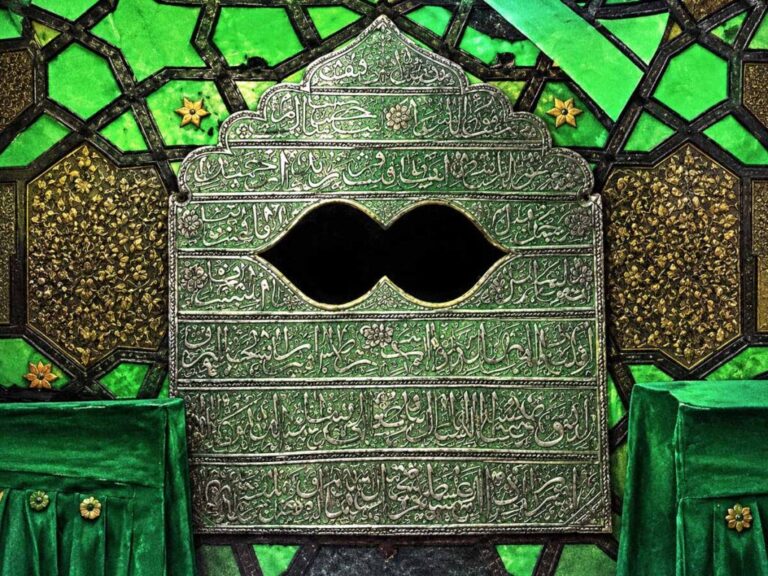
Account of the Incident of “Mawdi al-Isba’ayn”
The protagonist of this story was an Umayyad and a Nasibi (one who harbored hostility toward the Ahl al-Bayt) named Murrah ibn Qays, who lived in the fourth century AH. He attacked Najaf with his army, at a time when Najaf was a small, walled village. His aim was to exhume the sacred grave, but he perished in the attempt, may Allah curse him.
Mirza Hussain Nuri relates:
“Murrah ibn Qays was a wealthy disbeliever with abundant wealth and many servants and retainers. One day he consulted the elders of his people. They told him that Ali ibn Abi Talib (peace be upon him) was their blood-avenger. He asked where the grave of Ali (peace be upon him) was, and they directed him toward Najaf.
Murrah ibn Qays set out with two thousand horsemen and thousands of infantry. When he reached the outskirts of the city, the people prepared to defend themselves, and a six-day battle broke out. His soldiers destroyed part of the city wall, but the Muslims held firm. Nevertheless, Murrah ibn Qays managed to enter the sacred shrine.”
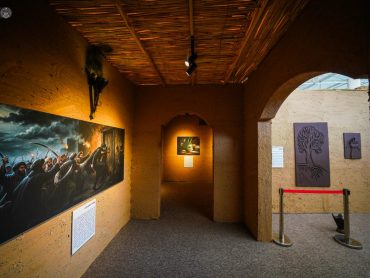
He said: “O Ali, you killed my fathers and forefathers!” and intended to exhume the sacred grave. At that very moment, two fingers emerged from the grave, like Dhu al-Fiqar, and came down upon the middle of his body, splitting him in two.
From that time on, the two halves of his body turned into a black stone, which was carried to the back of the city gate. Everyone who came to Najaf would strike that stone with his foot, and its strange property was that no animal would pass by it without bumping into it.
Later, a group of ignorant people took that stone to the Mosque of Kufa in order to sell it for a small price so that others might benefit from it, but over time the stone wore away and crumbled.
The Attention of the Shia and the Preservation of the Memorial
Shaikh Jafar Mahbouba states in his book Kashkul al-Fatuni that this stone remained at the gate of the fortress until 1200 AH, around the eighteenth century CE.
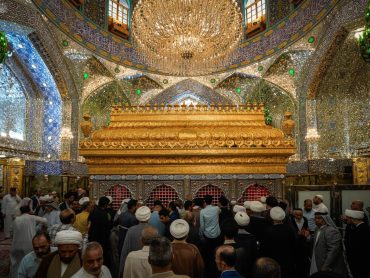
Throughout the centuries, the followers of the Ahl al-Bayt (peace be upon them) have always sought to preserve this symbol of the miracle. When the cenotaph was rebuilt, they installed precious jewels, gifts from sultans and kings, around it.
Sayyid Ahmad Hussaini, in the biography of Mirza Muhammad Taqi Shamsabadi Isfahani Almasi (d. 1159 AH), writes:
“He became known as ‘Almasi’ (the Diamond-Bearer) because his father, Mirza Kazim, had installed diamonds at the Place of the Two Fingers of the zarih of Amir al-Muminin (peace be upon him), worth 7,000 tomans.”
Features of “Mawdi al-Isba’ayn”
Shaikh Muhammad Hasan al-Jawahiri, in his jurisprudential encyclopedia Jawahir al-Kalam fi Sharh Shara’i al-Islam, writes in the discussion of li’an (mutual imprecation) in the Book of Marriage:
“In the matter of li’an, which is one of the topics related to marriage, the intensity of emphasis and gravity of the act may be increased by invoking the names of Allah the Exalted, which carry the sense of retribution and of divine majesty and awe. Such an act should be carried out in lofty and exalted places, such as between the Rukn and the Maqam in Mecca, on the Rock in the Aqsa Mosque, beside the grave of the Prophet (peace be upon him and his family) in Medina, at the spot known as the Two Fingers in the shrine of Amir al-Muminin (peace be upon him), near his blessed head, and likewise at other reputable shrines and mosques, such as the Mosque of Kufa, the Mosque of Suhayl, the Mosque of Baratha, and other well-known mosques.”
Today, “Mawdi al-Isba’ayn” remains part of the historical and spiritual narrative of the sacred Alawi shrine. It is a small mark on the Khatam Cenotaph that keeps an old account of a miracle attributed to Amir al-Muminin (peace be upon him) alive in the memory of pilgrims and in the oral history of Najaf.
Source
Drawn from the book Tarikh al-Marqad al-Alawi al-Mutahhar.
To view the previous article, please read “The History of the Khatam Cenotaph of the Tomb of Amir al-Muminin Through the Centuries.”