
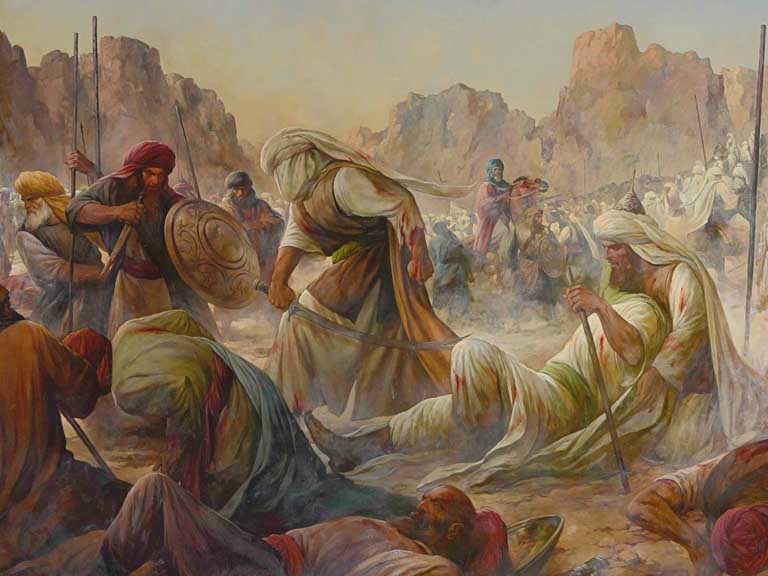
The expedition took place on the 7th or the middle of Shawwal. It is named after Mount Uhud because the battle unfolded at its base.
The Cause of the War
After their defeat at the Battle of Badr, the Quraysh prepared for a retaliatory strike under the command of Abu Sufyan. While the Prophet (peace be upon him and his family) and the elders of the Muhajirun and Ansar initially preferred to defend from within Medina, the younger Muslims and the Prophet’s uncle, Hamzah, advocated for meeting the enemy outside the city. Ultimately, the Prophet (peace be upon him and his family) decided to march out.
The Quraysh Army in Uhud Battle
Abu Sufyan spent heavily to equip an army of 3,000 warriors [1], including 700 armored soldiers, 200 horses, and 3,000 camels [2]. Safwan ibn Umayya suggested bringing women along to incite the men to revenge for those killed at Badr [3]. Some historians believe women were brought to prevent the men from fleeing, as retreating with women was difficult and abandoning them was considered a great shame [4]. Among them was Hind, the wife of Abu Sufyan [5].
The Muslims becoming aware of the movement of the Quraysh army
Before the Quraysh reached Uhud, Abbas ibn Abd al-Muttalib sent a messenger to the Prophet (peace be upon him and his family), informing him of the enemy’s plot and readiness. The Prophet (peace be upon him and his family) set out with approximately 1,000 men. Imam Ali (peace be upon him ) was the primary standard-bearer. Along the way, the Prophet (peace be upon him and his family) distributed various banners among the Muhajirun and Ansar.
The Desertion of the Hypocrites
Abdullah ibn Ubayy, the leader of the hypocrites, deserted the army with one-third of the force, persuading them to return by saying, “Why should we kill ourselves?” This left the Prophet (peace be upon him and his family) with only 700 loyal companions.
The Military Strategy
Upon reaching Uhud, the Prophet (peace be upon him and his family) organized his 700 men with a precise tactical plan. He stationed 50 archers on Mount Uhud to protect the rear of the Muslim camp. Their commander, Abdullah ibn Jubayr, was given strict orders: “Guard the rear and do not move from your positions, even if the Muslims are defeated or if they are victorious and collecting spoils. Everything depends on your position at this point.” [6]
The First Standard-Bearer of Islam
Amir al-Muminin (peace be upon him) was appointed the chief standard-bearer. Shaikh al-Mufid notes that Imam Ali (peace be upon him) held the distinction of carrying both the Rayah (major banner) and the Liwa (commander’s flag), signifying his unique trust and pivotal role in the Prophet’s military leadership. [7]
The Initial Victory of Muslims in the Battle of Uhud
As the battle commenced, Talha ibn Abi Talha, known as the “Ram of the Army” (the champion of the Quraysh), stepped forward and challenged: “Who will fight me?”
Ali ibn Abi Talib (peace be upon him) stepped out from the ranks to meet him. The Prophet (peace be upon him and his family) watched the confrontation from a shaded canopy nearby. Talha asked, “Who are you?” and Ali replied, “I am Ali, son of Abu Talib.” Talha remarked, “I knew none but you would dare attack me.”
Their swords were clashing when the Commander of the Faithful (peace be upon him) split Talha’s head with a blow; his eyes bulged and he let out a cry the likes of which no one had ever heard. At that moment, the banner fell from his hand and he wallowed in his blood like an ox.
It has been said:
“The Commander of the Faithful (peace be upon him) severed his leg with a blow; Talha fell and became exposed, so he [Imam Ali] thanked God and left him.” [8].
Then the Prophet (peace be upon him and his family) and the Muslims shouted “Allahu Akbar” (God is Greatest).
Following Talha, his brother Uthman stepped forward, only to be slain by Hamzah ibn Abd al-Muttalib.As Hamzah was moving away, he said:
“I am the son of water-bearer for Hujaj. A third brother, Abu Sa’id, took the standard, but Amir al-Muminin (peace be upon him) killed him as well. Then the banner fell into the hands of “Ata ibn Sharhabeel,” and the Commander of the Faithful (peace be upon him) killed him as well.”
Finally, one of the members of “Bani Abd al-Dar” raised the banner, and he too was killed by the Commander of the Faithful (peace be upon him). Shaikh al-Mufid records in Al-Irshad:
“There were nine standard-bearers, and Ali ibn Abi Talib killed all of them, leading to the enemy’s rout.” [9]
Most narrations confirm that after the killing of the standard-bearers and the clash of the two armies, no one faced Amir al-Muminin (peace be upon him) except that his sword was broken, a blow split his skull, and he was killed by that blow, until the army of the polytheists besieged the women of the Muslims and terror struck their hearts.
The victory that was achieved for the Prophet (peace be upon him and his family) at Uhud never occurred in the homeland.
Victory was with the Muslims until a group of archers disobeyed the orders of the Messenger of God (peace be upon him and his family) and went toward the spoils.
The defeat of the Muslims after the initial victory
Believing the battle was over, the majority of the archers stationed on the mountain abandoned their posts to collect war spoils, ignoring the direct orders of the Prophet (peace be upon him and his family) and the pleas of their commander, Abdullah ibn Jubayr. Only ten archers remained with him.
Khalid ibn al-Walid, noticing the mountain pass was undefended, led 200 cavalrymen in a flanking maneuver. They martyred the remaining archers and attacked the Muslims from the rear. Caught by surprise and surrounded, the Muslim ranks fell into chaos, and in the confusion, some even accidentally struck their own comrades.
Ibn Jubayr was killed after a valiant battle. The polytheists, having regrouped, surrounded the Muslims from behind. The Muslims then realized they had been encircled and engaged by the enemy, catching them off guard. At that moment, they were targeted by swords and spears from all sides and killed in a horrific manner. The situation became dire until they unwittingly began killing one another.
The Escape of the Muslims and Amir al-Muminin’s Defense of the Messenger of God
The Muslims fled from the army of the Messenger of God (peace be upon him and his family). In those fateful moments, Amir al-Muminin (peace be upon him) thought only of the Messenger of God, especially when he saw the polytheists advancing toward him as their target, since the battle had turned in their favor.
Amir al-Muminin (peace be upon him) and a group of Muslims surrounded the Messenger of God (peace be upon him and his family), as they were determined to defend him.
Hamzah tore through the enemies with his sword, and Amir al-Muminin (peace be upon him) struck like a hungry predator on its prey, scattering them and cutting them to pieces with his sharp sword-while they were on foot and the enemies on horseback-thus keeping them away from the Messenger of God (peace be upon him and his family) until their swords broke.
The Messenger of God (peace be upon him and his family) also fought bravely. The polytheists gathered around him, trying by every means to kill him.
The Rumor of the Prophet’s Death (peace be upon him and his family)
Ukkrimah narrates: I heard Amir al-Muminin (peace be upon him) say:
“On the day of Uhud, when people scattered from the Messenger of God (peace be upon him and his family), I lost control for a while and was worried about him. I fought in front of the Messenger of God (peace be upon him and his family) with my sword, then turned back but did not see him.”
I said:
“The Messenger of God is not one to flee, nor did I see him among the slain. I thought he had ascended to heaven, so I broke the scabbard of my sword and said to myself: ‘I will fight for the Messenger of God until I am killed.'”
Then I charged until they cleared a path, and I saw the Messenger of God unconscious on the ground. I stood over him; he looked at me and said:
“O Ali, what have the people done?”
I replied:
“O Messenger of God, they have become disbelievers, turned away, and surrendered.”
Amir al-Muminin’s Sacrifice in the Battle of Uhud (peace be upon him)
The Prophet saw a group from the enemy army approaching and said to me:
“O Ali, keep these away from me.”
I attacked them, striking left and right with my sword until they fled.
The Prophet ( peace be upon him and his family ) said to me:
“Do you not hear the praises for you in heaven? The angel Ridwan calls out: ‘There is no sword but Dhulfiqar, and no brave man but Ali.’
So I wept with joy and thanked God Almighty for this blessing. [10]
The Martyrdom of Hamzah, the Prophet’s Uncle ( peace be upon him and his family )
In this battle, “Hamzah ibn Abd al-Muttalib” was martyred by the spear of Wahshi, the slave of Jubayr ibn Mut’im, and Hind bint Utba mutilated him, cutting off his blessed nose, ripping open his liver, and eating it.
The Messenger of God ( peace be upon him and his family ) was deeply grieved and said:
“No calamity like yours has befallen me.”
The Presence of Muslim Women in the Battle of Uhud
In the battle, 14 women from the Ansar and Muhajir were present, responsible for tasks like providing water, treating the wounded, and cooking food. [11]
Among them were Lady Fatimah (peace be upon her), Umm Ayman, Hamna, Umm Salama, and Umm Amara (Nusaybah). [12]
The Honors of Amir al-Muminin in the Battle of Uhud (peace be upon him)
Ibn Abi al-Hadid said:
“Ali’s (peace be upon him) distinction in striving in the way of God is clear to friend and foe alike. He was the master of the mujahideen-indeed, is the virtue of jihad befitting anyone else?”
It is noted that the greatest battle of the Prophet (peace be upon him and his family) and the most impactful strike against the polytheists was the great Battle of Badr.
In that battle, seventy polytheists were killed, half of them by Imam Ali (peace be upon him). [13]
On the day of Uhud, according to the most authentic narrations, he killed the polytheists’ standard-bearers-said to be seven or nine-and the polytheists fled from the battlefield upon their deaths.
Had the archers not disobeyed the Prophet (peace be upon him and his family), the battle would have ended in favor of the Muslims.
All those killed from the polytheist army that day numbered twenty-eight, eighteen of whom were killed by Imam Ali (peace be upon him). [14]
Imam Jafar al-Sadiq (peace be upon him) said:
“The intent of the verse ‘among you are those who desire the world’ refers to the men and soldiers of Abdullah Jubayr who left their position to gather spoils, and the intent of ‘and among you…’and the intent of ‘those who desire the Hereafter’ is Abdullah himself and twelve of his companions who remained until they were killed. After that, He describes the state of those who fled from the battle, under the verse ‘So He gave you back sorrow for sorrow.'”
Abi Jarud narrates from Imam al-Baqir (peace be upon him) who said:
“The first sorrow was the fleeing of the Muslims, and the second was Khalid ibn al-Walid’s dominance over them.”
Uyashi, through his chain, under verse 155 of the blessed Surah Al Imran, narrates from Imam al-Sadiq (peace be upon him) who said:
“When the army of Islam fled on the day of Uhud, the holy Prophet (peace be upon him and his family) said to them: ‘Where are you fleeing? God has promised me to make Islam victorious over all religions.’ Some hypocrites said: ‘We fled, and the Prophet is mocking and ridiculing us.'” [15]
Numan al-Radhi narrates from Imam al-Sadiq (peace be upon him) who said:
“In the Battle of Uhud, people fled from around the Messenger of God (peace be upon him and his family) to such an extent that he became extremely angry-so much so that when he was angry, sweat like pearls would pour from his blessed forehead. He looked and saw Ali (peace be upon him) beside him. He said to him: Join the sons of your father (i.e., like the others who fled from the Messenger of God).”
He replied:
“O Messenger of God, I follow you.”
The Prophet (peace be upon him and his family) said:
“Then keep these enemies away from me.” Ali (peace be upon him) charged and struck the first one he reached with his sword.
Gabriel said:
“O Muhammad, this is true brotherhood.”
The Prophet said:
“He is from me, and I am from him.” Gabriel said: “And I am from you.”
Imam al-Sadiq (peace be upon him) said:
“At that moment, the Messenger of God (peace be upon him and his family) saw Gabriel standing on a pedestal of gold between heaven and earth, proclaiming: ‘There is no sword but Dhulfiqar, and no brave youth but Ali.'” [16]
Muhammad ibn Muhammad ibn Ishaam al-Kulayni marfu’ narrates from Imam al-Sadiq (peace be upon him) who said:
“The sword of Amir al-Muminin (peace be upon him) was called ‘Dhulfiqar’ because there was a line in the middle of its hilt running along the blade like the dark vertebrae of the spine. It was the same sword Gabriel brought from heaven, with a silver hilt-the sword for which a caller from heaven cried out: ‘There is no sword but Dhulfiqar, and no brave youth but Ali.'” [17]
What was the Outcome of the Battle?
The initial outcome of this battle was the defeat of the polytheists; however, a group of archers whom the Prophet (peace be upon him and his family) had placed under the command of Abdullah ibn Jubayr on Mount Ayneen on the left side of Mount Uhud abandoned their position, thinking they had won.
The polytheists also passed through this area, attacked the Muslims from behind, and defeated them. In this battle, the Muslims suffered heavy losses:
Including the martyrdom of about seventy Muslims, the martyrdom of Hamzah ibn Abd al-Muttalib and his mutilation, injury to the Prophet’s face (peace be upon him and his family), and the breaking of his tooth.
After the Battle of Uhud ended, the polytheists headed toward Mecca but regretted it en route and decided to return and finish off the rest of the Muslim army. Gabriel descended and ordered the noble Prophet (peace be upon him and his family) to mobilize for battle.
A caller summoned the wounded to move. It is said that sixty or seventy horsemen came out with the Messenger of God (peace be upon him and his family).
1) Al-Maghazi, Vol. 1, p. 203; Tarikh al-Tabari, Vol. 2, p. 59.
2) Al-Maghazi, Vol. 1, p. 203; Ansab al-Ashraf, Vol. 1, p. 383.
3) Al-Maghazi, Vol. 1, p. 202; Al-Muntazam, Vol. 2, p. 263.
4) Tarikh al-Tabari, Vol. 2, p. 59; Al-Sirah al-Nabawiyyah, Ibn Hisham, Vol. 3, p. 62.
5) Tarikh al-Tabari, Vol. 2, p. 59; Al-Sirah al-Nabawiyyah, Ibn Kathir, Vol. 2, p. 327.
Vol. 2, p. 59; Al-Sirah al-Nabawiyyah, Ibn Kathir, Vol. 2, p. 327.
6) Al-Tabaqat al-Kubra: Vol. 2, p. 30; Al-Kamil fi al-Tarikh: Vol. 2, p. 47; Al-Irshad: Vol. 1, p. 80 (with slight differences).
7) Bihar al-Anwar, Vol. 16, p. 117.
8) Al-Kamil fi al-Tarikh: Vol. 2, p. 47.
9) Al-Irshad, Shaykh al-Mufid: Vol. 1, p. 88.
10) Ilam al-Wara: Vol. 1, p. 378.
11) Ibn Athir, Vol. 6, p. 70.
12) Al-Kamil/Translation, Vol. 7, p. 177.
13) Sirat al-Masumun, Vol. 3, p. 38.
14) Bihar al-Anwar, Vol. 16, p. 119.
15) Tafsir Jami’, Vol. 1, p. 501.
16) Al-Kafi, Vol. 8, p. 110.
17) Ma’ani al-Akhbar, Vol. 1, p. 146.


