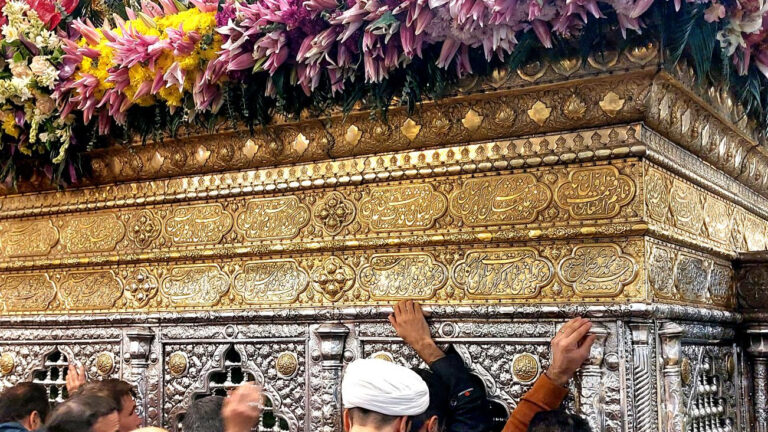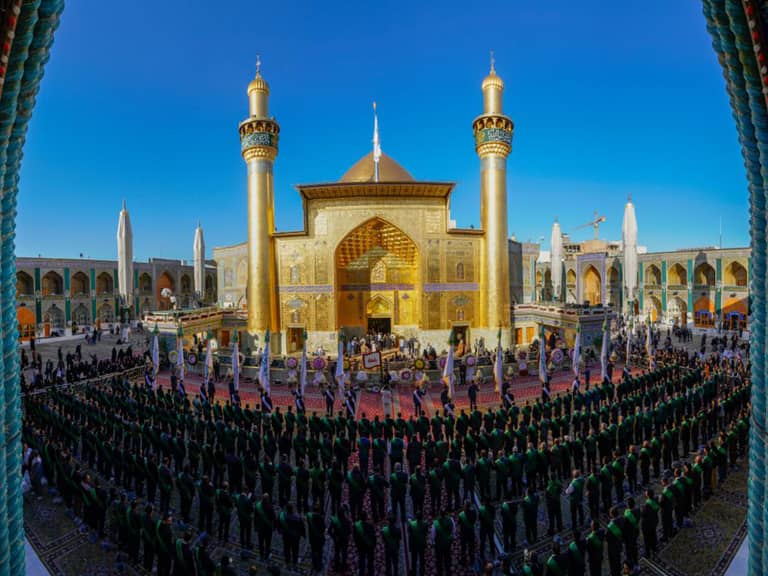
The position of Lady Fatimah al-Masumah (peace be upon her) among the Ahl al-Bayt is a manifestation of the profound connection between guardianship and spirituality, transforming Qom into a secure sanctuary for the lovers of the Ahl al-Bayt. The transmitted narrations indicate that the remembrance and status of Lady al-Masoumah (peace be upon her) is inseparably linked to the name of the Lord of the Pious and the virtue of his Shia followers.
Date and Place of Birth
Lady Fatimah al-Masumah (peace be upon her), the honorable daughter of Imam Musa al-Kadhim (peace be upon him) and sister of Imam al-Ridha (peace be upon him), was born on the first day of Dhu al-Qa’dah 173 AH in the city of Medina.
Imam al-Kadhim (peace be upon him) had thirty-seven children, among whom Imam al-Ridha (peace be upon him) and his sister Lady Al-Masoumah (peace be upon her) were born to the same mother named Najmah or (Tuktam or Arwi) famously known as Umm al-Banin.]1 [2]
Guardianship of Amir al-Muminin (peace be upon him) and the Salvation of His Shia
Lady Fatimah al-Masumah (peace be upon her), daughter of Imam al-Kadhim (peace be upon him), narrates from her noble mothers—Fatimah daughter of Imam al-Sadiq, Fatimah daughter of Imam al-Baqir, Fatimah daughter of Imam al-Sajjad, Fatimah daughter of Imam al-Hussain, and Umm Kulthum daughter of Amir al-Muminin—and they from Fatimah al-Zahra (peace be upon her) who said:
“I heard from the Messenger of God (peace be upon him and his family) who said: When I was taken to the heavens and entered Paradise, suddenly I saw a palace built from a single hollow white pearl. It had a door adorned with pearls and rubies, with a curtain hanging over it. I looked up; above the door was written: ‘There is no god but Allah, Muhammad is the Messenger of God, and Ali is the guardian and trustee of the people.’
On the curtain was inscribed: ‘Well done! Who is like the Shia of Ali?’
I entered the palace. I saw another palace of red agate, hollow, with a silver door adorned with green jade, and a curtain hanging over it. I looked; on the door it was written: ‘Muhammad is the Messenger of God, and Ali is his chosen successor.’
On the curtain it said: ‘Glad tidings to the Shia of Ali for purity and legitimate birth!’
I continued on my way and entered a palace of green emerald, hollow, more beautiful than any I had ever seen. It had a door of red ruby adorned with pearls, and a curtain over it. I raised my head; on the curtain was written: ‘The Shia of Ali are the saved and victorious!’
I asked: ‘O Gabriel, to whom do these palaces belong?’
He said: ‘O Muhammad! All these are for your cousin and successor, Ali ibn Abi Talib. On the Day of Resurrection, people will be resurrected barefoot and naked, except the Shia of Ali. Also, people will be called by their mothers’ names that day, except the Shia of Ali who will be called by their fathers’ names.’
I said: Why is that?’
He said: ‘Because they love Ali, their births are pure and legitimate.'” [3]
Prediction of the Burial Place by Amir al-Muminin (peace be upon him)
Narrations from the Infallible Imams indicate that years earlier, her burial place in Qom had been predicted. These narrations are transmitted from Amir al-Muminin (peace be upon him), as well as from Imam al-Sadiq (peace be upon him) and Imam al-Ridha (peace be upon him).
Abu Abdullah the Faqih of Hamadan in his book “Al-Buldan” narrates that Abu Musa al-Ash’ari asked Amir al-Muminin (peace be upon him):
“What is the safest city and best place when sedition and war descend?”
The Imam replied:
“The safest places in such times are the land of Jabal (Qom). When the situation in Khorasan becomes turbulent, war breaks out between the people of Gurgan and Mazandaran, and Sistan is ruined, then the safest places in those times are the neighborhood of Qom. A city from which the companions (of Imam al-Mahdi (may God hasten his reappearnce)) and the best people will emerge. This city is the place of Gabriel’s footsteps, and the place from which a flowing water emerges that whoever drinks from it will be safe from every affliction.” [4]
[1] Bihar al-Anwar, Allamah Majlisi, Vol. 101, p. 121.
[2] Wafayat al-A’immah, p. 313.
[3] Bihar al-Anwar, Vol. 65, p. 79 / Al-Musalsalat, p. 241.
[4] Bihar al-Anwar, Vol. 57, p. 217 / Safinat al-Bihar, Vol. 7, p. 359.