
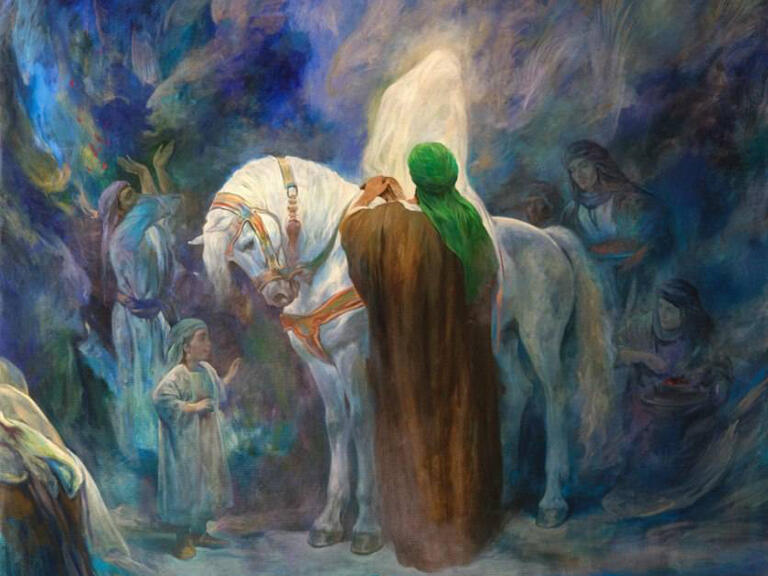
The marriage of Amir al-Muminin (peace be upon him) and Fatimah al-Zahra (peace be upon her) was not merely a personal event, but one of great historical and religious significance. This marriage strengthened the bond between the family of the Seal of the Prophets and Amir al-Muminin (peace be upon him), and played a crucial role in shaping the history of Islam.
Moreover, the simplicity and spirituality of this marriage have served as a model for Muslims throughout the ages. According to both Shia and Sunni sources, the union of Amir al-Muminin (peace be upon him) and Fatimah (peace be upon her) was by the command of Almighty God, and the Messenger of God (peace be upon him and his family) was commissioned to perform it.
The Love of Haydar
The exalted status and beloved nature of Amir al-Muminin (peace be upon him) in the sight of God and the Prophet (peace be upon him and his family) was such that in the story of his proposal to Fatimah (peace be upon her), he was honored in this way:
The Prophet (peace be upon him and his family) was in the house of his wife Umm Salamah when Amir al-Muminin (peace be upon him) knocked at the door to propose to Fatimah (peace be upon her). Umm Salamah said: “Who is at the door?” Before Amir al-Muminin (peace be upon him) could say “It is Ali,” the Messenger of God (peace be upon him and his family) told her: “O Umm Salamah, get up and open the door for him and give him permission to enter, for he is a man whom God and His Messenger love, and he loves God and His Messenger.” [1]
The Proposal Ceremony
Dahhak ibn Muzahim narrates that he heard Imam Ali ibn Abi Talib (peace be upon him) describe his proposal to Fatimah al-Zahra (peace be upon her):
“When I went to the Prophet of God (peace be upon him and his family), he saw me and smiled, then said: ‘O Ali, have you come to me for a request?’ I explained to him my close kinship, my precedence in Islam, my support for him, and the battles I had fought in the path of God.”
The Holy Prophet (peace be upon him and his family) said: “O Ali, you speak the truth; your station is even higher than what you have mentioned.” I said: “O Messenger of God, marry Fatimah to me.” The Prophet (peace be upon him and his family) said: “O Ali, before you several men made this request, but whenever I spoke to Fatimah, she showed disinclination. Wait a moment while I go to her and return.” [2]
Silence as Consent
The Prophet (peace be upon him and his family) went to Fatimah (peace be upon her) and said:
“O Fatimah!” She replied: “Yes, O Prophet of Allah, what do you wish?” The Prophet (peace be upon him and his family) said: “Ali ibn Abi Talib (peace be upon him) – you know his kinship, his virtue, and his Islam. I have asked God to marry you to the best of His creation and the most beloved to Him, and Ali has proposed to you. What do you say?”
Fatimah (peace be upon her) remained silent but did not turn her face away, and the Prophet saw no dislike on her face. So he stood up saying: “God is the greatest! Her silence is her consent.” Then Gabriel came to the Messenger of God and said: “O Muhammad, marry her to Ali ibn Abi Talib, for God has chosen these two for one another.” [3]
Why Other Suitors Were Rejected
Amir al-Muminin (peace be upon him) narrated about the proposal to Fatimah al-Zahra (peace be upon her):
“The Seal of the Prophets (peace be upon him and his family) told me: ‘O Ali, a group of Quraysh men have reproached me concerning Fatimah’s marriage. They said: “We proposed to Fatimah and you refused, but now you have given her to Ali ibn Abi Talib.” I replied: “By God, I did not reject you nor marry her off. Rather, God rejected your proposals and married Fatimah to Ali, because Gabriel descended to me and said: Almighty God says: ‘If I had not created Ali, there would be no husband worthy of Fatimah on the face of the earth.'” [4]
An Unequalled Match
Imam al-Sadiq (peace be upon him) said about the high station of the Siddiqah al-Kubra (Fatimah):
“If God had not created Amir al-Muminin Ali (peace be upon him) for Fatimah (peace be upon her), there would have been no equal for her on earth.” [5]
The Marriage Sermon in the Mosque
Jabir narrated about the marriage sermon of Amir al-Muminin (peace be upon him) :
“When the Prophet of God (peace be upon him and his family) decided to marry Fatimah (peace be upon her) to Amir al-Muminin (peace be upon him), he said: ‘O Ali, go to the mosque.’ When the mosque was filled with people, the Seal of the Prophets stood up, praised and thanked God, and said: ‘Almighty God has commanded me to marry my daughter Fatimah (peace be upon her) to my brother, my cousin, and the most deserving of people to me – Ali ibn Abi Talib (peace be upon him). God married her to Ali in the heavens among the angels, and commanded me to marry her to Ali on the earth in your presence.'” [6]
The Dowry (Mahr) and Trousseau
The Prophet (peace be upon him and his family) said to Amir al-Muminin (peace be upon him) :
“O Ali, what do you have that could be the dowry for Fatimah (peace be upon her)?” Amir al-Muminin (peace be upon him) replied: “O Messenger of God, you yourself witness that I possess nothing of this worldly wealth except my sword, my camel, and my coat of armor.” The Prophet (peace be upon him and his family) said: “O Ali, you need your sword and your camel. But sell your armor and use the proceeds to arrange the marriage with Fatimah (peace be upon her).” [7]
Amir al-Muminin (peace be upon him) said:
“The Messenger of God (peace be upon him and his family) told me to get up and sell my armor. I did so; I sold the armor for four hundred dirhams and brought the money to the Messenger of God (peace be upon him and his family), placing it in his lap. He did not ask how much it was, nor did I say anything about it.” Then he took some of the dirhams, called Bilal, gave him the money and said: “Buy perfume for Fatimah (peace be upon her).” Then the Messenger of God (peace be upon him and his family) took another portion of the dirhams with both hands, gave them to Ammar ibn Yasir, and said: “Buy for Fatimah (peace be upon her) clothing and household items befitting her.” [8]
The Prophet’s Blessing
The Prophet (peace be upon him and his family) prayed for the start of the married life of Ali (peace be upon him) and Fatimah (peace be upon her) as follows. Amir al-Muminin Ali (peace be upon him) said:
“The Prophet (peace be upon him and his family) married me to Fatimah (peace be upon her), then took my hand and said: ‘In the name of God, stand up and say: “By the blessing of God, and as God wills, there is no power except by God, I put my trust in God.”‘ Then he seated me next to Fatimah (peace be upon her) and said: ‘O God, these two are the most beloved of Your creation to me. Make them beloved to You as well. Bless their offspring and place them under Your protection. I seek refuge for these two and their children with You from the accursed Satan.'” [9]
Giving Away the Wedding Garment
The Prophet (peace be upon him and his family) prepared a garment for Fatimah (peace be upon her) for the first night of her marriage and gave it to her. That same night, a beggar asked her for clothing. She gave away her wedding garment to that beggar and put on her old clothes instead. When the Seal of the Prophets asked her why she had not worn the new garment, she recited:
“You will not attain righteousness until you spend from what you love” (Quran 3:92). [10]
A Heavenly Marriage
The Seal of the Prophets emphasized the heavenly nature of the marriage of Amir al-Muminin Ali (peace be upon him) and Fatimah (peace be upon her) in these narrations:
Jabir ibn Abdillah al-Ansari said:
“When the Prophet of God (peace be upon him and his family) married Fatimah (peace be upon her) to Amir al-Mu’minin Ali (peace be upon him), some of the Quraysh said: ‘O Messenger of God, you have married Fatimah to Ali with such a small dowry?’ The Prophet replied: ‘I did not marry her to him. Indeed, on the night of my Ascension ), God married her to Ali ibn Abi Talib.'” [11]
In another narration, the Prophet (peace be upon him and his family) said: “I am a human being like you. I marry from among you and give my daughters in marriage to your men – except for my daughter Fatimah (peace be upon her), for the decree of her marriage came from heaven.” [12]
Divine Glad Tidings
Regarding the heavenly glad tidings of the marriage of Fatimah (peace be upon her) and Amir al-Mu’minin (peace be upon him)Bilal ibn Hamamah narrated:
“One day, the Prophet of God (peace be upon him and his family) came to us, his face shining like the full moon. Abd al-Rahman ibn Awf said: ‘O Messenger of God, what is this light?’ The Prophet (peace be upon him and his family) said: ‘It is because of the glad tidings given to me by my Lord concerning my cousin and my daughter. Indeed, God has married Fatimah (peace be upon her) to Ali ibn Abi Talib (peace be upon him).'” [13]
The Sublime Station of the Master
The Prophet (peace be upon him and his family) said concerning Amir al-Muminin (peace be upon him), “Indeed, God Almighty made me and Ali ibn Abi Talib (peace be upon him) brothers, married my daughter to him from above the heavens, took His close angels as witnesses for it, and made him my successor and heir. Amir al-Muminin Ali (peace be upon him) is from me, and I am from him. His friend is my friend, and his enemy is my enemy. The angels seek nearness to God through love for him.” [14]
[1] Bihar al-Anwar, vol. 43, p. 126
[2] Amali of Tusi, p. 39, no. 44; Bisharat al-Mustafa, p. 261
[3] Amali of Tusi, p. 39, no. 44; Bisharat al-Mustafa, p. 261
[4] Allamah Muhammad Baqir Majlisi, Bihar al-Anwar, vol. 43, p. 288
[5] Usul al-Kafi, vol. 1, p. 467
[6] Bihar al-Anwar, vol. 100, p. 269
[7] Majlisi, Bihar al-Anwar (Beirut: Mu’assasat al-Wafa, 2nd ed., 1403 AH), vol. 43, pp. 120 & 140
[8] Bihar al-Anwar, vol. 43, p. 94
[9] Amali of Tusi, p. 40; al-Muhtadhir, p. 240
[10] ‘Awalam al-‘Ulum, vol. 11, p. 230
[11] Amali of Tusi, p. 257; al-Muhtadhir, p. 241
[12] al-Kafi, vol. 5, p. 568
[13] Mi’at Manqabah, p. 166
[14] Amali of Saduq, vol. 1, p. 27


