Imam Muhammad al‑Baqir (AS) presents wilayah not just as one of the pillars of the faith, but as the key to understanding and acting upon all other Islamic rites, and as a necessary condition for true knowledge of the Lord. These narrations, while explaining the station of Amir al‑Muminin (AS) as the central axis of wilayah, clearly show that accepting and following the Infallible Imams is the path that God has chosen for guiding humanity.
Date and Place of Martyrdom
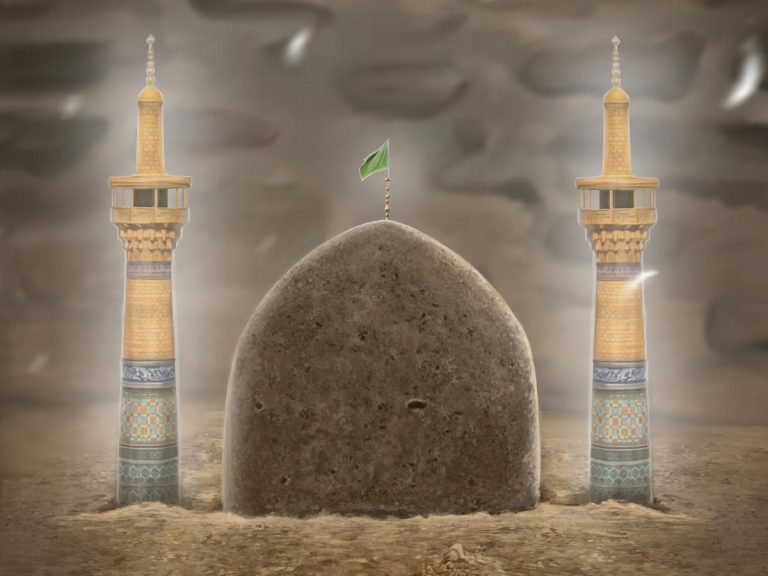
According to the famous account, Imam Muhammad al‑Baqir (AS) was martyred on the 7th of Dhu al‑Hijjah in the year 114 AH. It is said that he was poisoned by order of the Umayyad caliph Hisham ibn Abd al‑Malik, and the governor of Medina, Ibrahim ibn al‑Walid ibn Abd al‑Malik, carried it out.His blessed grave is in Baqi’, next to his father, Imam al‑Sajjad (AS).
The period of Imam al‑Baqir’s Ireligioud leadership began in 95 AH—the year Imam Zayn al‑Abidin (AS) passed away—and continued until 114 AH, lasting nineteen years and a few months. [1]
The Station of Wilayah in the Words of Amir al‑Muminin (AS) and Ammar ibn Yasir
Imam al‑Baqir (AS) narrates that Amir al‑Muminin Ali (AS) was once on the pulpit when a man came to him and asked permission to relate a narration he had heard from Ammar ibn Yasir, who in turn had heard it from the Messenger of God (PBUH). The Imam said: “Fear God, and do not attribute to ‘Ammar anything other than what he himself said.” He repeated this three times, then told the man: “Now speak.”
The man said:
“I heard ‘mmar say that the Messenger of God (PBUH) said: ‘I fight based on the Tanzil (the apparent revelation) of the Quran, and Amir al‑Muminin (AS) will fight based on its Ta’wil (its deeper interpretation).'”
Amir al‑Muminin (AS) then said:
“By the Lord of the Kabah, Ammar spoke the truth. This statement is one of a thousand profound sayings I learned from the Messenger of God (PBUH), and each word of them opens thousands of doors of knowledge for me.” [2]
The Fate of Enmity Toward Wilayah
Imam al‑Baqir (AS) explains the high station of wilayah in Islam with a narration: “The enemy of Amir al‑Muminin Ali (AS) will not leave this world without first drinking a gulp of the boiling water of Hell.” He also said: “Whoever opposes the wilayah of Amir al‑Muminin (AS), his praying and his committing adultery are the same (i.e., both are rejected).” [3]
Who Are the “Truthful Ones” (al‑Sadiqin) in the Qur’an?
There are verses in the Quran whose deep, illuminating interpretations by the Infallible Imams open a new window to understanding reality. Imam al‑Baqir (AS) explained who the “truthful ones” refer to in this narration.
Interpreting the noble verse:
“O you who have believed, fear God and be with the truthful (al‑sadiqin)” (Quran 9:119), Imam al‑Baqir (AS) said: “The sadiqin here is Amir al‑Muminin Ali ibn Abi Talib (AS); so be with him.” [4]
Who Is the “Manifest Imam” (Imam Mubin)?
In a narration from Imam al‑Baqir (AS), he explains the Quranic reference to the “Manifest Imam” as follows. He said: “When this verse was revealed to the Prophet (PBUH): ‘And everything We have enumerated in a Manifest Imam’ (Qur’an 36:12), Abu Bakr and Umar stood up and asked: ‘O Messenger of God, does “Manifest Imam” mean the Torah?’ The Prophet said: ‘No.’ They asked again: ‘Then does it mean the Gospel?’ He said: ‘No.’ They asked: ‘Does it mean the Qur’an?’ He said: ‘No.’ At that moment, Amir al‑Muminin Ali (AS) entered. The Prophet (PBUH) said: ‘He is the Manifest Imam. He is the Imam in whom God, the Blessed and Exalted, has gathered the knowledge of all things.'” [5]
Knowing God Through the Path of the Ahl al‑Bayt’s Wilayah
Imam al‑Baqir (AS) introduced love for the Ahl al‑Bayt as the way to attain divine attention and remove the veil between the servant and God.
In this regard, Abu Hamzah al‑Thumali relates that he asked Imam al‑Baqir (AS): “What is the knowledge of God?” The Imam replied: “Knowledge of God means to affirm God and His Messenger Muhammad (PBUH) regarding the wilayah of Amir al‑Muminin Ali (AS) and the Imams after him, to follow them, and to disavow their enemies.” [6]
Love for the Master of the Pious Ensures Steadfastness in Religion
Imam al‑Baqir (AS) said about love for the Master of the Pious and its effect on the believer’s heart: “God has not placed love for Amir al‑Muminin Ali (AS) in anyone’s heart without this guarantee: if one of his feet slips (i.e., he makes a mistake), the other foot (his certainty and love) will remain steadfast.” [7]
The Fruit of Loving the Family of Muhammad (PBUH & His Family)
Imam al‑Baqir (AS) said about removing the veil between oneself and God and attaining divine attention: “Whoever wishes that there be no veil between him and God, so that he may look at God and God may turn His attention to him, should love the family of Muhammad, disavow their enemies, and follow the Imams from the family of Muhammad (PBUH). When he does that, God turns His attention to him, and He also turns His attention to God.” [8]
The Mission of the Prophets: Centered on Wilayah and Disavowal of Enemies
Imam al‑Baqir (AS) said about the wilayah of the Ahl al‑Bayt and disavowal of their enemies, and about the misguidance of nations: “God never sent a prophet without that prophet having the wilayah of us (the Ahl al‑Bayt) and disavowal of our enemies. This meaning is also found in verse 36 of Surah al‑Nahl: ‘And We certainly sent into every nation a messenger, [saying], “Worship God and avoid the false god (taghut).” And among them were those whom God guided, and among them were those upon whom error was justly imposed.’ Those who went astray, went astray because they denied the family of Muhammad (PBUH).” [9]
The Fifth Pillar of Islam and the Key to Acceptance of Deeds
Zurarah narrates from Imam al‑Baqir (AS) that he said about the five essential pillars of Islam and the most important among them: “Islam is built on five things: prayer, zakat, fasting, Hajj, and wilayah.” Zurarah asked: “Which of these is superior?” The Imam said: “*Wilayah* is superior, because wilayah is the key to all of them, and the Imam is the guide to them.”
Then he said:
“Know that if a person spends his nights in worship, fasts his days, gives all his wealth in charity, and goes on Hajj his entire life, but does not recognize the wilayah of the Chosen guardian of God (Wali God) so as to follow him and perform all his actions under his guidance, he will have no share of God’s reward and will not be counted among the people of faith.” [10]
[1] Muntaha al‑Amal, Shaykh Abbas Qummi
[2] Bihar al‑Anwar, vol. 32, p. 299
[3] Thawab al‑A’mal wa ‘Iqab al‑A’mal, vol. 2, p. 210; Bihar al‑Anwar, vol. 27, p. 235
[4] Al‑Manāqib, vol. 3, p. 92
[5] Tafsir Kanz al‑Daqa’iq, vol. 11, p. 61
[6] Tafsir al‑’Ayyashi, vol. 2, p. 116; Bihar al‑Anwar, vol. 27, p. 57
[7] Bihar al‑Anwar, vol. 65, p. 199
[8] Bihar al‑Anwar, vol. 27, p. 51
[9] Tafsir al‑Burhan, vol. 3, p. 419
[10] Ithbat al‑Hudat, vol. 1, p. 117