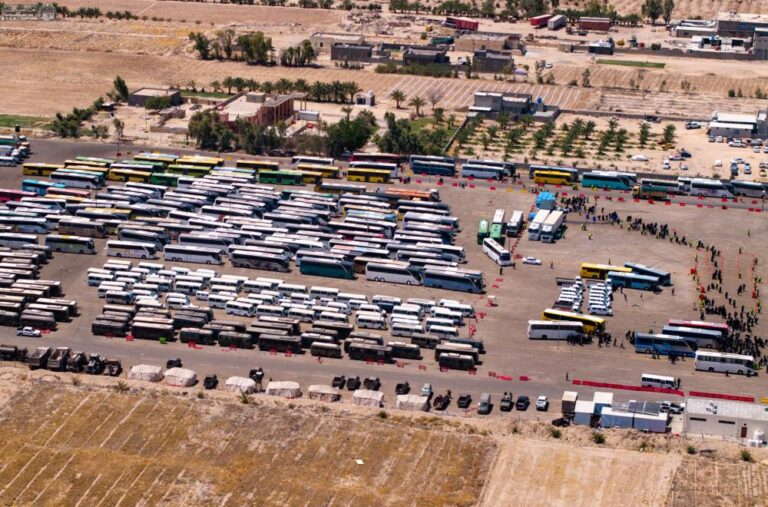
The Deputy Custodian of the Holy Alawi Shrine, at a joint press conference attended by local officials, security commanders, and heads of service agencies in Najaf Province, announced the success of the comprehensive plan to serve Arbaeen pilgrims, stating that approximately 17.5 million pilgrims were honored to visit the sacred shrine of Amir al-Muminin Ali (peace be upon him) during the pilgrimage season.
Haidar al-Eisawi, a member of the Holy Alawi Shrine’s Board of Trustees, speaking at the conference — attended by the head and members of the Provincial Council, the Governor of Najaf al-Ashraf, and heads of security and service agencies — stated:
“Preliminary figures indicate that, from the first day of the month of Safar through the conclusion of the Arbaeen ceremonies, the number of pilgrims to the sacred shrine of Amir al-Muminin (peace be upon him) reached approximately 17.5 million. This figure is preliminary, and as the process of review and data recording continues, it is likely to rise further.”
Najaf: The Main Station for Pilgrims
Referring to the special status of the city of Najaf al-Ashraf, al-Eisawi said:
“This city is the principal point of reception for pilgrims arriving from outside Iraq as well as from the country’s southern provinces. Moreover, Najaf al-Ashraf also serves as the point of return for pilgrims after the conclusion of the Arbaeen ceremonies in holy Karbala — a factor that has resulted in an unprecedented volume of pilgrim presence in the city and underscores its central role in managing the days of Arbaeen.”
He further stated that all departments of the Holy Alawi Shrine, mobilizing their full capacities, provided pilgrims with an extensive array of services, including accommodation and rest stations, food distribution, medical services, transportation, security services, ablution and rest facilities, and other services required by pilgrims throughout the days of the pilgrimage.
Institutional Synergy
The member of the Holy Alawi Shrine’s Board of Trustees emphasized that the success of this plan was the result of coordination and joint cooperation among the Holy Alawi Shrine, the Najaf al-Ashraf Provincial Council, the Governorate, and security, service, and medical agencies. According to him, all relevant institutions worked in a spirit of teamwork to provide the best possible services to the pilgrims of Imam al-Hussain (peace be upon him) who had entered the city of Amir al-Muminin (peace be upon him).
The Governor of Najaf al-Ashraf, Yousef Kannawi, also stated:
“The success of the Arbaeen service plan is the result of the cooperation and synergy of the people of Najaf al-Ashraf, the Holy Alawi Shrine, the local and central governments, as well as supporting ministries — a cooperation that laid the groundwork for providing every type of service to pilgrims of the sacred shrine of Amir al-Muminin (peace be upon him) in the city of Najaf al-Ashraf.”
It is worth noting that the success of the special Arbaeen plan was the result of efficient management grounded in institutional coordination, effective cooperation between the Holy Alawi Shrine and the government agencies and institutions of Najaf al-Ashraf Province, and the extensive efforts of the shrine’s servants across all departments, units, and volunteer service providers with diverse areas of expertise.