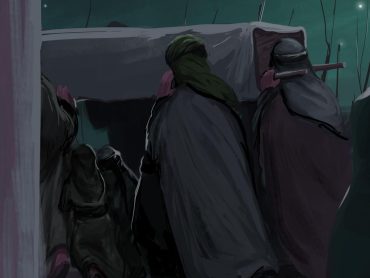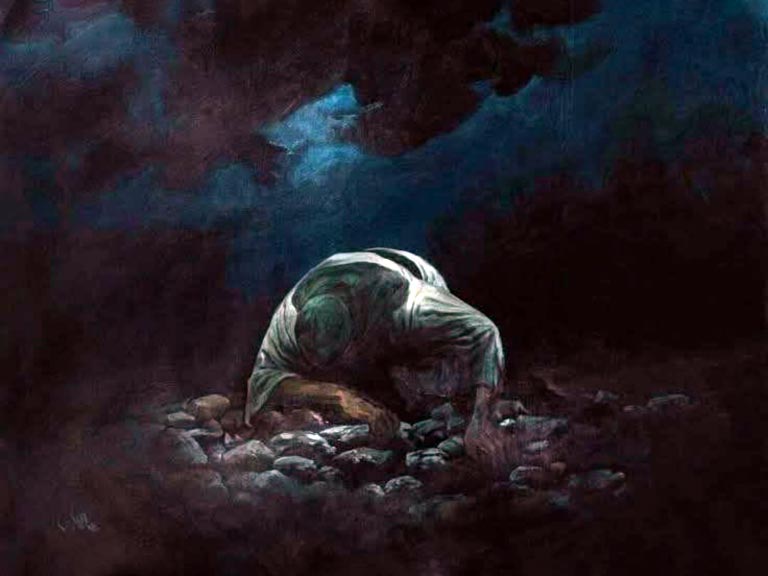
The account of the martyrdom and night burial of Lady Fatimah al-Zahra (peace be upon her) is one of the most delicate and sorrowful passages in the history of Islam. In it, Amir al-Muminin (peace be upon him), with foresight and authority, laid her pure body to rest out of sight of all. With unmatched firmness against those who sought to exhume the grave and violate this sacred resting place, he defended the sanctuary of the Family of Allah and the daughter of the Prophet (peace be upon him and his family).
The Ritual Washing
Precise details have been narrated about the final moments of the life of Lady Fatimah (peace be upon her) and her ritual washing, which show how few people were present at that heart-rending farewell.
According to a narration from Muhammad ibn Hammam, a trusted Shia hadith scholar of the era of the Minor Occultation and a companion of the special deputies of Imam al-Mahdi (may God hasten his noble reappearance), the blessed life of Lady Fatimah al-Zahra (peace be upon her) lasted eighteen years and eighty-five days. Amir al-Muminin (peace be upon him) washed her. In this task, only Imam al-Hasan and Imam al-Hussain (peace be upon them both), Zaynab, Umm Kulthum, the servant Fiddah, and Asma bint Umays were present beside him. [1]
A Wronged Funeral and Burial
With the martyrdom of Lady Fatimah (peace be upon her), the city of Medina sank into great sorrow, and her pure body, in accordance with her bequest, was buried at night and in secret.
When Lady Fatimah (peace be upon her) closed her eyes on the world, the news of her martyrdom spread through Medina, and the people raised cries of lamentation and weeping. The women of the city gathered at her house and wept loudly, saying: “O our lady, O daughter of the Messenger of Allah!” A great crowd also hurried to Amir al-Muminin Ali (peace be upon him). He was in mourning, with Imam al-Hasan and Imam al-Hussain (peace be upon them both) sitting before their father and weeping; seeing the two of them weep, the people wept too.
Meanwhile, Lady Umm Kulthum (peace be upon her), her face veiled and wearing a long cloak whose train dragged along the ground, came out of the house and said in sorrow:
“O grandfather, O Messenger of Allah! Now we have lost you as though there will never be another meeting.”
The people gathered, waiting for the pure body to be brought out so they could pray over it, but Abu Dharr came out of the house and said to the people: “Go back; the bringing out of the body of the daughter of the Prophet of Allah (peace be upon him and his family) has been delayed.”
After the people dispersed, part of the night had passed, and the city had settled into quiet, Amir al-Muminin Ali (peace be upon him), Imam al-Hasan and Imam al-Hussain (peace be upon them both), together with special companions such as Ammar, al-Miqdad, Aqil, Zubayr, Abu Dharr, Salman, Buraydah, and a few of Bani Hashim and the chosen friends of Amir al-Muminin (peace be upon him), brought out the pure body, prayed over it, and buried it in the darkness of the night. Amir al-Muminin Ali (peace be upon him) made seven other grave shapes around the grave, so that the true grave would not be recognized.
The close companions of Amir al-Muminin (peace be upon him) have narrated that after the burial, he leveled the sacred grave of Lady Fatimah (peace be upon her) with the surface of the ground and, using a trowel, smoothed it so evenly that no one could tell its true location. [2]
The Hidden Grave
After the night burial of Lady Zahra (peace be upon her), the discovery of her grave became a contentious matter, and it was met with the decisive reaction of Amir al-Muminin (peace be upon him).
The next morning, when the Muslims learned of the night burial of Lady Fatimah (peace be upon her) and set out toward al-Baqi, they came upon forty new graves and could not tell which of the forty was the grave of Lady Zahra (peace be upon her). All the people cried out over this calamity and blamed one another, saying: “Your Prophet left behind no more than one daughter. Fatimah (peace be upon her) was buried, and you were not present when she died, you did not pray over her body, and you do not even know where her grave is!”
Some of the elders then said: “Summon a group of Muslim women to open these graves, so that we may find the body of Fatimah (peace be upon her), pray over it, and visit her grave!”
When this plot reached Amir al-Muminin Ali ibn Abi Talib (peace be upon him), he came, with an angry face and red eyes, the veins of his neck swollen, wearing the yellow cloak he wore in times of wrath and leaning on Dhu al-Fiqar, until he reached al-Baqi.
The Wrath of Amir Al-Muminin
A man went among the people and said: “This is Ali ibn Abi Talib (peace be upon him), who has come in this state. Ali swears that if a single stone is moved from these graves, he will set the sword among all of you and wipe out every last one of you.”
Umar and his companions went to Amir al-Muminin (peace be upon him) and said: “O Aba al-Hasan! What do you intend? By Allah, we will open the grave of Fatimah (peace be upon her) and pray over her body!” At that moment, Amir al-Muminin (peace be upon him) confronted Umar with firmness, tore him from his place, slammed him to the ground, and said:
“O son of the black woman! I set aside my right (to the caliphate) out of fear that people would turn back from the religion. But as for the grave of Fatimah (peace be upon her), by Allah, if you and your companions try to touch these graves, I will water the earth with your blood. Umar! Give up this notion.”
After this decisive warning, Abu Bakr came to Amir al-Muminin (peace be upon him) and said: “O Aba al-Hasan! I adjure you by the right of the Prophet and by the One who is above the Throne to let go of Umar, for we shall refrain from doing anything you do not approve of.” The narrator says: “Amir al-Muminin (peace be upon him) released Umar. The people dispersed and did not pursue this matter any further.” [3]
The Secret of the Night Burial
The anger of Lady Fatimah (peace be upon her) toward a particular group was the main reason for the night burial of her body and for preventing those persons from attending the ceremony.
Ibn Nubatah, one of the companions of Amir al-Muminin, narrates that Amir al-Muminin Ali (peace be upon him) was asked about the reason for the night burial of Lady Fatimah (peace be upon her). He replied:
“Because that lady was angry with a group and did not wish that group to attend her funeral; for it is forbidden for anyone who loves that group to pray over the bodies of that lady’s children.” [4]
The bequest of Lady Fatimah (peace be upon her) that certain persons not attend the prayer over her pure body was the main reason the burial was carried out in the darkness of night.
Ibn al-Bata’ini, a companion and narrator of Imam al-Sadiq and Imam al-Kadhim (peace be upon them both), narrates from his father that Imam al-Sadiq (peace be upon him) was asked about the reason for the night burial of Lady Fatimah (peace be upon her) and why it was not held in the daytime. He said:
“Because she had bequeathed that those two Bedouins (Abu Bakr and Umar) not pray over her pure body.” [5]
References
[1] Bihar al-Anwar, vol. 43, p. 159
[2] Rawdat al-Wa’izin, vol. 1, p. 150
[3] Bihar al-Anwar, vol. 43, p. 159
[4] Bihar al-Anwar, vol. 43, p. 209
[5] Bihar al-Anwar, vol. 43, p. 206