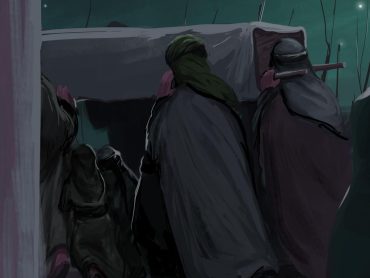
According to a report of the arguments of Amir al-Muminin (peace be upon him), he would carry Lady Fatimah (peace be upon her) on a mount by night to the gatherings of the Ansar to seek their support.¹ Many of them replied that they had already pledged allegiance to Abu Bakr, and that had he come to them before Abu Bakr, they would not have pledged allegiance to anyone else. Amir al-Muminin (peace be upon him) would respond by asking whether it would have been right for him to leave the body of the Messenger of Allah (peace be upon him and his family) unburied and go out to contend over rule. In support of the position of Amir al-Muminin (peace be upon him), Lady Fatimah (peace be upon her) said:
“Abu al-Hasan did nothing but what was fitting, and they did what Allah will call them to account for and seek justice against.”
This report portrays Lady Fatimah’s (peace be upon her) effort to defend the station of Amir al-Muminin (peace be upon him) and, at the same time, how her plea for support went unanswered. She was a lady who came forward herself to defend the Wilayah of Amir al-Muminin (peace be upon him), and she found herself confronting a group of people who had earlier stood beside the Messenger of Allah (peace be upon him and his family).
Another manifestation of her oppression was the affair of Fadak. According to a narration from Imam Musa al-Kadhim (peace be upon him), when Allah placed Fadak and the lands around it in the hands of the Messenger of Allah (peace be upon him and his family) without any fighting or military expedition, the verse “And give the relative his right”² was revealed. Thereupon, by divine command, the Messenger of Allah (peace be upon him and his family) granted Fadak to Lady Fatimah (peace be upon her). This right remained in the hands of her representatives throughout the Prophet’s lifetime. After his martyrdom, however, the representatives of the Prophet’s daughter were expelled from Fadak, and Lady Fatimah’s (peace be upon her) request to recover it was rejected.
The narration continues that, to establish her right, she even presented Amir al-Muminin, Imam al-Hasan, Imam al-Hussain (peace be upon them) and Umm Ayman as witnesses. Despite their testimony, and after the Prophet’s daughter had returned several times, Abu Bakr, who saw his rule to be at risk, finally issued her a written document stating that Fadak would not be encroached upon. But when Lady Fatimah (peace be upon her) left the mosque with the document, Umar met her and asked to see it. She refused to hand it over, yet Umar, after striking and abusing her, took the document from her hand, spat on it, and burned it, erasing it.³ This conduct did not stop at depriving her of Fadak; it destroyed even the document that had been issued to prevent any encroachment on her right.
These two events, which reflect only part of the injustice and tyranny inflicted upon the Prophet’s family, each reveal an aspect of the oppression of Lady al-Siddiqah al-Tahirah (peace be upon her). On the one hand, she strove to defend the right of Amir al-Muminin (peace be upon him). On the other, she was deprived of a right granted to her by divine command and subjected to violent treatment that took from her even the means of preserving the document of that right. Thus, the oppression of the leader of the women of both worlds must be sought in the whole series of events that, after the martyrdom of the Messenger of Allah (peace be upon him and his family), targeted her rights and those of the Prophet’s family.
References
- «و خَرَجَ عَليٌّ عَلَيهِالسَّلامُ يَحمِلُ فاطِمَةَ بِنتَ رَسولِ اللهِ صَلَّى اللهُ عَلَيهِ وَآلِهِ عَلَى دابَّةٍ لَيلاً» Awalim al-Ulum wa al-Maarif, vol. 11, p. 576.
- Al-Isra: 26.
- «فَأوحَى اللهُ إلَيهِ أنِ ادفَع فَدَكَ إلَى فاطِمَةَ عَلَيهَا السَّلامُ»
Tafsir Nur al-Thaqalayn, vol. 3, p. 154.