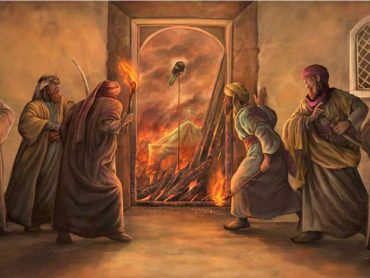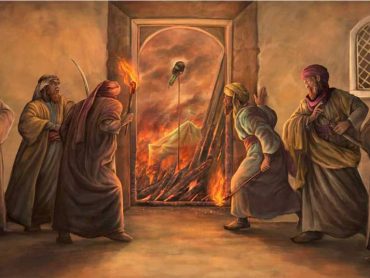
Imad al-Din al-Tabari relates in Al-Kamil al-Bahai that in the morning, people came toward the house of Lady Fatimah to pray over her body. Miqdad saw Abu Bakr and said: “We buried Fatimah last night.”
Umar turned to Abu Bakr and said: “Did I not tell you that they would do this?”
Miqdad replied: “Fatimah herself willed this, so that you would not attend her funeral.”
The report continues that Umar raised his hand and struck Miqdad, and kept striking him until he grew tired. Those present stepped between the two and freed Miqdad from his grip. Once released, Miqdad turned to him and said: “It is no wonder that you strike me. You struck the daughter of the Messenger of God in her side with a sheathed sword and left her bloodied, and you hurt her back with a whip, until she departed this world in that condition. I am of less worth to you than she and her husband.”[2]
Then, according to the same report, they said: “By God, the one most deserving of beating and punishment is Ali ibn Abi Talib!” and they went to the house of Amir al-Muminin (peace be upon him). He was sitting by the door, with his companions around him. Umar said: “O son of Abu Talib, you do not give up your old envy! You washed the Messenger of God without informing us, you prayed over Fatimah while we were absent, and you made al-Hasan tell Abu Bakr to come down from my father’s pulpit.”
Amir al-Muminin (peace be upon him) gave no answer. Aqil spoke: “By God, you were the foremost in envy and enmity toward the Messenger of God and his family. Yesterday you struck her, and she departed this world with her back bloodied, displeased with the two of you.”
At this point, al-Tabari tells of Umar reaching out his hand toward Aqil. Seeing this, Amir al-Muminin (peace be upon him) seized him by the collar and said: “By God, son of al-Khattab, I do not think you will stop until we say aloud what is known about you!”[3]
The Banu Hashim rose to support him, and Zubayr, al-Abbas, Abdullah ibn Jafar, Salman, Miqdad, Abu Sufyan ibn al-Harith ibn Abd al-Muttalib, Abu Dharr, Ammar and other companions joined them. Khalid drew his sword, and Amir al-Muminin (peace be upon him) answered him sharply. Abu Bakr took his hand and said: “Sit down, Abu al-Hasan.” He replied that they should go to the grave of the Prophet (peace be upon him and his family) and sit between the grave and the pulpit.[4]
In the continuation of the account in Al-Kamil al-Bahai, Amir al-Muminin (peace be upon him) answered the words that had been spoken against him. Regarding the washing of the Prophet (peace be upon him and his family), he explained that the Messenger of God had willed that no one but him should see his body, and had said that whoever saw his private parts would go blind. He had asked who would assist him in the washing, and the Prophet named Gabriel and the angels.
Amir al-Muminin (peace be upon him) related that during the washing, Fadl ibn al-Abbas had been blindfolded and brought water, while the angels helped in turning the Prophet’s body. When they wished to remove the shirt, they heard a voice, whose speaker they could not see, saying not to remove the Messenger of God’s garment. So they prepared the embalming spices and the shroud, placed the body in the shroud, and only then removed the shirt.
Concerning Imam al-Hasan (peace be upon him), he reminded them that as a child he would sit on his grandfather’s shoulders while the Prophet delivered sermons. When he saw another man on the Prophet’s pulpit, he was saddened and said: “Come down from my father’s pulpit.” Amir al-Muminin (peace be upon him) swore that he had not taught him those words.
He then turned to the burial of Lady Fatimah (peace be upon her): You know what passed between you and Fatimah. She passed away while angry with you, and she willed to me that if you two prayed over her, she would complain of me as she complains of you to her father, and I did not wish to grieve her.[5]
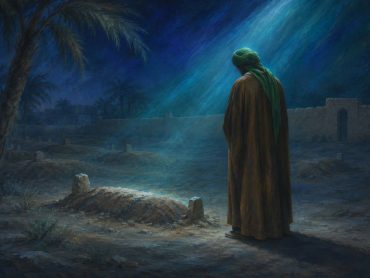
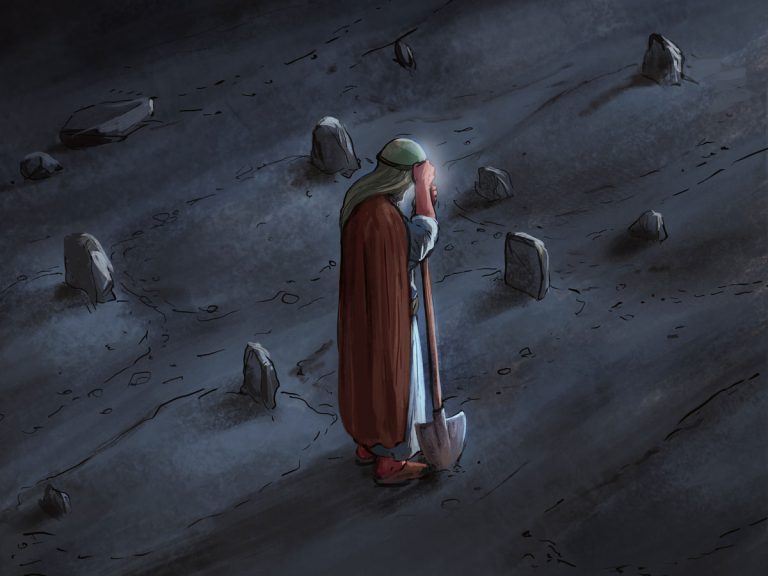
In another report, Dalail al-Imamah describes the people’s reaction in al-Baqi. According to this account, after learning of the passing of Lady Fatimah (peace be upon her), people came to al-Baqi and found forty fresh graves. They did not know which was hers, and they blamed one another, saying that the daughter of the Prophet had died and been buried while they were absent from her passing, her prayer and her burial, and that they did not even know her grave.[6]
It continues that those in power wished to bring women to open the graves, find her body and pray over it. The news reached Amir al-Muminin (peace be upon him). Angered, he came to al-Baqi with Dhu al-Fiqar and warned that he would not allow anyone to lay hands on the graves.
In this report, Umar insists on opening the grave and praying over her. Amir al-Muminin (peace be upon him) seizes him by the collar and throws him to the ground, saying that he had given up his own right for fear that people would turn back from their religion, but that he would not allow any violation of the grave of Fatimah. Abu Bakr steps forward and asks him to release Umar, saying they would do nothing against his wishes. He lets him go, and the people disperse.[7]
Thus, according to these reports, the safeguarding of Lady Fatimah’s will by Amir al-Muminin (peace be upon him) did not end with the burial at night. Even after the burial, he stood against those who wished to act contrary to her wish.
References
- Shaikh al-Mufid, Al-Amali, p. 281:
«فَلَمَّا حَضَرَتْهَا الْوَفَاةُ وَصَّتْ أَمِيرَ الْمُؤْمِنِينَ عليه السلام أَنْ يَتَوَلَّى أَمْرَهَا، وَيَدْفِنَهَا لَيْلًا، وَيُعَفِّيَ قَبْرَهَا، فَتَوَلَّى ذَلِكَ أَمِيرُ الْمُؤْمِنِينَ عليه السلام وَدَفَنَهَا وَعَفَّى مَوْضِعَ قَبْرِهَا.»
- Imad al-Din al-Tabari, Al-Kamil al-Bahai, vol. 1, pp. 312–314, according to the citation in the source text. The edition directly consulted in this study: Al-Kamil al-Bahai fi al-Saqifah, translated by Muhammad Shuaa Fakhir, Maktabat al-Haydariyyah, vol. 1, pp. 396–398. The passage concerning Miqdad on p. 396 of the Arabic translation reads:
«فرفع عمر يده وضرب المقداد على وجهه، وما زال يضربه حتّى كلّ من الضرب»
In this edition, “face” is specified; the wording “head and face” appears in some secondary accounts. This Arabic wording is a translation of the Persian report, not the Arabic text of a transmitted (musnad) narration.
- Ibid., Arabic translation, vol. 1, p. 397:
«فمدّ عمر يده إلى عقيل»
- Ibid., pp. 397–398. The statement addressed to Khalid is recorded in the text as:
«يا فاسق الخبيث، ما كان ظالماً أشرّ على رسول الله بسيفك هذا أنت وأبوك»
The translator states in a footnote on p. 397 that the wording is corrupted and that he was unable to establish its correct form; for this reason, no conjectural translation of it is given in the text. He also notes that the author cites no source or chain of transmission for this report. This account is cited here as attributed to Al-Kamil al-Bahai and must not be presented as a hadith with a sound chain of transmission.
- Ibid., p. 398. The account of Amir al-Muminin’s answers concerning the washing of the Prophet, the words of Imam al-Hasan, and the will of Lady Fatimah all appear on this page. The original book is in Persian; to quote the exact Persian wording and carry out a final collation with the original text, pp. 312–314 of the same cited edition must be examined. The Arabic text available is the translation by Muhammad Shuaa Fakhir.
- Dalail al-Imamah, ed. Muassasat al-Bithah, p. 136:
«وَأَصْبَحَ الْبَقِيعُ لَيْلَةَ دُفِنَتْ وَفِيهِ أَرْبَعُونَ قَبْراً جُدَداً … فَضَجَّ النَّاسُ وَلَامَ بَعْضُهُمْ بَعْضاً، وَقَالُوا: لَمْ يُخَلِّفْ نَبِيُّكُمْ فِيكُمْ إِلَّا بِنْتاً وَاحِدَةً، تَمُوتُ وَتُدْفَنُ وَلَمْ تَحْضُرُوا وَفَاتَهَا وَلَا دَفْنَهَا وَلَا الصَّلَاةَ عَلَيْهَا! بَلْ وَلَمْ تَعْرِفُوا قَبْرَهَا!»
The presence of fresh graves in al-Baqi does not, by itself, establish the actual place of burial; the same report earlier contains the phrase:
«دفنها في الروضة»
The sources differ in the details of the burial place and of how the grave was concealed.
- Dalail al-Imamah, pp. 136–137; also reported by al-Majlisi in Bihar al-Anwar, vol. 43, p. 171. Relevant parts of the report:
«فَقَالَ وُلَاةُ الْأَمْرِ مِنْهُمْ: هَاتُوا مِنْ نِسَاءِ الْمُسْلِمِينَ مَنْ يَنْبُشُ هَذِهِ الْقُبُورَ حَتَّى نَجِدَهَا فَنُصَلِّيَ عَلَيْهَا وَنَزُورَ قَبْرَهَا. فَبَلَغَ ذَلِكَ أَمِيرَ الْمُؤْمِنِينَ … فَخَرَجَ مُغْضَباً … وَهُوَ يَتَوَكَّأُ عَلَى سَيْفِهِ ذِي الْفَقَارِ، حَتَّى وَرَدَ الْبَقِيعَ»
And later:
«أَمَّا حَقِّي فَقَدْ تَرَكْتُهُ مَخَافَةَ أَنْ يَرْتَدَّ النَّاسُ عَنْ دِينِهِمْ، وَأَمَّا قَبْرُ فَاطِمَةَ فَوَالَّذِي نَفْسُ عَلِيٍّ بِيَدِهِ لَئِنْ رُمْتَ وَأَصْحَابُكَ شَيْئاً مِنْ ذَلِكَ لَأَسْقِيَنَّ الْأَرْضَ مِنْ دِمَائِكُمْ»
And the end of the report:
«فَخَلَّى عَنْهُ وَتَفَرَّقَ النَّاسُ وَلَمْ يَعُودُوا إِلَى ذَلِكَ.»
This report speaks of a decision to open the graves, a threat to do so, and the prevention of it, not of the actual opening of the grave of the Lady.