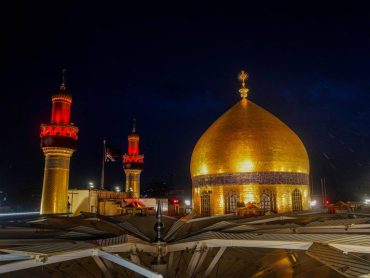
Salman al-Farsi passed away on the 8th of Safar in the year 35 AH, during the caliphate of Uthman ibn Affan. After the Battle of the Trench, Salman took part in all the battles of the Prophet’s era and played an effective role in them. After the Prophet’s passing, he became one of the special companions of Amir al-Muminin (peace be upon him), and because of his knowledge and experience in military and administrative affairs, he was trusted during the caliphate of Amir al-Muminin as well. He would reproach the other Companions for failing to follow the Prophet’s command regarding the succession of Amir al-Muminin (peace be upon him).
The Rank of Salman al-Farsi
Salman al-Farsi hailed from Istakhr in Fars — or Isfahan, according to some accounts. He was among the Companions of the Prophet (peace be upon him and his family) who took part in major battles like Badr and Uhud. Salman was held in special esteem by the Prophet and the Ahl al-Bayt for his knowledge and piety, and after migrating to Medina, he engaged in religious and social activities alongside them and Amir al-Muminin (peace be upon him). [1]
The Leader of Creation’s Elite
Amir al-Muminin (peace be upon him) once spoke about the high station of his special companions by introducing seven pillars of creation. He said: “God created the earth for seven people — through their blessing, God’s creation receives sustenance, rain falls, and victory over enemies is achieved: Abu Dharr, Salman, Miqdad, Ammar, Hudhayfah, Abdullah ibn Mas’ud, and I, who am the leader of this group.” [2]
The Beloved Companions of God and the Prophet (peace be upon him and his family)
The Final Prophet (peace be upon him and his family) named those of his companions who enjoy God’s special love. He said: “God has commanded me to love four of my companions and has told me that He loves them too.”
The companions asked: “O Messenger of God, who are they?” He repeated three times: “Know that Amir al-Muminin (peace be upon him) is one of them, and Miqdad ibn al-Aswad, Abu Dharr al-Ghifari, and Salman al-Farsi are the rest.” [3]
Elsewhere, the Prophet of God (peace be upon him and his family) said: “O Ali, Paradise longs for you, Ammar, Salman, Abu Dharr, and Miqdad.” [4]
Salman al-Farsi’s Scholarly Status
In the eyes of Amir al-Muminin (peace be upon him) and Imam al-Sadiq (peace be upon him), Salman al-Farsi was a treasure trove of divinely-inspired knowledge. Because of his virtues, he was considered a member of the Prophet’s household.
Abu Amr al-Kindi, a companion of Imam al-Hussain (peace be upon him), narrates: “One day we were in the presence of Amir al-Muminin Ali (peace be upon him). When people saw him in good spirits, they asked him to say something about Salman al-Farsi. He described him as follows: ‘He was like Luqman the Wise — a man from the Ahl al-Bayt, who had knowledge of the past and the future. He had read the first and last of the heavenly books, and was an ocean of boundless knowledge.'” [5]
Salman is one of those chosen ones who, through the bond of his soul with wilayah, attained the limitless station of knowledge and understanding.
Amir al-Muminin Ali (peace be upon him) said: “Salman is an ocean that never runs dry, a treasure that has no end, and he is from us, the Ahl al-Bayt.” [6]
Elsewhere, Amir al-Muminin (peace be upon him) said: “Salman has knowledge of past and future things, and is like an ocean that never dries up.” [7]
Other Imams also spoke about Salman’s knowledge an
d wisdom. Imam al-Sadiq (peace be upon him) said in a narration: “Salman was a muhaddath (one spoken to by angels), and he earned this title only because the Prophet (peace be upon him and his family) and Amir al-Muminin (peace be upon him) would inform him from the storehouse of divine knowledge — things that no one else could grasp.” [8]
The Spiritual Rank of Salman and Miqdad
The Prophet (peace be upon him and his family), explaining the high station of Salman and Miqdad and the deep bond of love they shared with him and Amir al-Muminin (peace be upon him), said: “Gabriel told me from the Lord Almighty: Salman and Miqdad are two brothers, and in their friendship they are as pure and sincere as you and Ali (peace be upon him) — who is your brother, successor, and confidant. Their place among your companions is like that of Gabriel and Michael among the angels. Whoever shows enmity toward them is an enemy, and whoever shows friendship to them, to you, and to Ali (peace be upon him) is loved by God. So much so that if all the people of the earth loved Salman and Miqdad as the angels of the heavens, the veils, the Kursi, and the Throne love them — purely for the love of Muhammad (peace be upon him and his family) and Ali (peace be upon him), for loving their friends and hating their enemies — God would not punish anyone.” [9]
Salman’s Devotion to Wilayah
Salman al-Farsi, through his commitment to the covenant of wilayah and his following of Amir al-Muminin (peace be upon him), attained such perfection that made him superior to all.
Salman al-Farsi says: “We made a covenant with the Prophet of God (peace be upon him and his family) to wish well for the Muslims, to follow Amir al-Muminin Ali ibn Abi Talib (peace be upon him), to accept his wilayah and friendship, and to remain steadfast in it.” [10]
Imam al-Sadiq (peace be upon him) emphasized three outstanding and lofty qualities in Salman al-Farsi’s character. He said: “Salman was elevated and superior for three reasons: first, he prioritized the will of Amir al-Muminin (peace be upon him) over his own; second, he preferred the poor over the rich; and third, he had a great love for knowledge and scholars.” [11]
Salman’s Defense of the Imamate of the Master of the Pious
In a powerful sermon, Salman al-Farsi laid out the divine station and rightful succession of Amir al-Muminin (peace be upon him), while pointing to the deviation of the community from the prophetic path and the repetition of the ways of the Children of Israel in a historical event.
Three days after the burial of the Prophet (peace be upon him and his family), Salman al-Farsi gave a sermon among the people and said: “O people, hear my words and reflect on them. I possess vast knowledge — if I were to tell you all the truths about the virtues of Amir al-Muminin Ali (peace be upon him), a group of you would say he is mad, and another group would say: ‘O God, forgive the one who kills Salman!’
O people, you have destinies that bring many hardships, but Ali ibn Abi Talib (peace be upon him) has knowledge of these destinies and hardships. He holds the inheritance of the successors, the decisive word, and the origin of lineages. He is like Harun ibn Imran was to Musa. The Messenger of God (peace be upon him and his family) would always tell him: ‘You are my successor and caliph over my nation among my family, and your station with me is like that of Harun to Musa (peace be upon him).’ But you have followed the way of the Children of Israel and failed to recognize the truth. You know, yet you do not act. And by God, step by step you tread the path of the Children of Israel and follow their ways to the letter.” [12]
Burial of Salman al-Farsi by the Master of the Pious
Asbagh ibn Nubatah, a companion of Amir al-Muminin (peace be upon him), says: “Just as Salman passed away, and we had not yet lifted his body from the cemetery, suddenly we saw a man riding a mule, looking deeply sorrowful. He dismounted, greeted us, and we returned his greeting. He said: ‘Hurry and prepare the washing, prayer, shroud, and burial of Salman’s body.’ We assisted him. He had brought camphor for the embalming, shroud, and burial. At his instruction, we brought water. He washed Salman’s body, shrouded him, and we performed the funeral prayer and buried him.
That man was Amir al-Muminin (peace be upon him), who personally prepared Salman’s grave and covered it. At the end, with his own hand, he wrote the following verse on Salman’s grave: ‘I have come to the Generous One with no provision — not of good deeds nor of a sound heart — and carrying the ugliest of provisions, when coming before the Generous One.'” [13]
References:
[1] Al-Nujum al-Zahirah, Vol. 1, p. 89
[2] Al-Khisal, Vol. 2, p. 360
[3] Amali al-Mufid, Vol. 1, p. 124
[4] Rawdat al-Wa’izin, Vol. 2, p. 280
[5] Al-Gharat, Vol. 1, p. 177
[6] Amali al-Saduq, p. 55
[7] Amali al-Saduq, Vol. 1, p. 252
[8] Ilal al-Sharayi’, Vol. 1, p. 183
[9] Al-Ihtijaj, Vol. 1, p. 40
[10] Amali al-Tusi, Vol. 1, p. 155 [11] Amali al-Tusi, Vol. 1, p. 133
[12] Bihar al-Anwar, Vol. 29, p. 79
[13] Bihar al-Anwar, Vol. 22, p. 380