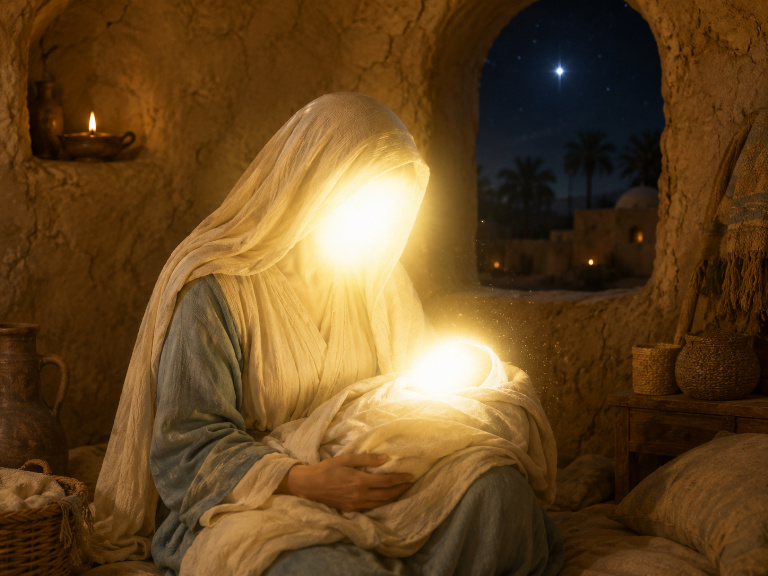
The Prophet Muhammad (peace be upon him and his family) was born in Makkah on the 17th of Rabi al-Awwal in the Year of the Elephant, to a father named Abdullah ibn Abd al-Muttalib and a mother named Aminah bint Wahb.
Amir al-Muminin (peace be upon him) describes the astonishing events and transformations of the universe on the night of the birth of the Seal of the Prophets (peace be upon him and his family):
“At the birth of the Messenger of God (peace be upon him and his family), the idols of the Ka’bah were overturned, and as night fell, a call rose from the heavens: ‘The truth has come, and falsehood has vanished; indeed falsehood is ever bound to vanish’ (Surah al-Isra, 81). That night, light spread across the whole world, stone and clay and trees broke into laughter, and every creature in the heavens and the earth turned to glorifying God. In that same moment, Satan fled in terror, crying out: ‘Muhammad (peace be upon him and his family) is the best of the nation, the most excellent of creation, the most honored of servants, and the most exalted of all the worlds.'” [1]
An Eternal Bond and a Single Light
The exalted station and luminous reality shared by the Seal of the Prophets (peace be upon him and his family) and Amir al-Muminin (peace be upon him) in the order of creation depict an eternal, unbreakable bond. These lofty truths express the essential nobility of the Ahl al-Bayt and the wellspring of guidance and faith for their true followers.
The eternal bond and unity of light between the Prophet (peace be upon him and his family) and Amir al-Muminin (peace be upon him) was established before the creation of man. The Prophet (peace be upon him and his family) said of this:
“Ali and I were a single light before God, glorifying and sanctifying Him fourteen thousand years before the creation of Adam. When God created Adam, He placed that light in his loins, and we remained together in a single body until we were separated in the loins of Abd al-Muttalib; prophethood came to me, and the caliphate fell to Ali ibn Abi Talib (peace be upon him).” [2]
The Creator of the world brought the Ahl al-Bayt and their followers into being from a single source of light. Jabir ibn Abdullah al-Ansari relates that the Messenger of God (peace be upon him and his family) said:
“God Almighty created me, Ali ibn Abi Talib, Fatimah, al-Hasan, and al-Hussain (peace be upon them) from a single light. He then joined that light together and brought forth our followers from it. So we glorified God, and our followers glorified Him; we sanctified Him, and our followers sanctified Him as well.” [3]
The oneness of being and the shared reality of prophethood and imamate between the Prophet (peace be upon him and his family) and Amir al-Muminin (peace be upon him) find their fullest expression here. The Messenger of God (peace be upon him and his family) also said:
“Ali ibn Abi Talib and I are of a single light; he and I are of a single reality. He is from me, and I am from him. His flesh is my flesh, and his blood is my blood. Whatever grieves him grieves me, and whatever grieves me grieves him.” [4]
The Continuation of One Light on the Path to Salvation
The Noble Prophet (peace be upon him and his family), himself the embodiment of “the truth has come” and the herald of the age of falsehood’s decline, in the turmoil of the trials that would follow him, bound Ammar ibn Yasir’s hand to the cord of Amir al-Muminin’s guardianship — for the two of them are a single light, and it is through following the path of Amir al-Muminin (peace be upon him) that the guidance and salvation of the nation endure.
Knowing of the trials to come after him, the Messenger of God (peace be upon him and his family) called Ammar ibn Yasir to hold fast to Amir al-Muminin (peace be upon him). He said:
“O Ammar! After me there will arise trials and turmoil, until the sword of discord passes among the nation, and some of them slay others, and one group disavows another. When you witness this, follow this shorn-headed man at my right hand — Ali ibn Abi Talib! If all the people take one path and Ali ibn Abi Talib takes another, take the path of Ali ibn Abi Talib and abandon the people, for Ali ibn Abi Talib will never turn you from the path of guidance. Know that obedience to Ali ibn Abi Talib is obedience to me, and obedience to me is obedience to God.” [5]
The exalted rank of Amir al-Muminin (peace be upon him) beside the Noble Prophet (peace be upon him and his family) rises above the bounds of mere friendship, joining instead to the very foundation of faith, worship, and complete piety. The Prophet (peace be upon him and his family) said of devotion to Amir al-Muminin (peace be upon him):
“Devotion to Ali ibn Abi Talib is an enduring good; with it, no sin can bring harm. Enmity toward him is an evil; with it, no good deed will bring benefit.” [6]
The Prophet (peace be upon him and his family) said of the guardianship of Amir al-Muminin (peace be upon him):
“Ali ibn Abi Talib is the gate of forgiveness; whoever enters through it is a believer, and whoever departs from it is a disbeliever.” [7]
Abu Dharr relates that the Prophet (peace be upon him and his family) likened the station of Amir al-Muminin (peace be upon him) among the nation to the Ka’bah. He said:
“The likeness of Ali ibn Abi Talib among this nation is the likeness of the veiled Ka’bah: to look upon it is worship, and to set one’s intent toward it is obligatory.” [8]
Imam al-Baqir (peace be upon him), relating from his forefathers, narrates that the Prophet (peace be upon him and his family) was asked: “Who is the best of people?” He replied: “The best, the most pious, and the closest of people to Paradise is whoever is closest to me; and among you, none is more pious or closer to me than Ali ibn Abi Talib.” [9]
Amir al-Muminin: Successor and Bearer of the Path of Prophethood
The appointment of Amir al-Muminin (peace be upon him) to the station of imamate and succession to the Prophet (peace be upon him and his family) stems from divine ordinance and eternal election. This lofty station of guardianship is the sole path of salvation from misguidance, and the firmest bond between servants and the covenants of God. The manifestation of his rank as minister and helper of the Prophet at the Throne and the Lote Tree of the Utmost Boundary reflects the unbreakable bond between prophethood and imamate within the order of creation.
The Prophet (peace be upon him and his family) said:
“God placed the offspring of every prophet in his own loins, but He placed my offspring in the loins of Ali ibn Abi Talib.” [10]
In prophetic thought, Amir al-Muminin is his true successor. The Messenger of God (peace be upon him and his family) described this bond:
“He is my helper, my minister, and my successor among my family. Ali ibn Abi Talib is the best of those I leave behind; he fulfills my promises and settles my debts.” [11]
The Messenger of God (peace be upon him and his family) said of the covenant with Amir al-Muminin (peace be upon him):
“So long as you remain within the guardianship of Ali ibn Abi Talib, you will not go astray or perish. Should you oppose him, error and desire will draw you into misguidance. Uphold piety toward his covenant, for Ali ibn Abi Talib is God’s covenant among you.” [12]
Ibn Abbas relates, concerning the succession of the Prophet, that the Messenger of God (peace be upon him and his family) took the hand of Ali ibn Abi Talib and then performed four units of prayer. He then raised his hands in supplication:
“O God! Just as Musa ibn Imran asked of You, I too ask that You expand my breast, ease my task, loosen the knot from my tongue that they may understand my speech, and appoint for me a minister from my family — my brother Ali ibn Abi Talib; strengthen my back through him, and make him a partner in my affair.” [13]
The Messenger of God (peace be upon him and his family) said of his successor:
“Ali ibn Abi Talib is the best of those I leave behind; it is he who settles my debts and fulfills my obligations.” [14]
In one account, the Messenger of God (peace be upon him and his family) spoke of the exceptional qualities of Ali ibn Abi Talib:
“O Ali! God looked upon the worlds and chose me from among them, raising me above all the men of the worlds. Then He looked a second time and chose you from among them, raising you above all the men of the worlds. Then He looked a third time and chose the Imams of your line above all the men of the worlds. Then He looked a fourth time and chose Fatimah (peace be upon her) above all the women of the worlds. O Ali! I saw your name joined with my own in three places, and this brought me peace:
1. During the Ascension (Mi’raj), when I reached Bayt al-Maqdis and was raised toward the heavens, I saw an inscription on its rock: ‘There is no god but God, and Muhammad (peace be upon him and his family) is His Messenger; I have confirmed him through his minister and aided him by his minister.’ I asked Gabriel (peace be upon him): ‘Who is my minister?’ Gabriel said: ‘Ali ibn Abi Talib.’
2. When I reached the Lote Tree of the Utmost Boundary, I saw an inscription reading: ‘I am indeed God; there is no deity but Me, and I alone am. Muhammad is My chosen one among My creation; I have confirmed him through his minister and aided him by his minister.’ I asked Gabriel (peace be upon him): ‘Who is my minister?’ He answered: ‘Ali ibn Abi Talib.’
3. When I passed beyond the Lote Tree and reached the Throne of the Lord of the Worlds, I saw an inscription on its pillars reading: ‘I am indeed God; there is no deity but Me, and I alone am. Muhammad is My beloved and My friend; I have confirmed him through his minister and aided him by his minister.'” [15]
[1] Bihar al-Anwar, vol. 15, p. 274
[2] Manaqib Ibn al-Maghazili, p. 88; Tarikh Dimashq, vol. 42, p. 67; al-Manaqib al-Khwarazmi, p. 145; Sharh al-Akhbar, vol. 1, p. 220; Ilal al-Shara’i, p. 134
[3] Kashf al-Ghummah, vol. 1, p. 458; Bihar al-Anwar, vol. 27, p. 131
[4] Awali al-La’ali, vol. 4, p. 124
[5] al-Umdah, vol. 1, p. 450
[6] al-Manaqib Ibn Shahrashub, vol. 3, p. 197; Kashf al-Ghummah, vol. 1, p. 93; Kashf al-Yaqin, vol. 1, p. 225; Irshad al-Qulub, vol. 2, p. 234; Bihar al-Anwar, vol. 39, p. 248; al-Fada’il, vol. 1, p. 96; Awali al-La’ali, vol. 4, p. 86; al-Manaqib al-Khwarazmi, vol. 1, p. 76; Yanabi al-Mawaddah, vol. 1, p. 375
[7] al-Sawa’iq al-Muhriqah, p. 125
[8] Tarikh Dimashq, vol. 42, p. 356; Manaqib Ibn al-Maghazili, p. 107
[9] Yanabi al-Mawaddah, vol. 2, p. 274
[10] al-Mu’jam al-Kabir, vol. 3, p. 44
[11] Tarikh Dimashq, vol. 42, p. 57
[12] Yanabi al-Mawaddah, vol. 2, p. 285; Ihqaq al-Haqq, vol. 6, p. 57
[13] Manaqib Ibn al-Maghazili, p. 389
[14] Tarikh Dimashq, vol. 42, p. 57
[15] Man La Yahduruhu al-Faqih, vol. 4, p. 374