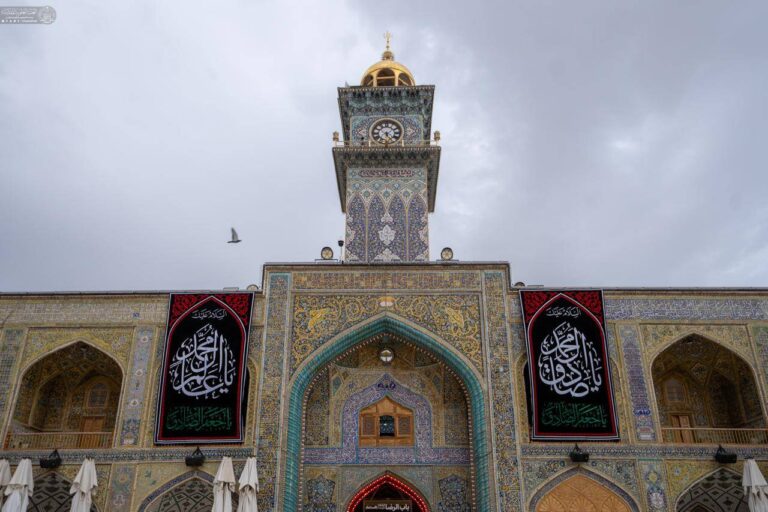
Imam al-Sadiq (peace be upon him), known as Jafar ibn Sadiq (peace be upon him) and al-Sadiq Al Muhammad, the sixth leader of the Shia, relying on the verses of revelation, affirmed the truth that when the Qur’an speaks of “light,” “guidance,” and “wilayah,” it is in reality speaking of the being of Amir al-Muminin Ali (peace be upon him).
Drawing on these verses, Imam al-Sadiq (peace be upon him) built a bridge of proof between Creator and creation, to show that faith in the Qur’an without acceptance of wilayah is like a bond severed midway.
The Straight Path
In explaining the straight path (sirat al-mustaqim) mentioned in the verses of the Qur’an, Imam al-Sadiq (peace be upon him) identified Amir al-Muminin (peace be upon him) and knowledge of him as the true guide of this path, and in his argument referred to verse 4 of Surah al-Zukhruf.
Imam al-Sadiq (peace be upon him) said:
“The straight path is Amir al-Muminin Ali (peace be upon him) and knowledge of him. And the proof of this is God’s saying: ‘And indeed, it is, in the Mother of the Book with Us, exalted and full of wisdom.’ And what is meant by ‘exalted and full of wisdom’ is Amir al-Muminin (peace be upon him) in the Mother of the Book.”(1)
The second verse of Surah al-Baqarah refers to the Book of the Qur’an as a guide for the God-conscious. Drawing on this verse, Imam al-Sadiq (peace be upon him) identifies Amir al-Muminin (peace be upon him), in accordance with the teachings of the Qur’an and the standards of piety, as the source of enlightenment and guidance for the people.
It has been narrated from Imam al-Sadiq (peace be upon him) regarding God Almighty’s saying in verse 2 of Surah al-Baqarah:
“This is the Book about which there is no doubt, a guidance for the God-conscious.” He said: “‘The Book’ is Amir al-Muminin Ali (peace be upon him), about whom there is no doubt. And ‘a guidance for the God-conscious’ means he is the one who illuminates and clarifies for our Shia.”(2)
Manifest Light
Verse 174 of Surah al-Nisa points to the importance and station of the message of revelation, described as an illuminating light that provides guidance and direction for mankind. Referring to this verse, Imam al-Sadiq (peace be upon him) identifies Amir al-Muminin (peace be upon him) as the continuer of the path of the Noble Prophet, one bound to the light of revelation, who plays a vital role in illuminating and guiding society.
Abdullah ibn Sulayman has related from Imam al-Sadiq (peace be upon him) regarding God’s saying in verse 174 of Surah al-Nisa:
“There has certainly come to you a proof from your Lord, and We have sent down to you a clear light.” I asked [about it]; the Imam said: “The proof is the Messenger of God (peace be upon him and his family), and the light is Amir al-Muminin Ali (peace be upon him).”(3)
Verse 112 of Surah Al ‘Imran refers to unity and the necessity of holding fast to a rope from God. Imam al-Sadiq (peace be upon him) identifies the rope on the people’s side as the wilayah of Amir al-Muminin (peace be upon him), since he, as the successor of the Seal of the Prophets, held a central role in guiding the Islamic ummah, and following him means holding fast to this divine rope, preserving the unity and cohesion of the Muslims.
Imam Jafar al-Sadiq (peace be upon him) said regarding verse 112 of Surah Al ‘Imran:
“Except by a rope from God or a rope from the people.” He then said: “The rope from God’s side is the Qur’an, and the rope from the people’s side is Amir al-Muminin Ali ibn Abi Talib (peace be upon him).”(4)
Verse 115 of Surah al-Baqarah points to the fact that direction and place impose no limitation upon God, and that He is present everywhere. Amir al-Muminin (peace be upon him) and the Ahl al-Bayt are God’s representatives on earth, and in interpreting this verse, Imam al-Sadiq (peace be upon him) describes the Ahl al-Bayt, by virtue of their connection with God, as possessing a divine countenance (wajh Allah) and as bearing the guidance and leadership of the people.
Dawud ibn Kathir said: I said to Imam Jafar al-Sadiq (peace be upon him): “Are you the prayer, the zakat, and the hajj mentioned in the Qur’an?” The Imam said: “O Dawud! In the Qur’an, we are the prayer, the zakat, the fasting, the hajj, the sacred month, the sacred city, the Kaaba, the qiblah, and the countenance of God (wajh Allah), where He has said: ‘So wherever you turn, there is the face of God.’ And we are the signs and the clear proofs.”(5)
(*Ta’wil al-Ayat al-Zahirah*, vol. 1, p. 21)
Obedience to Those in Authority
Verse 59 of Surah al-Nisa, known as the verse of obedience or the verse of Uli’l-Amr, commands the believers to obey God, the Seal of the Prophets, and those in authority (uli’l-amr), who hold the divine mandate over the affairs of society. In interpreting this verse, Imam al-Sadiq (peace be upon him) identifies Amir al-Muminin (peace be upon him) as the true embodiment of society’s guides and the holder of divine authority in administering the ummah and expounding the faith.
Imam Jafar al-Sadiq (peace be upon him) said regarding God Almighty’s words in verse 59 of Surah al-Nisa:
“Obey God and obey the Messenger and those in authority among you.” He said: “It was revealed concerning Amir al-Muminin Ali (peace be upon him).”(6)
Verse 65 of Surah al-Nisa points to the importance of accepting the judgment of the Seal of the Prophets, presented as the true measure of faith. In interpreting this verse, Imam al-Sadiq (peace be upon him) held that following Amir al-Muminin Ali (peace be upon him) is a continuation of obedience to God and His Messenger.
It is related that Abdullah al-Najashi said: I asked Imam al-Sadiq (peace be upon him) about verse 65 of Surah al-Nisa. He said:
“But no, by your Lord, they will not [truly] believe until they make you, [O Muhammad], judge concerning that over which they dispute among themselves and then find within themselves no discomfort from what you have judged and submit in full submission.” He said: “What is meant by this is Amir al-Muminin Ali (peace be upon him).”(7)
Verse 238 of Surah al-Baqarah emphasizes the importance of maintaining the prayers, especially the middle prayer. Imam Jafar al-Sadiq (peace be upon him) affirms that the prayer symbolically refers to the Prophet and his pure family, and that the middle prayer represents Amir al-Muminin (peace be upon him).
Imam Jafar al-Sadiq (peace be upon him) said regarding verse 238 of Surah al-Baqarah:
“Maintain with care the prayers and the middle prayer, and stand before God, devoutly obedient.” He said: “The prayer is the Messenger of God, Amir al-Muminin, Fatimah, al-Hasan, and al-Hussain (peace be upon them); the middle prayer is Amir al-Muminin (peace be upon him); and ‘stand devoutly obedient’ means to rise up in obedience to the Imams (peace be upon them).”(8)
The Divine Covenant
Verse 40 of Surah al-Baqarah refers to a covenant and pact, signifying the importance of faithfulness and commitment. In interpreting this verse, Imam al-Sadiq (peace be upon him) explained God’s covenant as fidelity to the wilayah of Amir al-Muminin Ali (peace be upon him).
Sama’ah ibn Mihran related that he asked Imam al-Sadiq (peace be upon him) about verse 40 of Surah al-Baqarah:
“Fulfill My covenant, and I will fulfill your covenant.” I asked [about it]; the Imam said: “‘Fulfill My covenant’ means fulfill the wilayah of Amir al-Muminin Ali (peace be upon him), which God has made obligatory, ‘and I will fulfill your covenant’ — and I will grant you Paradise in fulfillment.”(9)
Verse 81 of Surah Al ‘Imran refers to the covenant taken by God from the prophets, that whenever a prophet should come bearing new signs and scriptures, the prophets before him would support him. Amir al-Muminin Ali (peace be upon him) was ever the supporter of the Prophet and the defender of the faith. In interpreting this verse, Imam al-Sadiq (peace be upon him) raised the significant role of Amir al-Muminin (peace be upon him) in aiding the Seal of the Prophets.
Imam Jafar al-Sadiq (peace be upon him), in interpreting verse 81 of Surah Al ‘Imran:
“And [remember] when God took the covenant of the prophets, [saying], ‘Whatever I give you of the Scripture and wisdom and then there comes to you a messenger confirming what is with you, you [must] believe in him and support him.'” He said: “From the time of Adam (peace be upon him) until now, God has sent no prophet except that he returns to this world and aids the Noble Prophet (peace be upon him and his family) and Amir al-Muminin (peace be upon him). Thus the meaning of ‘you must believe in him’ is that you must believe in the Prophet (peace be upon him and his family), and ‘and support him’ means you must support Amir al-Muminin Ali (peace be upon him).”(10)
Verse 143 of Surah al-Baqarah points to the importance of a moderate, balanced community and its role as guide and witness among the other nations. In explaining this verse, Imam Jafar al-Sadiq (peace be upon him) held that the middle nation bears the role of witness and God’s proof over other people, and identified the Ahl al-Bayt as an embodiment of this nation.
It is related from Burayd al-‘Ijli that he asked Imam Jafar al-Sadiq (peace be upon him) about verse 143 of Surah al-Baqarah:
“And thus We have made you a median community that you will be witnesses over the people and the Messenger will be a witness over you.” I asked [about it]; the Imam said: “We are the median community, and we are God’s witnesses over His creation and His proof on earth.”(11)
Ease and Good Deeds
In narrations from Imam Jafar al-Sadiq (peace be upon him), what is meant by “ease” (yusr) in verse 185 of Surah al-Baqarah is identified as wilayah and following Amir al-Muminin (peace be upon him). This is because the path of guidance, servitude to God, and acceptance of the wilayah of the Ahl al-Bayt bring ease (yusr) in both religion and worldly life, while turning away from this axis brings hardship and difficulty (‘usr).
Imam Jafar al-Sadiq (peace be upon him) said regarding God Almighty’s words in verse 185 of Surah al-Baqarah:
“God intends for you ease and does not intend for you hardship.” He said: “That ‘ease’ is Amir al-Muminin Ali ibn Abi Talib (peace be upon him).”(12)
Verse 89 of Surah al-Naml refers to righteous deeds, interpreted as acceptance of the wilayah of Amir al-Muminin Ali (peace be upon him). In interpreting this verse in the words of the Master of the Pious, Imam al-Sadiq (peace be upon him) held that in the Qur’an, “good” (hasanah) means recognition of and love for the Ahl al-Bayt, while “evil” (sayyi’ah) means denial of their wilayah and enmity toward them.
Imam Jafar al-Sadiq (peace be upon him) narrated from his noble father, Imam Muhammad al-Baqir (peace be upon him), that one day Abu Abdillah al-Jadali came to Amir al-Muminin Ali (peace be upon him).
The Imam said to him: “O Abu Abdillah! Shall I inform you of the meaning of the words of God, Mighty and Majestic, where He says: ‘Whoever comes with a good deed will have better than it, and they, from the terror of that Day, will be safe. And whoever comes with an evil deed — their faces will be overturned into the Fire, [and it will be said], “Are you recompensed except for what you used to do?”‘” Abu Abdillah al-Jadali said: “Yes, O Amir al-Muminin, may I be your ransom.”
The Imam then said: “The good deed is recognition of our wilayah and love for us, the Ahl al-Bayt; and the evil deed is denial of our wilayah and enmity toward us, the Ahl al-Bayt.”(13)
The Righteous Deed
In verse 10 of Surah Fatir, God refers to His power and majesty, and singles out the righteous deed as one of the significant qualities to be regarded. In the exegeses, the wilayah of Amir al-Muminin Ali (peace be upon him) is an instance of the highest examples of righteous deeds, since obedience and following of the Imam, as the most just and most faithful of leaders, is in keeping with God-consciousness and the practice of religion.
Imam al-Sadiq (peace be upon him) said regarding verse 10 of Surah Fatir:
“To Him ascend good words, and righteous deeds raise them.” He said: “The righteous deed is our wilayah, the wilayah of the Ahl al-Bayt. So whoever does not accept our wilayah, God will raise none of his deeds.”(14)
Denial of Wilayah
Verse 48 of Surah al-Nisa refers to the forgiveness of sins other than associating partners with God (shirk). In interpreting this verse, Imam al-Sadiq (peace be upon him) stressed the importance of accepting the wilayah of Amir al-Muminin Ali (peace be upon him), equating it with avoidance of shirk.
It is related from Abd al-Rahman ibn Kathir, one of the Shia traditionists and companions of al-Sadiq Al Muhammad (peace be upon him): “I accompanied Imam al-Sadiq (peace be upon him) on the pilgrimage. Along the way, the Imam ascended a hill and looked out over the crowd of people, then said: ‘How much noise there is, yet how few true pilgrims!’ Dawud al-Raqqi said: ‘O son of the Messenger of God! Does God answer the supplication of this multitude?’
The Imam said: ‘Woe to you, O Abu Sulayman! “Indeed, God does not forgive association with Him” — and whoever denies the wilayah of Amir al-Muminin Ali (peace be upon him) is like an idol-worshipper.'”(15)
According to verse 162 of Surah Al ‘Imran, those who do not believe in the wilayah of Amir al-Muminin Ali (peace be upon him) are like the disbelievers who are deprived of God’s mercy. In the Qur’an, God calls the people to follow the wilayah of the Ahl al-Bayt (peace be upon them), and denial of this wilayah can lead to divine wrath and loss in this world and the next.
Imam Jafar al-Sadiq (peace be upon him) said, regarding God’s words in verse 162 of Surah Al ‘Imran:
“…is like one who has drawn upon himself the anger of God…” to the words “…the [final] destination.” He said: “By God, this concerns those who denied the right of Amir al-Muminin Ali (peace be upon him) and the Imams of the Ahl al-Bayt (peace be upon them), and did not recognize their right, and for that reason incurred the wrath and anger of God Almighty.”(16)
Verse 81 of Surah al-Baqarah warns that a conscious turning away from the path of truth and the filling of one’s inner being with evil leads a person to divine wrath and punishment. Denial of the wilayah of Amir al-Muminin Ali (peace be upon him) is likewise one of the instances of this deviation, one that leads to ruin.
It is related from Abu Hamzah that Imam al-Baqir or Imam al-Sadiq (peace be upon them) said regarding verse 81 of Surah al-Baqarah:
“Yes, whoever earns evil and his sin has encompassed him…” He said: “When they deny the Imamate of Amir al-Muminin Ali (peace be upon him), ‘those are the companions of the Fire; they will abide therein eternally.'”(17)
In interpreting verse 167 of Surah al-Baqarah, Imam al-Sadiq (peace be upon him) points to the consequence of denying the wilayah of Amir al-Muminin Ali (peace be upon him), linking it to the fire of Hell, and warns of the consequences of disregarding it.
Mansur ibn Hazim related: I said to Imam al-Sadiq (peace be upon him), regarding God’s words in verse 167 of Surah al-Baqarah: “And they are not to emerge from the Fire” — who is meant by this? The Imam said: “The enemies of Amir al-Muminin Ali (peace be upon him); they are the ones who will remain in the Fire forever, for all eternity.”(18)
1. Tafsir al-Qummi, vol. 1, p. 28
2. Bihar al-Anwar, vol. 35, p. 402
3. Tafsir al-‘Ayyashi, vol. 1, p. 285
4. Tafsir al-‘Ayyashi, vol. 1, p. 196
6. Tafsir al-‘Ayyashi, vol. 1, p. 249
7. *Basa’ir al-Darajat, vol. 1, p. 520
8. Tafsir al-‘Ayyashi, vol. 1, p. 128
9. Tafsir al-‘Ayyashi, vol. 1, p. 42
10. Tafsir al-Qummi, vol. 1, p. 25
11. Basa’ir al-Darajat, vol. 1, p. 63
12. Tafsir Furat al-Kufi, vol. 1, p. 62
13. Tafsir Nur al-Thaqalayn, vol. 4, p. 103 / *Usul al-Kafi*, vol. 1, p. 185
14. Usul al-Kafi, vol. 1, p. 430
15. Basa’ir al-Darajat, vol. 1, p. 358
16. Tafsir al-‘Ayyashi, vol. 1, p. 205
17. Usul al-Kafi, vol. 1, p. 429
18. Tafsir al-‘Ayyashi, vol. 1, p. 73