
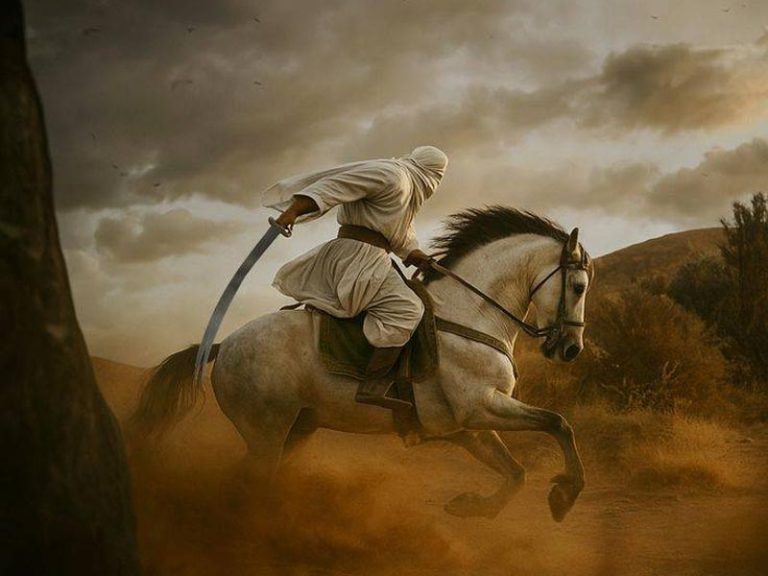
The tribe of Bani Nadir, after being expelled from their land due to treachery, headed to Khaybar and incited other Jews to war against the Prophet of Islam; this is cited as one of the primary causes of the Battle of the Trench. Subsequently, they also stirred up the polytheists of Mecca to fight against the Seal of Prophets.
The Consultation of the Last Prophet
In this war, all the forces of the polytheists and Jewish tribes who opposed Islam mobilized their entire strength to eliminate the Prophet of Islam and the Muslims. However, to confront them, the Muslims-at the suggestion of Salman ibn Farsi—dug a trench around Medina, a tactic that was not common among the Arabs at the time and caused great surprise to both Muslims and polytheists.
The Messenger of Allah (peace be upon him and his family) consulted with the people regarding the method of confronting the polytheists. He heard various suggestions, such as staying in the city, defending from high points, or going outside the city for face-to-face combat. Finally, he chose Salman’s proposal to dig a trench around Medina so that the battle would take place in specific areas and prevent the enemy’s assault into the city through vulnerable points. (1)
Through this military tactic, along with divine unseen assistance, the conspiracy of the polytheists and Jews ended in a crushing defeat without a major clash. This not only stripped them of any possibility of reorganization or future mobilization but also increased the authority of the Islamic government in Medina.
The Revelation of Verses
It was decided that a trench should be dug from Uhud to Ratij. To encourage the Muslims in digging the trench, the Messenger of Allah himself participated in the work.
Jabir ibn Abdullah al-Ansari narrated:
“While digging the trench, I was beside the Messenger of Allah (peace be upon him and his family) while the people and Amir al-Muminin (peace be upon him) were digging. The Prophet said to Amir al-Muminin (peace be upon him): ‘May my father be sacrificed for the one who digs the trench while Gabriel sweeps the dust from before him and Michael assists him, whereas he has not assisted anyone before him.'”
Then the Messenger of Allah (peace be upon him and his family) said to Uthman ibn Affan: “Dig.” Uthman became angry and said: “Muhammad is not satisfied that we accepted Islam at his hands until he commands us to hardship and toil.”
Therefore, God revealed this verse to His Prophet:
“They consider it a favor to you that they have accepted Islam. Say, ‘Do not consider your Islam a favor to me. Rather, Allah has conferred a favor upon you that He has guided you to the faith, if you should be truthful.'” (Al-Hujurat: 17) (2)
The Challenge of Ibn Abd Wudd
Amr ibn Abd Wudd was an elderly man whose bravery was legendary. He, along with a group, crossed the trench and demanded a challenger, while the Muslims remained silent out of fear. (3)
Amr challenged them three times, and each time, no one responded affirmatively except Amir al-Muminin (peace be upon him).
When Amir al-Muminin (peace be upon him) intended to go to the field to confront Amr ibn Abd Wudd, the Prophet (peace be upon him and his family) said: “O Ali, come to me.” Then he took off his long turban, wrapped it nine times around the blessed head of Amir al-Muminin (peace be upon him), gave him his sword, and said: “Go to the battlefield.” (4)
And he sought help from God for him, saying: “O Allah, help him against Amr.” (5)
When Amir al-Muminin (peace be upon him), with the permission of the Last Prophet, set out to fight him, he destroyed Amr, and two others among Amr’s companions were also killed.
Ibn Abd Wudd’s Fear of Amir al-Muminin (peace be upon him)
Ibn Abi al-Hadid recorded the story of the battle between Amir al-Muminin (peace be upon him) and Amr ibn Abd Wudd in the Battle of the Trench as follows:
“Amr was an elderly man who had passed his eightieth year and had been a friend of Abu Talib during the Age of Ignorance(pre-Isalm).
He asked: ‘Who are you?'”
Amir al-Muminin (peace be upon him), stated his lineage to him:
“I am the son of Abu Talib!” Amr said: “Yes; your father was my companion and friend. Go back, for I do not wish to kill you for this reason.”
Then Ibn Abi al-Hadid narrated:
“Our Shaikh, Abu al-Khayr Musaddiq ibn Shabib al-Nahwi, whenever we reached this passage, would say: ‘By God, Amr did not ask Ali to return to save Ali’s life, but rather he was afraid of him, for he knew whom Ali had killed at Badr and Uhud. He realized that if he fought him, he would be killed; therefore, he was ashamed to show his inability and pretended that he did not want to kill him and that his heart ached for him. In this, he was truly a great liar.'” (6)
The Death of Ibn Abd Wudd
When Amir al-Muminin (peace be upon him) killed Amr ibn Abd Wudd, he stood by the trench while wiping the blood from his sword and brandishing it in the air, reciting verse 101 of Surah Al-Muminun:
“Then when the Trumpet is blown, there will be no kinship between them on that day.” Subsequently, the polytheists split into seventeen groups, and Amir al-Muminin (peace be upon him) mowed down each group like wheat without them being able to move from their positions. (7)
The Chivalrous Conduct of Amir al-Muminin (peace be upon him)
Umar ibn al-Khattab said to Amir al-Muminin (peace be upon him): “Why did you not strip off his expensive armor? There is none better in all of Arabia!”
His Eminence replied:
“When I struck him, he used his private parts as a means of protection, and I felt ashamed before my cousin, the Prophet of Islam, to leave him naked.” (8)
The Role of Amir al-Muminin (peace be upon him)
The action of Amir al-Muminin (peace be upon him) in killing Amr was highly effective in the support and victory of Islam and the defeat of the disbelievers in this war.
In the Battle of the Trench, as Amir al-Muminin (peace be upon him) headed toward the battlefield to face Amr ibn Abd Wudd, the Messenger of Allah (peace be upon him and his family) said:
“The whole of Faith has come out against the whole of Polytheism.” (9)
And when Amir al-Muminin (peace be upon him) killed Amr ibn Abd Wudd, the renowned champion of the Arabs, the Messenger of Allah said:
“The struggle of Ali ibn Abi Talib (peace be upon him ) against Amr ibn Abd Wudd is superior to all the deeds of my Ummah until the Day of Resurrection.” (10)
Regarding the killing of Ibn Abd Wudd, Amir al-Muminin (peace be upon him), said:
“I killed Amr ibn Abd Wudd, who was equal to a thousand men.” (11)
Concerning the combat of Amir al-Muminin (peace be upon him), Ibn Abbas narrated:
“In the Battle of the Trench, God spared the believers from fighting by means of Ali ibn Abi Talib (peace be upon him) who killed Amr.” (12)
The Stature of Amir al-Muminin (peace be upon him)
Ibn Abi al-Hadid, one of the Sunni scholars, writes:
“Abu Hudhayl was asked whether the status and rank of Abu Bakr is greater in the sight of God or Ali? He replied: ‘When Ali stepped forth to battle Amr ibn Abd Wudd on the day of the Trench, this single act of his equaled the deeds and devotions of all the Muhajireen and Ansar, and was even greater than their collective deeds, let alone the deeds of Abu Bakr alone.'” (13)
Reference to the Battle of the Trench in the Ziyarah of Amir al-Muminin (peace be upon him)
“Peace be upon you, O you through whom Allah sufficed the believers in fighting on the Day of the Confederates (al-Ahzab).”
(Peace be upon you, who on the day of the Battle of the Confederates against the enemies, was alone sufficient to relieve the believers of the need to fight.)
“Peace be upon you, O manifester of wonders and signs; peace be upon you, O commander of the battles.”
(Peace be upon you, O manifestation of miracles, signs, and wondrous feats; peace be upon you, O commander of the Islamic army in wars.)
“Peace be upon you, O one at whose charges in the heat of battle the angels of the heavens were amazed.”
(Peace be upon you, at whose combat and charges in the battlefield the angels of heaven were struck with wonder.) (14)
Divine Assistance
The factor that completed the enemy’s defeat and made the Quraysh’s decision to return definitive was the sudden onset of a storm; it was such that it uprooted the tents and sent the cooking pots flying off the fires.
This divine unseen assistance, coupled with the biting cold, further added to their hardships. Verse 9 of Surah Al-Ahzab also refers to this storm:
“O you who have believed, remember the favor of Allah upon you when armies came against you and We sent upon them a wind and armies [of angels] you did not see.”
At this juncture, the Messenger of Allah (peace be upon him and his family) dispatched Hudhayfah across the trench to investigate the enemy’s nighttime movements. He entered the camp and observed Abu Sufyan delivering a speech, saying:
“O people of Quraysh! This place where we are is not a place for us to stay. Our livestock have perished, and the wind and storm have left us neither tent, nor shelter, nor fire; furthermore, the Bani Qurayza have broken their pact with us. It is best that we depart from here.”
He then mounted his camel and began striking it with his whip, unaware that the camel’s legs were still bound. Hudhayfah returned and conveyed the joyful news of the polytheists’ retreat to the Last Prophet and the rest of the Muslims. (15)
- Al-Ansab, Vol. 1, p. 343.
- Ta’wil al-Ayat al-Zahirah, Vol. 2, p. 607.
- History of al-Tabari (Tarikh al-Tabari), Vol. 2, p. 574.
- Ta’wil al-Ayat al-Zahirah fi Fada’il al-‘Itrah al-Tahirah, Vol. 1, p. 443.
- Al-Maghazi, Vol. 2, p. 471.
- Bihar al-Anwar, Vol. 39, p. 5 / Sharh Nahj al-Balagha, Vol. 19, p. 63.
- Madinat Ma’ajiz al-A’immah al-Ithna ‘Ashar, Vol. 1, p. 427.
- Bihar al-Anwar, Vol. 20, p. 203.
- Sharh Nahj al-Balagha, Vol. 13, p. 261.
- Mustadrak of Al-Hakim al-Nishapuri, Vol. 3, p. 32 / Shawahid al-Tanzil, Vol. 2, p. 15.
- Al-Khisal, Vol. 2, p. 572.
- Shawahid al-Tanzil, Vol. 2, p. 10.
- Sharh Nahj al-Balagha, Vol. 19, p. 60.
- Zad al-Ma’ad, Ziyarah for the 17th of Rabi’ al-Awwal / Al-Mazar al-Kabir, Vol. 1, p. 205.
- Al-Maghazi, Vol. 2, p. 292.


