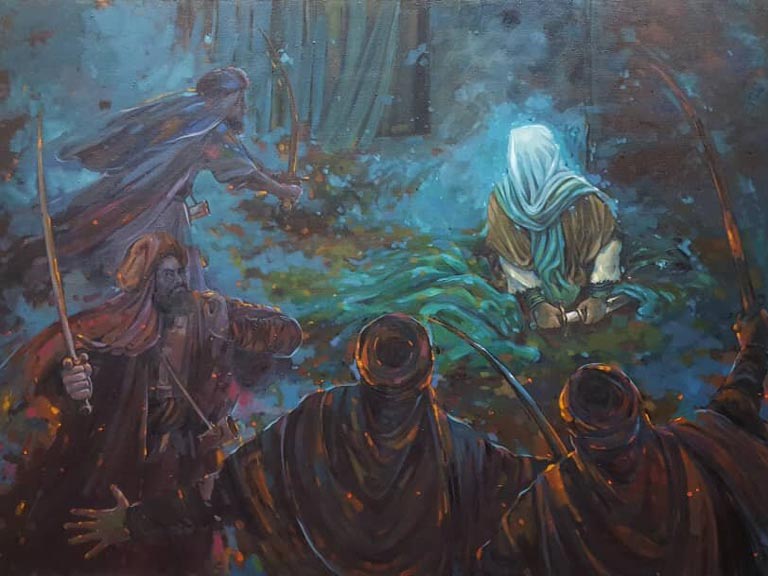
This study examines the historical role of Lady Umm Kulthum (peace be upon her) during critical phases of Islamic history. Her presence during the final nights of the life of the Commander of the Faithful (peace be upon him), her forthright reaction to his martyrdom, her conscious defense of the principle of Wilayah, her testimony regarding Fadak, and her revelatory role in Kufa and Damascus after the tragedy of Ashura collectively portray a figure of deep awareness and remarkable courage in confronting political and social deviations.
Birth, Lineage, and Family Status
According to Shaikh al-Mufid, Lady Umm Kulthum (peace be upon her) was among the children of the Commander of the Faithful, Ali ibn Abi Talib (peace be upon him), and Lady Fatimah al-Zahra (peace be upon her). Alongside Imam al-Hasan, Imam al-Hussain, and Lady Zaynab (peace be upon them), she was counted among their noble offspring. Her given name was “Zaynab al-Sughra,” while “Umm Kulthum” was her honorific title.
There is no unanimous report in early historical sources regarding the exact date of her birth; however, some sources record her birth as having occurred in the year 6 AH.
According to Shaikh Abbas Qumi, the Prophet Muhammad (peace be upon him and his family) bestowed this honorific upon her due to her resemblance to his own daughter, Umm Kulthum.
Lady Umm Kulthum (peace be upon her): The Final Host of Her Father
On the night of the 16th of Ramadan in the year 40 AH, the Commander of the Faithful (peace be upon him) saw the Prophet Muhammad (peace be upon him and his family) in a dream, who gave him glad tidings of their imminent meeting in Paradise. Amir al-Muminin conveyed this news to his daughter, Umm Kulthum (peace be upon her).
On the night of the nineteenth of Ramadan, Amir al-Muminin (peace be upon him) was a guest in the house of Lady Umm Kulthum (peace be upon her). Throughout that night, he remained awake and repeatedly stated, “This is the promised night.” Lady Umm Kulthum asked, “Father, why does sleep not come to your eyes?” He replied, “Indeed, if morning comes, I shall be martyred.”
Her Effort to Dissuade Amir al-Muminin (peace be upon him)
Deeply concerned by her father’s words, Lady Umm Kulthum (peace be upon her) attempted to dissuade him from going to the mosque and suggested that another person lead the prayer in his place. Initially, the Commander of the Faithful (peace be upon him) accepted this suggestion and instructed that Judah lead the prayer. He then stated that there is no escape from the appointed decree and proceeded toward the mosque, exemplifying complete submission to the divine will and acceptance of destiny.
Her Reaction to Her Father’s Martyrdom
After the martyrdom of Amir al-Muminin (peace be upon him), Lady Umm Kulthum (peace be upon her), while weeping, addressed Ibn Muljam, saying:
“Woe to you! As for my father, there is no fear or harm upon him. God has disgraced you in this world and the Hereafter, and your final abode shall be Hell, wherein you shall abide forever.”
Her Enlightening Role in Defending Imam Ali (peace be upon him)
Several Shiite and Sunni sources provide brief accounts highlighting her active and conscious role in supporting her father in accordance with the social conditions of her time. Wherever possible, Lady Umm Kulthum (peace be upon her) defended Amir al-Muminin (peace be upon him) with prudence and within the prevailing societal frameworks.
It is reported that when the Commander of the Faithful (peace be upon him) camped with his army in Dhi Qar, Aisha wrote to Hafsa claiming that he had become fearful of their forces and that whether he advanced or retreated, he would ultimately be defeated. Hafsa rejoiced at this claim and instructed her servants to sing verses mocking the situation of Amir al-Muminin. Women from among the Tulaqa—those freed after the conquest of Makkah by the Prophet Muhammad (peace be upon him and his family)—gathered to listen.
When this reached Lady Umm Kulthum (peace be upon her), she veiled herself and, accompanied by a group of women, entered the gathering anonymously. After some time, she revealed her identity. Hafsa was overcome with shame and exclaimed, “Indeed, we belong to God, and to Him we shall return.” Lady Umm Kulthum then said to her,
“If today you unite to harm my father, you had previously acted in the same manner against his brother, the Messenger of God (peace be upon him and his family), and God revealed a verse concerning you.”
“If you both support one another against him, then indeed God is his Protector, and Gabriel, and the righteous believers, and the angels thereafter are his supporters.”
Other reliable historical sources also record additional sharp exchanges between Lady Umm Kulthum (peace be upon her) and Hafsa.
Her Testimony Regarding Fadak
According to Adud al-Din al-Iji (d. 756 AH) in al-Mawaqif, Lady Umm Kulthum (peace be upon her) was among those who testified that Fadak had been granted as a gift by the Prophet Muhammad (peace be upon him and his family) to Lady Fatimah al-Zahra (peace be upon her).
This report underscores her historical presence in one of the most significant legal disputes following the passing of the Prophet Muhammad (peace be upon him and his family). Its transmission in Sunni theological sources further strengthens its historical credibility and highlights her prominent role in defending the rights of the Ahl al-Bayt.
A Narrator of the Hadith of al-Ghadir (The Fatimid Chain)
Lady Umm Kulthum (peace be upon her) is also counted among the narrators of the Hadith of al-Ghadir. Ibn al-Jazari, the Shafi scholar and traditionist, records a chain of transmission narrated by women of the Ahl al-Bayt, stating:
Lady Fatimah al-Masuma, daughter of Imam Musa ibn Jafar (peace be upon him), narrated from Fatimah, daughter of Imam Jafar al-Sadiq (peace be upon him); from Fatimah, daughter of Imam Muhammad al-Baqir (peace be upon him); from Fatimah, daughter of Imam Ali Zayn al-Abidin (peace be upon him); from Fatimah and Sukayna, daughters of Imam al-Hussain (peace be upon him); from Umm Kulthum, daughter of Lady Fatimah al-Zahra (peace be upon her); and from her mother, Lady Fatimah al-Zahra (peace be upon her), who said:
“Have you forgotten the words of the Messenger of God (peace be upon him and his family) on the Day of al-Ghadir Khumm, when he said, ‘Whomsoever I am his master, Ali is his master’?”
Her Sermon in Kufa
The most significant documented account of Lady Umm Kulthum’s (peace be upon her) role is her address upon the arrival of the captives in Kufa. Sayed Radi al-Din Ibn Tawus, in al-Luhuf ala Qatla al-Tufuf, records her words, Quranic recitation, and poetry during this event, noting that her speech caused intense weeping and distress among the people of Kufa.
In her sermon, she identified the Ahl al-Bayt as the embodiment of the “Party of God,” declaring:
“Behold, the Party of God—they are indeed the victorious.”
She contrasted this with the enemies of the Ahl al-Bayt, whom she described as the “Party of Satan,” affirming:
“Behold, the Party of Satan—they are indeed the losers.”
The narrator relates that the people wept bitterly; women disheveled their hair, cast dust upon their heads, struck their faces, and cried aloud, while men also wept and tore at their beards. No day had witnessed such collective grief.
Poetry Attributed to Lady Umm Kulthum (peace be upon her)
Following her sermon in Kufa, Lady Umm Kulthum (peace be upon her) recited poignant verses, saying:
“You killed my brother with patience and injustice—woe to you! Soon you shall be repaid with a fire whose flames fiercely blaze.”
These verses conveyed a powerful and direct rebuke to the people of Kufa for their role in the martyrdom of Imam al-Hussain (peace be upon him).
The Brutality of Shimr in Rejecting Her Request
Among the most heartrending reports is her address to Shimr after the tragedy of Karbala, as the captives approached Damascus. She requested that they be taken through a gate with fewer onlookers and that the severed heads be kept away from the litters so that people’s gazes might be diverted from them.
Out of sheer cruelty and enmity, Shimr not only rejected this humane request but also ordered the heads of the martyrs to be raised on spears and placed among the litters, parading the captives before the public until they were halted at the gate of Damascus and kept at the steps of the Grand Mosque.
Passing and Burial
According to a number of historians, Lady Umm Kulthum (peace be upon her) survived after the return of the Ahl al-Bayt (peace be upon them) from Damascus to Madinah and passed away four months after returning from Karbala. She was laid to rest in Madinah.
Indeed, Lady Umm Kulthum (peace be upon her) stands as a luminous example of a conscious, faithful, and responsible Muslim woman who steadfastly defended the position of Imamate and the truth of Islam at the most critical junctures of history.