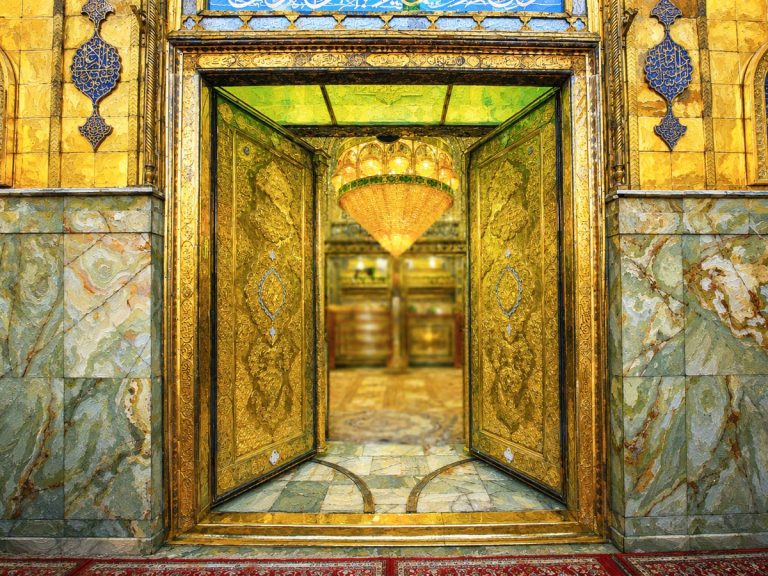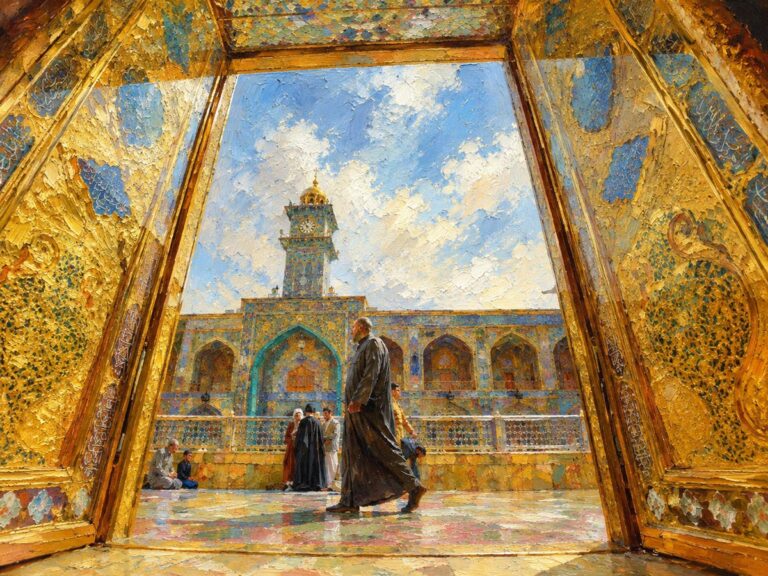
On Monday, 8 Shaban 1373 AH (1954 CE), the door was installed in place of the old silver one, through the efforts of Allamah Sayyid Muhammad Kalantar and at the expense of three Tehrani merchants. They were Hajj Mahdi Moqaddam and his two nephews, Hajj Kazem Agha Tavakolian Moqaddam and Hajj Abdullah Moqaddam, who together spent more than half a million tomans on the project.
The Craftsmanship of Isfahan, Presented to Najaf
The door was built in the city of Isfahan by skilled master artisans and distinguished artists, with the utmost precision and mastery. In its time it was unrivaled and a marvel to behold, and its striking design, original motifs and brilliant colors captivated every viewer.
Dr. Suad Maher said in this regard:
“In truth, the making of such a door, beyond its material value, demonstrates how far handicrafts and applied arts had advanced in contemporary Iran, so that it may be counted among the masterpieces of twentieth-century decorative and applied arts.”
Work on the door was completed in Isfahan on 25 Rabi al-Thani 1373 AH (1954 CE). It was then transferred to the home of its first patron in Tehran, where a large gathering of dignitaries, notables and Iranian government officials came to seek blessings and view it. Mohammad Reza Shah Pahlavi also attended the ceremony and ordered that the convoy carrying the door be given unhindered passage toward the Iraqi border, with all security measures provided for its protection.
Subsequently, during the reign of King Faisal II, Iraqi administrative authorities likewise made every effort to cooperate and coordinate with the Iranian side to bring the convoy into Iraqi territory. The convoy finally arrived in Najaf al-Ashraf on 20 Jumada al-Thani, accompanied by the same master goldsmiths, who were present to personally oversee the installation of the golden door.
The Idea of Building the Golden Door
Mr. Alaa al-Din Kalantar recounted his father’s role in the project:
“My father’s first success was his effort to build the great golden door of the shrine of Amir al-Muminin (peace be upon him). The truth is that this was his first inspired initiative and the beginning of his works, something no one before him had attempted. He proposed the idea, then approached merchants and explained the plan to them, and they declared their readiness to cover the costs.
He then traveled to Isfahan and met leading masters of various arts, such as goldsmithing, enameling and calligraphy. Among them were the late Muhammad Hussain Parvaresh, master of goldsmithing; the late Shukrullah Saniizadeh, master of enameling, and Parsayan, a specialist in that art; and the late Sayyid Muhammad Arizi and Hajj Muhammad Taqi Dhu al-Fann, eminent masters of calligraphy and script.
He explained his vision to them and, through repeated journeys, personally supervised the progress of the work. He also selected Quranic verses revealed in honor of Amir al-Muminin (peace be upon him), noble prophetic traditions on his virtues, and verses of distinguished Arabic poetry in praise of the Imam, to be inscribed on the two leaves of the door and on its borders. As a result, the door became a masterpiece of artistic creativity.”
The finest teak wood was used in building the golden door. This work was carried out with care and skill by two merchants, Mr. Karim al-Maraabi and Hajj Hasan Yazdi, both from Hillah. The project consumed approximately three thousand five hundred mithqals of pure gold and fifty thousand mithqals of refined silver.
The wooden components were made in Najaf, in the workshop of Hajj Salih Halbus. He asked those in charge of the project to allow him to bear, as a vow and gift, the cost of the wood and iron used in the crescent crown above the door and its glass frame, and the request was accepted.
The Magnificent Installation Celebration
Finally, a magnificent celebration was held in the Holy Alawi Shrine on the morning of Monday, 8 Shaban, to mark the beginning of the door’s installation. At the ceremony, Shaikh Muhammad Ali al-Yaqubi delivered a brief address and recited his beautiful ode for those present; its text was inscribed on the crescent arch above the door. The poem records the date of the door’s installation in 1373 AH.
Two other chronogram poems are also inscribed on the other two sections of the golden door. On the frame of the right-hand section, an ode by Sayyid Muhammad Jamal al-Hashemi was written in raised golden lettering, while the frame of the left-hand section bears an ode by Shaikh Abd al-Hamid al-Samawi.
Shaikh al-Iraqayn Abd al-Rida Al Kashif al-Ghita also stated:
“These verses were composed by the master Shaikh Muslim al-Jabiri as the chronogram for the installation of the golden door of the mausoleum of Amir al-Muminin (peace be upon him). He recited this poem that same day, after sunset, in the Haydari Courtyard during the installation ceremony.”
The date of the door’s installation was likewise recorded in verse by Shaikh Abd al-Hussain al-Huwayzi.
On the afternoon of Thursday, 11 Shaban 1373 AH (1954 CE), the inauguration ceremony of the golden door took place. It was performed by the shrine’s custodian, Sayyid Abbas Rafii. Thousands of devotees and admirers attended the grand celebration and listened to the impassioned ode of the poet and scholar Shaikh Abd al-Munim al-Faratsi.
The next morning, Friday, 12 Shaban, the Muntada al-Nashr Society (the Society for Publication and Center of Dissemination) held a special ceremony in honor of those involved in the project, particularly Sayyid Muhammad Kalantar and the benefactors of the Moqaddam family. The program included an address delivered by the society’s representative, Allamah Shaikh Muhammad Rida al-Muzaffar, and two odes recited by Sayyid Muhammad Jamal al-Hashemi and Allamah Shaikh Abd al-Mahdi Matar.
The Text Removed During the Door’s Restoration
During the military events accompanying the uprising of 1411 AH (1991 CE), the shrine’s golden door suffered severe damage. It was subsequently restored and rebuilt. In the process, some writings and inscriptions were removed, including a Persian ode engraved on both sides of the door. A note on the left-hand section concerning the place of construction, the makers and the patron was also taken down.
Its text read:
“This door was built in the city of Isfahan by the hands of master craftsmen: Hajj Sayyid Muhammad Arizi, Hajj Muhammad Taqi Dhu al-Fann, and Muhammad Hussain Parvaresh. And this servant, hopeful of the intercession of my fathers and forefathers, is Muhammad ibn Sultan al-Musawi Kalantar. And the blessings of God be upon Muhammad and his pure and infallible family.”
In 1437 AH (2016 CE), the golden door was removed once again, and because so much time had passed since its original installation, major repairs were begun by specialized technical teams of the Holy Alawi Shrine.
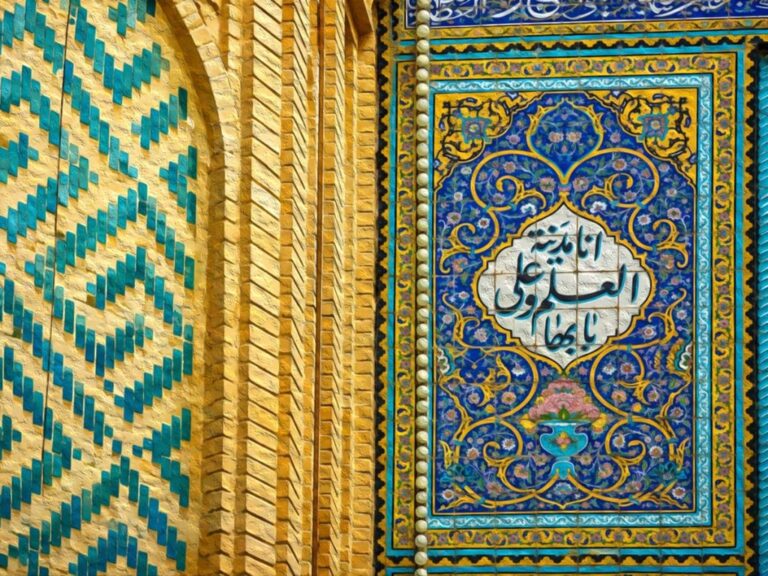
During this process, re-gilding was carried out under the supervision of master goldsmith Majid Abu al-Nawaeer, with careful attention to the artistic and decorative details. Finally, on 13 Rajab al-Murajjab 1438 AH (2017 CE), coinciding with the blessed birth anniversary of Amir al-Muminin (peace be upon him), the Gate of the City of Knowledge, the door was reinstalled in its place.
References
Adapted from the book “Tarikh al-Marqad al-Alawi al-Mutahhar”
The previous installment in this series examined the exquisite doors of the riwaqs of the Holy Alawi Shrine.