
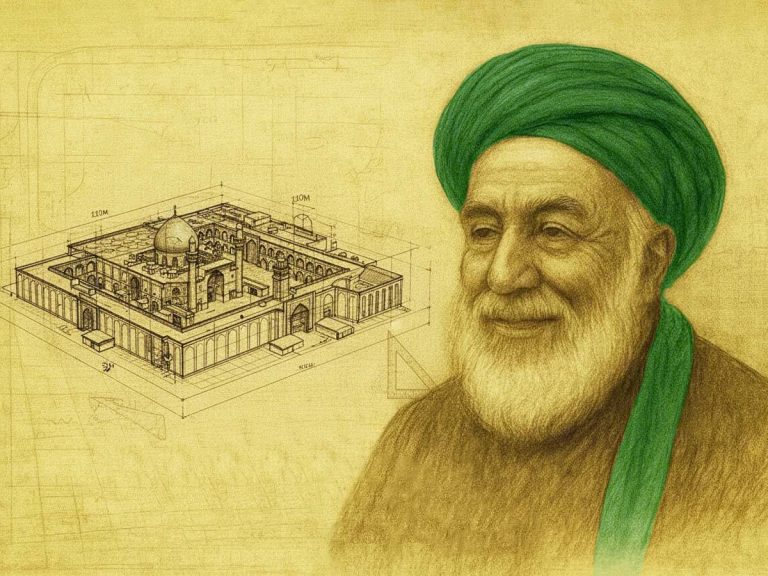
By integrating his engineering expertise with artistic intuition, Shaikh al-Baha’i made a monumental contribution to the magnificent architecture of the Holy Alawi Shrine—a structure that stands as a manifestation of the union between science, art, and faith in the history of Islamic civilization.
Shaikh al-Baha’i ’s Scientific and Engineering Standing
As is well-known, Shaikh al-Baha’i excelled in mathematics, geometry, and astronomy, possessing a profound understanding of the mechanisms of the astrolabe. He authored numerous treatises and works in these sciences, particularly on determining the direction of the Qibla. His notable works include Tashrih al-Aflak (Anatomy of the Spheres), Khulasat al-Hisab (The Essence of Arithmetic), Astrolabe (in Arabic and Persian), and a treatise on the Qibla. Serving as the chief engineer for Shah Abbas I, he designed and executed unique and iconic landmarks across Iran.
Evidence of Shaikh al-Baha’i ’s Residence in Najaf
The room where Shaikh al-Baha’i resided during his supervision of the construction of the new building of Holy Shrine is located on the upper floor of the western section of the Noble Alawi Courtyard, near Bab al-Faraj. Specifically, it is situated directly above the “first chamber” and adjacent to the Abu Talib’s (peace be upon him) Portico on the left side. This historical fact has been passed down through generations of Najaf residents and is widely renowned.
During his supervision of the shrine’s construction, he composed two couplets of poetry which were inscribed on tiles and adorned the wall of the designated shoe-depository area (known as al-Kishwaiyya) at one of the shrine’s gates, named Bab al-Murad.
Written Documentation of Shaikh al-Baha’i’s Presence
An important text in the book al-Kashkul confirms the role of Allamah al-Baha’i in Safavid architectural design. It states:
“The author of these lines, Muhammad, known as Baha’ al-Din al-Ameli, decided to build a place for keeping the shoes of the pilgrims of the Holy Alawi Shrine in Najaf al-Ashraf and to inscribe the two couplets that came to his mind upon it.”
هذا الأُفُقُ الْمُبِينُ قَدْ لَاحَ لَدَيْكَ

فَاسْجُدْ مُتَذَلَّلاً وَعَفْرْ خَدَّيْكَ

ذا طُورُ سِينِينَ فَاغْضُضِ الطَّرْفَ بِهِ

هذا حَرَمُ العِزَّةِ فَاخْلَعْ نَعْلَيْكَ
This clear horizon has appeared before you, So prostrate in humility and rub your cheeks in the dust. This is the Mount Sinai [of the Soul], so lower your gaze, This is the Sanctuary of Might, so “put off thy shoes.”
Regarding these verses, Allamah Sayed Ni’matullah al-Jaza’iri (d. 1112 AH) remarked:
“These words deserve to be written with light upon the countenances of the maidens of Paradise.”
It is noteworthy that this inscription is no longer present in the Alawi Courtyard, as many historical and heritage landmarks were lost over the past four centuries due to restoration and tile-work renovations. The tile bearing this inscription was removed in 1369 AH (1950 AD) during the renovation and glazing of the walls of the Holy Shrine’s chambers and porticos. Consequently, a vital physical document indicating Shaikh al-Baha’i ’s presence in Najaf and his supervisory role in the shrine’s construction was lost.
Dr. Hasan al-Hakim writes:
“Shaikh al-Baha’i played a major role in the architecture of the Alawi Courtyard and the Holy Shrine. It is rare to find a scholar among Arab and Muslim thinkers who, alongside religious expertise, possessed such mastery in mathematics, astronomy, and engineering. He resided in Najaf for a period as a professor in its school, forming deep bonds with the scholars of Najaf. Even after his return to Isfahan, literary correspondence—both poetry and prose—continued between him and the scholars of Najaf. During the design of the Noble Alawi Courtyard, he established a place for storing pilgrims’ shoes.”
Historical Analysis of Shaikh al-Baha’i ’s Presence
Some have cast doubt on or denied Shaikh al-Baha’i ’s role in the architectural design of the Alawi Shrine. The reason for this skepticism is that the commencement of the construction is often attributed to the grandson of Shah Safi, rather than his grandfather, Shah Abbas I. This would mean that since Shaikh al-Baha’i passed away before Shah Safi ascended the throne in 1038 AH, he could not have played a role.
For instance, Sayed Hasan al-Sadr (d. 1354 AH) believed that the construction did not begin under Shah Abbas I but was commissioned by his grandson, Shah Safi, dating it to 1047 AH. He further noted that after Shah Safi’s death in 1052 AH, his son Shah Abbas II continued the completion of the structure. On this basis, he dismissed the possibility of Shaikh al-Baha’i designing the architectural plans, as his death preceded the start of construction ordered by Shah Safi.
In response to this view, Shaikh Jafar Mahbuba states:
“What is well-known among the people of Najaf is that the construction of this edifice took place during the time of Shah Abbas I, and there is no doubt regarding this matter. They have accepted and continuously passed down this narrative through generations, just as they do for their other holy sites and historical monuments. Furthermore, historical sources confirm the prevalence of this belief; as mentioned in the Persian works Muntazam-i Nasiri and Mulhaq-i Rawdat al-Safa, the construction of the dome, the Noble Alawi Courtyard, and the Sanctuary of the Holy Shrine are listed among the works of Shah Abbas I, as we have previously cited. Therefore, this can be correctly attributed to Shaikh al-Baha’i, who was a contemporary of Shah Abbas. This is especially true since we have found no reports indicating that Shah Abbas II built the dome or even visited Najaf for pilgrimage.
Sayed Hasan al-Sadr cited the words of Muhammad ibn Zuwayr al-Sulaymani and Sayed Ali Shulistani to support his claim. However, what I have found in the statements of Sayyid Ali Shulistani—as quoted in Mazar al-Bihar and Shaikh Yusuf al-Bahrani’s al-Kashkul—proves neither the start of construction under Shah Safi and its completion by Shah Abbas II, nor does it negate the role of Shah Abbas I in the building’s construction.”
We emphasize that what was proposed by Sayed Sadr and those who follow his view was merely an error and contradicts what is recorded in authentic historical texts. Sources explicitly state that the commencement of this edifice’s construction in the year 1023 AH, during the reign of Shah Abbas I, was inscribed on the wooden door of the Holy Alawi Shrine. This means that Shaikh al-Baha’i was alive at that time, and the beginning of the new construction over the Holy Shrine occurred during his lifetime.
Historical evidence and numerous reasons indicate that Shaikh al-Baha’i played a very significant role in the design and engineering of this sacred structure; for he possessed exceptional genius and unparalleled talent, accompanied by divine success and Alawi grace. May Allah grant him the best reward of the righteous and bestow upon him the intercession of Amir al-Muminin (peace be upon him) .
The book “History of the Holy Alawi Shrine” (Tarikh al-Marqad al-Alawi al-Mutahhar)


One Response
As Salam alaika Ya Rasulullah Sallallahu alayhe wasallam,
As Salam alaika Ya Imam Ali ra. as. Karram Allahu Wajhah
Requesting dua:
My mother’s (Syada Shamim Islam)
is in critical condition hospitalized. She is 83 years old.
Please ask for khaas Dua –
As Salam alaika Ya Imam e Hussain as.