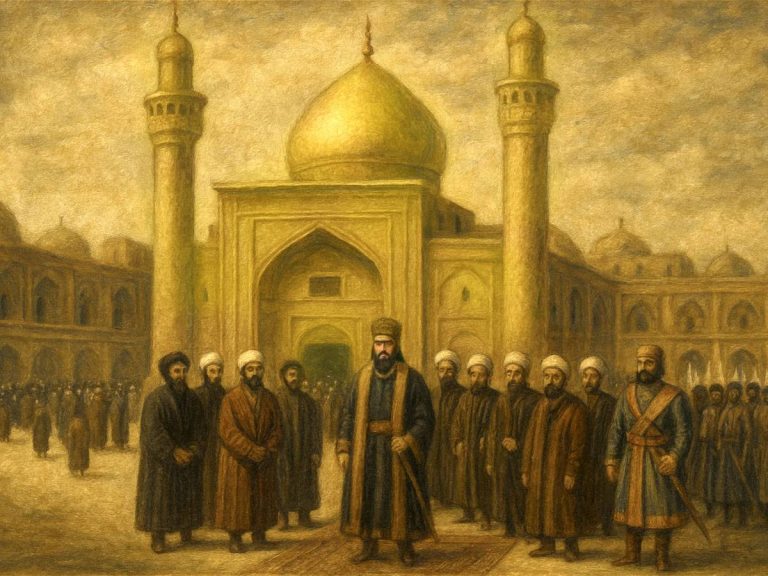
This commendable undertaking, which reflected his reverence for Shia holy places, also contributed greatly to the flourishing of Islamic architecture and art. With prudence and precision, Nader Shah employed the finest materials and the most skillful craftsmen of the time so that the beauty and majesty of this blessed shrine might be preserved for future generations.
Symbolic Meaning in the Shrine’s Architecture
Whatever the motive behind Nader Shah’s gilding of the shrine may have been, the profound symbolic significance of the act is unmistakable: the gold, after the shah had himself turned away from worldly life, was surrendered to the shrine of Amir al-Muminin (peace be upon him). This gesture signifies renunciation of the world and devotion to spiritual realities, a theme repeatedly emphasized in sermons and hadith.
It is noteworthy that the gilding process included numerous remarkable embellishments and gold leaf panels upon which Quranic verses, Prophetic traditions, and poems in Arabic, Persian, and Turkish were inscribed. The years of commencement and completion of the gilding were also recorded through several poetic chronograms, and certain texts and numerals were engraved at various points on the dome, the minarets, and the golden Iwan.
Several poets and scholars contemporary with Nader Shah rendered the year of gilding of the upper dome of the holy sanctuary, namely 1155 AH, into verse and prose, including Allama Sayed Nasrullah al-Ha’iri (d. 1168 AH), who composed a long ode on the subject.
The Crown Above the Dome
The religious symbolism inspired by the Quran and the traditions of the Ahl al-Bayt (peace be upon them) is clearly visible in the architecture of the upper holy shrine. At the highest point of the spherical golden dome stands a golden crown consisting of an almost circular ring, representing the disc of the sun. From this ring extend fourteen rays, symbolizing the Fourteen Infallible figures : Muhammad, Ali, Fatimah, al-Hasan, al-Hussain, and the nine Imams from the descendants of al-Hussain (peace be upon them).
This symbol also alludes to the belief that the Ahl al-Bayt are the light of God, and it further refers to two historical incidents concerning the reflection of sunlight for Amir al-Muminin (peace be upon him).
At the center of the circle is a heart composed of two positive parts around a single axis, and this heart can move and rotate by means of the wind. The meaning of this symbol is evident to any discerning mind: it conveys that the orbit of all circles revolves around a central axis.
Upon the disc, an open hand is inscribed together with the Quranic phrase: “The Hand of God is above their hands.” Clearly, the emblem of the palm refers to the Five of the Cloak (peace be upon them), as well as to the pledge of allegiance to Amir al-Muminin (peace be upon him). The palm was made 63 centimeters long, a number representing the years of the life of Amir al-Muminin (peace be upon him).
Naderi Endowment
It should be noted that the golden dome crowned with the golden crown, rays, and palm placed above it, and installed atop the dome during the first gilding, was endowed by Sultan Nader Shah for the dome of Amir al-Muminin (peace be upon him) . This endowment was recorded on two small seals engraved upon the sphere.
One seal read:
“Endowment of His Holiness Amir al-Muminin (peace be upon him).”
The other, in Persian, stated that the top ornament of the blessed dome had been offered to Ali ibn Abi Talib by command of the king of the world and Nader of the age, and was marked by the humble, sinful servant, the dog of the threshold, Ibn Mirza Muhammad Ibrahim Khan Zargar-Bashi Tabrizi, in the year 1155.
Shaikh Muhammad Harz al-Din also reports one of the most interesting anecdotes: when Nader Shah was asked about the inscription on the golden palm above the dome, he replied, “Write: The Hand of God is above their hands.”.
His minister was first astonished and denied that such a thing could have been intended by the shah, but after asking again, Nader Shah confirmed the same answer, and thus the minister came to recognize the shah’s discernment.
Chronology Of The Work
In 1153 AH / 1740 CE, a royal creed was issued for the gilding of the upper shrine of Amir al-Muminin (peace be upon him) . In 1154 AH / 1741 CE, preparations were made, and texts were selected from Quranic verses, Prophetic traditions, and Arabic, Persian, and Turkish poems that would decorate the dome, the minarets, and the grand Iwan.
The gilding process was carried out in two stages. The first stage, gilding of the radiant dome, began in 1155 AH / 1742 CE. The second stage, from 1156 AH / 1743 CE, completed the gilding and ornamentation of the minarets and the great eastern Iwan.
In addition, Persian records concerning the beginning and completion of the gilding were engraved on the large and small spheres of the golden crown adorning the dome. The work process and those responsible for it were documented in a Nastaliq inscription on the first small sphere at the dome’s summit. The inscription states that the work began on the twelfth of Muharram 1155 and was completed in the blessed month of Ramadan, under the supervision of Mahdi Quli Khan and Ibrahim Khan as chief goldsmith, with Muhammad Sabir Isfahani serving as architect.
From this text it may be inferred that the gilding of the upper dome lasted approximately seven and a half lunar months. Furthermore, the date of completion of the upper shrine’s gilding, namely 1156 AH, and the name of Nader Shah were inscribed in a circular Turkish band on the upper portion of the large sphere.
Several poetic chronograms for the beginning and end of the gilding of the holy shrine were also composed in the ode of Muhammad Zaki Mashhadi, known as Nadim. This ode, a mixture of Turkish, Persian, and some Arabic words, is inscribed on a Quranic band encircling the dome in the form of upper and lower inscriptions.
Inscriptions And End Date
At the end of the dome band, a small golden seal is engraved in Persian Naskh script with a text that records the completion of the work and names the officials involved, including Mahdi Quli ibn Muhammad Khan Bidgali Shamlu, Muhammad Ali ibn Muhammad Salih Qazvini, and Ibrahim Zargar-Bashi ibn Mirza Muhammad Tabrizi, who was entrusted with the gilding of this radiant dome, the place of circumambulation for humans and jinn. The inscription also states that the work was completed in 1156 AH, and that it was written by Muhammad Husain Tabrizi, son of Zargar-Bashi.
The meaning of this text:
“Praise and gratitude be to Almighty God. All these humble servants—Mahdi-Quli bin Muhammad Khan Bidgoli Shamlu, Muhammad-Ali bin Muhammad-Salih Qazvini, and the Chief of Illumination and Gilding, Muhammad-Ibrahim bin Mirza-Muhammad Tabrizi, who were commissioned with the illumination of this luminous dome, a place of circumambulation for mankind and jinn—have attained a sublime station by the grace of God. Praise be to Allah, who honored us with this magnificent blessing. In the year 1156 AH, this inscription was penned by Muhammad-Husain Tabrizi, the son of the Chief Goldsmith (Zargar-Bashi).”
It is also noteworthy that 24 golden leaves were installed around the neck of the dome, bearing noble verses from Surat al-Fath and continuing the dome-neck band. By examining the sequence of verses in this surah, it becomes clear that the final page was devoted to recording the date of completion of the upper gilding.
On this page, in Arabic and in a densely layered thuluth script, it is written:
“Compiled by Fani Muhammad Muqim in the year 1156 AH, employing an eminent historiographical style.”
At the two upper sides of this leaf, in Arabic and Persian Naskh, it is also written that the Kaba of Islam was honored by the gilding of the dome, and that Ibrahim Khan ibn Mirza Muhammad Tabrizi, master goldsmith, was successful in beginning the work in 1155 and completing it in 1156; the inscription was written by Muhammad Husain ibn Zargar-Bashi.
Furthermore, over twenty names are inscribed on several golden plates of the dome, commemorating the heads of various departments who supervised the illumination process. Approximately half of these plates bear the name of the supervisor of the illumination operations, Ibrahim Khan, while a few others feature the name of the architect, Muhammad Sabir.
Recording the Name of Nader Shah on the Golden Iwan
The completion of the illumination operations is recorded in an Arabic inscription, written in dense Thuluth script within a broad band atop the Golden Iwan. The text reads as follows:
“Praise be to Almighty God. The illumination of this luminous dome and the hallowed sanctuary was completed by the command of the Great Khagan, the Sultan of Sultans, Abu al-Muzaffar, fortified by the power of Shah Nader—may God perpetuate his kingdom and sovereignty and bestow his bounty, justice, and benevolence upon the worlds. Its chronogram states: ‘May God perpetuate his state,’ the year 1156 AH.”
Additionally, on the band of the Golden Iwan, to the right and left, a poetic chronogram marking the completion of the illumination of the upper shrine is inscribed. This poem, a Qasida by Mirza Abd al-Razzaq Tabrizi Jahanshahi—renowned by the pen name “Nash’ah” (or Nash’a)—is engraved in Turkish using the Nastaliq script along the length and perimeter of the Iwan walls. The year 1156 AH is inscribed beneath the final verse.
The primary text states:
“Be mannerly, for he—the Commander of the Faithful, Ali (peace be upon him)—is a constant sun around which mankind and jinn circumambulate.”
The Year of Completion of Illumination Operations
At the end of this band, there are two plates inscribed in Persian, recording the names of those responsible for the gilding of the upper hallowed shrine:
“The illumination of this dome and sublime court was brought to fruition and concluded through the diligence and efforts of the servants of the Celestial Court: Mahdi-Quli bin Muhammad Bidgoli Shamlu, Muhammad-Ali bin Muhammad-Salih Qazvini, and the comptroller of this undertaking, Muhammad-Ibrahim Zargar-Bashi bin Mirza Muhammad Tabrizi, in the year 1156 AH. Praise be to Allah for His blessings. Written by the humblest servant of the King of Religion, bin Ali Muhammad Amin.”
Furthermore, two golden plates are situated on either side of the small Iwan within the Great Golden Iwan. These bear poetic verses in Turkish by the poet Nadim, with a Persian inscription beneath:
“The servant of this station, Muhammad-Zaki Nadim.”
This inscription refers to the year 1156 AH, signifying “The Servant of this Station, Muhammad-Zaki Nadim,” and marks the completion of the gilding of the upper shrine. Two verses of poetry are inscribed on the right-hand plate.
The date of the illumination’s completion (1156 AH) is also recorded at the end of a Qasida by Urfi Shirazi (d. 991 AH), concluding with the name of the calligrapher, Muhammad-Jafar Isfahani.
Similarly, on the final row of golden plates at the base of the northern minaret, adjacent to the tomb of Allamah Hilli, five Persian verses are engraved, ending with the name of the calligrapher, Muhammad-Jafar. The Qasida concludes with a verse recording the chronogram for the completion of the minarets’ illumination (1156 AH):
“From this minaret of grace, which casts its shadow over the seven heavens,
Do not call it a minaret, but a palm tree of the Secure Sinai, where the muezzins are like Moses at the Lote-tree.
The manifestation was eternally of spiritual meaning; it has now manifested in gold.
I plunged into the crucible of thought for the chronogram of this sun-like manifestation;
The reciter of my melody-composing nature said: ‘Exalted is His State, Allahu Akbar.'”
On the opposite side, on the final row of decorated golden plates at the base of the southern minaret, adjacent to the tomb of Allamah Ardabili, five Arabic verses by Ali bin Abi al-Ma’ali Tabatabai are inscribed. The final verse of this Qasida refers to the year 1156 AH as the date of completion for both minarets.
It is noteworthy that calculating the abjad (numerical) value of the phrase “Allahu Akbar” yields 289. When multiplied by four, the sum is 1156, precisely the year the illumination of the two minarets was completed.
Moreover, the date is inscribed using the chronogram “Sadan Aziman” (A Great Felicity) on a small window the size of a golden plate at the base of the southern minaret. The numerical value of these two words also totals 1156. The year 1156 AH is further inscribed at the end of the band of Quranic verses encircling the body of the southern minaret.
Adapted from the book The History of the Hallowed Alawite Shrine (Tarikh al-Marqad al-Alawi al-Mutahhar).