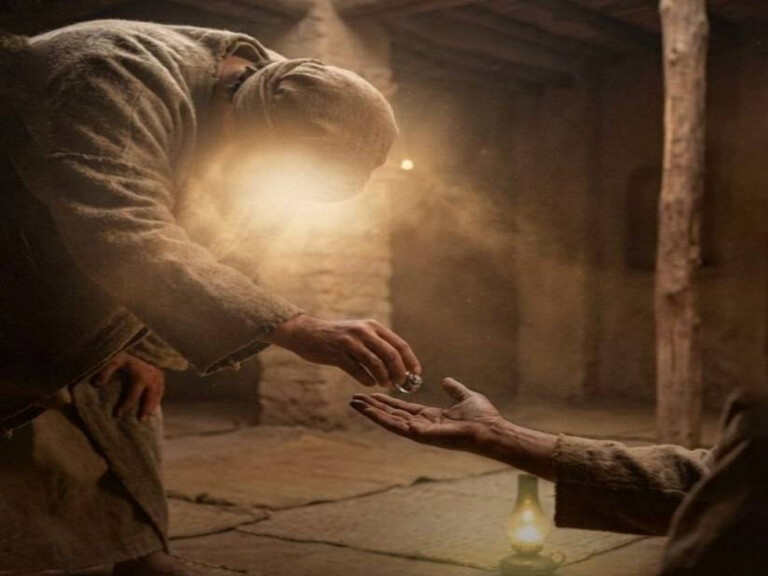
The gilding of the Holy Alawi Shrine commenced in 1155 AH (1742 AD) by the order of Nader Shah and was completed in 1156 AH (1743 AD).
Nader Shah’s Decree for Gilding the Alawi Dome
In the book Tarikh-e Jahangushay-e Naderi, Mirza Muhammad Mahdi Astarabadi writes:
“With the issuance of the royal decree to gild the dome of Najaf al-Ashraf, officials and agents were appointed to execute this command. With utmost beauty and precision, they completed the gilding of a dome that equaled the heavens in its height. Subsequently, all those who played a role in this endeavor were honored. A sum of ten thousand (equivalent to fifty thousand Tomans of that era) was spent to adorn the lofty and radiant dome with gold.”
Mirza Muhammad Kadhim Marvi also provides a detailed account in the book Alam-aray-e Naderi, stating:
“Since fulfilling a vow, spreading goodness, and donating wealth are commendable acts, God has stated in the Holy Quran: ‘They fulfill their vows and fear a Day whose evil will be widespread’ (Surah al-Insan: 7); furthermore, donating a portion of wealth and feeding the needy, orphans, and captives is a deed mentioned in the verse: ‘And they give food in spite of love for it to the needy, the orphan, and the captive’ (Surah al-Insan: 8), promising a great reward in the Hereafter.”
The Reason Behind Nader Shah’s Specific donation
It is stated in Alam-aray-e Naderi:
“The great and wise Sultan, His Majesty and the noble Khagan—who is both a doer of good and the Sultan of Sultans—having sent the victorious banner to the rulers of India, Baluchistan, and Turkestan, entered Khorasan. Upon reaching the holy land of the shrine of the oppressed Imam, Ali ibn Musa al-Rida (peace be upon him), he resolved to decorate the dome of Amir al-Muminin (peace be upon him) in Najaf al-Ashraf with gold, so that it might shine as brightly as the dome of the Eighth Imam.”
As soon as this thought occurred to him, he issued an immediate order to gather the architects and masters of the Razavi Shrine. A group of committed specialists, led by Muhammad Husain Beig and accompanied by Aqa Najaf—a native of Qazvin skilled in architecture and decoration—presented themselves before the Sultan.
A Letter from Iran to the Governor of Baghdad
Subsequently, a letter as radiant as sunlight was sent to Ahmad Pasha, the Governor of Baghdad, stating:
“Our beloved King, who is always a pioneer in good deeds and generosity, has decided to adorn the noble dome of the Amir al-Muminin (peace be upon him) the representative of Divine Art and the cousin of Prophet Mustafa—namely, the Commander of the Faithful (peace be upon him)—with red gold.”
“In these days, we have dispatched a group of experienced foremen and architects, along with the sum of fifty thousand pure Eastern Tomans and six thousand Tabrizi Tomans to those regions. It is hoped that by Divine grace and the power of the faithful Sultan, the tasks will be accomplished, revealing his worthy services for attaining honor in this world and elevation in the Hereafter.”
The wages of all laborers and craftsmen striving in the construction of the Holy Alawi Dome are to be paid by the trustees of the Great Sultan’s treasury, provided their wages are satisfactory and no negligence occurs in payment. Furthermore, the satisfaction of the poor and needy must always be considered to ensure sacred and divine results.
“If the allocated budget proves insufficient, a letter specifying the required amount shall be written and sent to the governors of Kermanshah and Hamadan. The best services must be provided to these individuals in every possible way.”
This decree was issued from the land of “Fayz al-Bunyan” along with the required funds in the year 1153 AH.
Implementation of Orders by the Governor of Baghdad
Ahmad Pasha received the foremen and architects upon their arrival in the Dar al-Salam (Baghdad) and hosted them as was fitting. Thereafter, he set out to find the honor of visiting the “Sultan of Najaf.” He granted the laborers and foremen sent by the King twice what they had requested, thereby ensuring the orders were fully executed. Furthermore, 300 laborers along with the necessary pack animals for transporting essential building materials were continuously assigned from Baghdad to Najaf for the construction of the Holy Dome. The masters also determined the appropriate time to begin crafting the golden tiles and the scaffolding for the Alawi Dome. In summary, the construction of the Holy Dome was completed in 1155 AH. Mirza Abd al-Razzaq Tabrizi Jahanshahi described the history of this exalted dome in a Turkish poem. As a result, after the completion of the Holy Alawi Dome, Ahmad Pasha composed a report on this achievement and dispatched it to the Exalted Court of the Sultan. He bestowed magnificent robes and numerous valuable gifts upon the foremen, architects, and other project participants. By commemorating and honoring their efforts, he secured their satisfaction and joy, and the Great Sultan granted them permission to return. Upon their return and audience at the Royal Court, they were treated with special care to demonstrate appreciation for their endeavors. Furthermore, a vast quantity of Indian fabrics and jewels was sent to Ahmad Pasha as a gesture of gratitude.
Nader Shah’s Long-standing Desire
Nader Shah had always yearned to visit the Holy Shrines and dreamed of beholding the dome of the “Sultan of Najaf.” Fortunately, during this period, divine grace favored him, and he succeeded in visiting that pure and celestial abode. After the King of the time was honored by visiting the “Martyr of Karbala”—the burial site of the body that rests without a head—he visited the other martyrs of Karbala and then resolved to travel to Najaf. He entered that holy threshold—the abode of divine men and the “Victorious Lion of God,” the Imam of the East and the West, the Commander of the Faithful and the Imam of the Pious, Ali ibn Abi Talib (peace be upon him)—in a state of profound humility as a pilgrim, to perform the rites of circumambulation around this holy sanctuary.
He then placed his forehead of sincerity upon the ground of that sacred place, which is the Qibla of the needy and the haven for attaining one’s goals, beseeching the Generous and Merciful Lord to fulfill all that was in his heart. In summary, when the King of the time and the conqueror of nations was assured of the response from the Amir al-Muminin (peace be upon him) to his plea, he raised his head from the prostration of divine bounties and honored the servants of the holy threshold and the local residents with various gifts. He then decided to raise his banner toward Dar al-Salam (Baghdad) and, after seeking permission from the Shrine of Amir al-Muminin (peace be upon him), departed at the magnificent sunrise.
Nader Shah’s Vow for the Conquest of India
It is appropriate to mention what al-Barraqi narrated from Shaikh Muhammad Kabbah in his book al-Durar al-Manthurah fi Fawa’id min Abwab Ghayr Mahsurah:
“In the year 1155 AH, the dome of our Master, the Commander of the Faithful (peace be upon him), was constructed with pure gold. This was done by Nader Shah, for he had made a vow—if God granted him the power—to perform this task using wealth from the land of India. God provided him the means; India and many other lands were conquered, and he was granted the title ‘Abu al-Futuh’ (The Father of Victories). He remained faithful to his vow.”
Shaikh Jafar Mahbuba also wrote:
“King Nader Shah Afshar visited Najaf in the year 1156 AH. He entered Najaf on Sunday, the 21st of Shawwal, and stayed there until Friday. He then moved toward Karbala, where he stayed for five days along with his ministers, troops, state dignitaries, and his close companion , Mirza Zaki.”
Poetry Describing a Miracle of the Commander of the Faithful
His companion (Nadim) composed these lines regarding Najaf:
“Sleep peacefully in the dust of Najaf, O Nadim,
Think not of the questioning on the Day of Reckoning;
In a place where, by a mystery, wine turns into pure honey,
Undoubtedly, sins are transformed into virtues.”
Shaikh Mahbuba included the translation of these two couplets in the margins of his book:
“Sleep, O Nadim, upon the dust of Najaf, in peace and security, and ask not about what shall occur on the Day of Reckoning; for the land in which wine is miraculously transformed, undoubtedly, sins therein are transmuted into righteous deeds.”
This refers to a famous miracle of the Commander of the Faithful (peace be upon him) which has been passed down through generations. It is narrated that certain impure individuals had brought wine into the holy city of Najaf from the outside; however, before the wine could even reach the initial boundaries of the Sanctuary, it was miraculously transformed. The words of Nader Shah’s companion (Nadim) serve as a witness to the occurrence of this wondrous miracle, which is regarded as one of the well-known and undeniable truths.”
Nader Shah’s Extraordinary Pilgrimage in Najaf
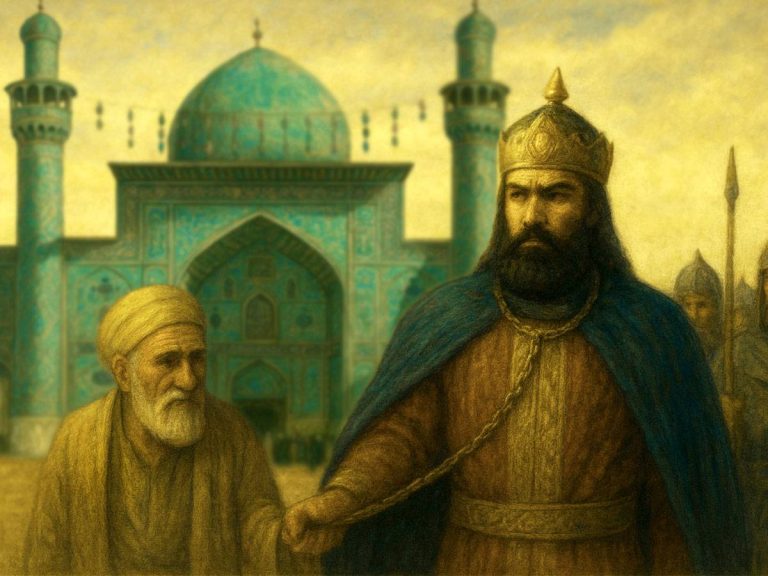
Shaikh Muhammad Husain Hirz al-Din narrated that in the year 1157 AH, Sultan Nader Shah Afshar visited the Shrine of Amir al-Muminin (peace be upon him). When he entered Najaf, he did not proceed via the common eastern route but entered through the southern alley leading to Bab al-Qibla.
The Sultan ordered that his neck be bound with a chain and that, through this chain, he would enter the Shrine of Amir al-Muminin (peace be upon him) via a narrow alleyway with utmost humility and submissiveness. None of the ministers or others dared to lead the King as he had requested, until an unknown man appeared and said: ‘I shall lead him.’ Thus, Nader Shah entered the Shrine in this state, and the unknown man departed thereafter.
It is said that this chain is the very golden chain hanging in the Golden Iwan at the eastern entrance of the Holy Shrine. The alleyway through which Nader Shah passed became famous as “Zuqaq al-Zanjil” (The Alley of the Chain) and is recorded in the old documents of this district, which is situated to the south of the Abbasi Caravanserai and south of the Holy Shrine.”
The Story of Nader Shah’s Devotion to Amir al-Muminin (peace be upon him)
Shaikh Muhammad Husain Hirz al-Din also narrates from the Persian book Nadernameh by Muhammad Husain Quddusi:
“When the people of Iran were suffering from the oppression of the Afghans, particularly in Isfahan, and presented their grievances to the scholars of Najaf seeking aid, one of the great Sayed scholars of Najaf, Sayed Hashim al-Hattab, was in a state of profound concern and reflection. In a dream, he saw the Prophet (peace be upon him and his family) and Amir al-Muminin (peace be upon him) and turned to them to present the grievances of the Persian Shias.
Suddenly, Abbas ibn Ali (peace be upon him) entered, holding a leash tied to the neck of a powerful beast—a majestic creature with small, piercing eyes. When this figure appeared, the Commander of the Faithful (peace be upon him) said: ‘The Shias shall soon be delivered.’
Sayed Hashim awaited the interpretation of this vision until Nader Shah became King. When Nader Shah came to Najaf al-Ashraf, a tent was pitched for him outside the city, and the religious scholars entered the tent, except for Sayed Hashim al-Hattab. Nader Shah inquired why he was late and was told that the Sayed was an ascetic who avoided social circles and politics. The King insisted on meeting him and ordered his entourage to facilitate the meeting in whatever way suited the Sayed’s preference.
For the welfare of the Shias, the Sayed mounted his donkey and entered Nader Shah’s tent, tethering the animal to the tent pole, and Nader Shah rose to welcome him. When the Sayed’s gaze fell upon Nader Shah, he cried out loudly several times: ‘Allahu Akbar! Allahu Akbar! Allahu Akbar!’ Nader Shah was astonished and asked for the reason; the Sayed then recounted his vision. Upon hearing the dream, Nader Shah ordered a rope to be brought, bound himself with it, and proceeded toward the Holy Shrine in that humble state. Thereafter, whenever Nader Shah intended to visit the Shrine, he would command a collar to be fastened around his neck and enter in that manner.
Consequently, Nader Shah developed a unique devotion and faith toward Amir al-Muminin (peace be upon him) and undertook the restoration of the sacred site, the gilding of the Iwan, and its beautification. From that time, he chose for himself the title: ‘The Dog of Ali’s Threshold, Nader Quli’.”
Adapted from the book “History of the Holy Alawi Shrine” (Tarikh al-Marqad al-Alawi al-Mutahhar)